
Politics
The sentencing of officer Benedict Bryant a rare moment of accountability
Key Points
analysis Jai Wright's family fight 'never about a sentence' in rare moment of accountability Mon 8 Jun 2026 at 3:10pm Inside a quiet district courtroom in the heart of Sydney's bustling CBD, a historic moment has unfolded involving a NSW Police officer. Warning: Aboriginal and Torres Strait Islander readers are advised that this story contains the image of a person who has died. On Friday, Benedict Bryant was sentenced to two years imprisonment over a collision that caused the death of...
analysis
Jai Wright's family fight 'never about a sentence' in rare moment of accountability
Mon 8 Jun 2026 at 3:10pm
Inside a quiet district courtroom in the heart of Sydney's bustling CBD, a historic moment has unfolded involving a NSW Police officer.
Warning: Aboriginal and Torres Strait Islander readers are advised that this story contains the image of a person who has died.
On Friday, Benedict Bryant was sentenced to two years imprisonment over a collision that caused the death of 16-year-old Dhungutti boy Jai Kalani Wright in 2022.
As Judge Culver read out the words "two years' imprisonment", Jai's family gasped with shock, while others were silent, wiping their tears.
Bryant avoided time behind bars and will serve his sentence through an intensive corrections order which includes 500 hours of unpaid community service. He was also disqualified from driving for the next three years.
For some, it was disappointing, but for Jai's parents it was a relief.
"It was never about a sentence," Jai's father Lachlan Wright said.
"A conviction is a conviction, no matter what. That's a big thing for a judge to have judged."
This sentence comes at a poignant time.
Bryant is believed to be the first police officer convicted of a crime related to a Black death in custody — a crisis that is not new.
A landmark report delivered 35 years ago by a Royal Commission into Aboriginal Deaths in Custody gave the government solutions to address this.
Yet, the numbers have only climbed since.
There's a harrowing story behind why the Royal Commission was established and it starts with the death of a young boy, similar in age to Jai Wright.
The birth of anguish and distrust
John Pat was a 16-year-old Yindjibarndi boy from Roebourne, Western Australia, who died in a juvenile police cell in 1983.
He was taken there after a fight broke out at a local pub between Aboriginal people and off-duty police officers, as well as a police aide.
Pat had suffered serious injuries after falling backwards and hitting his head during the incident. But instead of going to hospital, he was taken to the police station, where witnesses say he was assaulted and dragged to a cell.
Hours later he was found dead.
The four officers and the police aide stood trial for manslaughter in WA's supreme court, with an all-white jury acquitting them of any wrongdoing.
No disciplinary action was taken and they all returned to work.
The anguish and distrust of police John Pat's family felt rippled across the nation and the globe, sparking the Royal Commission into Aboriginal Deaths in Custody.
The final report, delivered in 1991, outlined 339 recommendations for governments, including ways to repair the relationship between the police and First Nations communities.
It was a relationship already tarnished by the legacy of the frontier wars, further damaged by the protection laws enacted as early as the 1840s to the 1970s in some parts of the country.
The police took First Nations children from their parents, sending them to training institutes where they were stripped of their birth names and banned from practising their culture. Some never reunited with their parents again.
Police also enforced segregation, restricting where Indigenous people lived, forcing them onto missions and reserves on the fringes of town.
The Commission's report provided a turning point for the country, yet not much has changed; it is gathering dust while the number of Black deaths in custody continues to rise.
We know this because we count every time an Indigenous person dies in custody.
At the time of writing, 634 lives have been lost.
In the absence of real systemic change, the families left behind have not given up.
They have brought cases of police misconduct out of the shadows and into the light, with hopes the truth of these tragedies will create a shift.
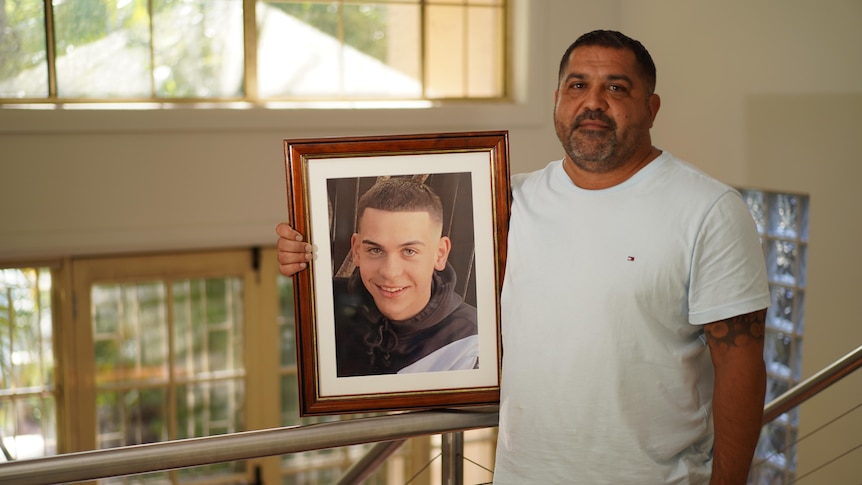
Standing outside of court, Jai's father Lachlan Wright said his son's case was about truth and accountability that came at a traumatic cost.
"We've lost our son, nothing can ever bring [him] back," Wright said.
"This shows that something went terribly wrong and people have to be held accountable for their mistakes."
The long and painful fight for justice
The first time I interviewed Lachlan Wright, it was in their family home.
He showed me Jai's room, still intact with his PlayStation, photos with his siblings hugging his hip and much-loved rappers hanging on the wall.
If it wasn't for the candle with Jai's portrait, you would think he was still here.
"Whether you were in a bad mood or a good mood, he knew how to get you laughing. That's definitely what we miss the most," Wright said as he showed me photos of Jai.
For the last four years, the family have been fighting for answers to understand what happened to Jai on that fateful morning in 2022.
They say NSW Police gave them different versions of events, which prompted calls for an independent investigation.
The first version came from a senior officer who told the family Jai was being pursued by police before an unmarked police car drove in front of him and caused him to fall off the bike.
The second version was from an investigator on the case who denied there was a pursuit and said Jai lost control of the motorbike, hitting a parked unmarked police car.
An internal investigation undertaken by NSW Police cleared Bryant of any wrongdoing, despite statements from officers that he had likely breached the Safe Driving Policy.
Six months after the incident, the NSW Office of the Director of Public Prosecutions (ODPP) said it was reviewing the case, but in the end no charges were laid.
It wasn't until NSW Coroner Teresa O'Sullivan was tasked with investigating the cause of Jai's death that she suspended the coronial inquest and referred the case to the ODPP to consider laying criminal charges.
Almost two years after Jai's death, Bryant was charged.
It wasn't a moment of celebration for Jai's family; it was confirmation the gut feeling they had was right.
In November 2025, Judge Culver found Bryant guilty of dangerous driving occasioning death.
Behind the convicted sergeant in the courtroom were a sea of police officers and detectives.
And to the right were Jai's family and friends — from toddlers to elders — with sorrow and heartbreak written on their faces, as they adorned red jerseys showing his playful smile.
The verdict stated Bryant "was driving an unmarked police vehicle and did not have his lights and sirens activated to alert other road users", "established a roadblock … as a form of barrier or obstruction, without authorisation" and "was aware of a police directive that the trailbike was not to be pursued."
LoadingGail Hickey's fight
Just five minutes down the road from the site where Bryant and Jai Wright collided, another Aboriginal boy lost his life, 22 years ago.
It was Valentine's Day and 17-year-old TJ Hickey was riding his bike through Redfern after visiting his mum.
A witness told the Hickey family that they saw police chase TJ down a street where he lost control of his bike and was thrown over the handlebars and impaled on a metal picket fence.
The coroner investigating his death said TJ rode through a police operation where officers were looking for an Aboriginal man who allegedly stole a handbag.
The inquest heard a police car had followed behind TJ but police pursuit allegations were dismissed, with the coroner calling his death a "freak accident".
During the inquest there were inconsistencies from police of what happened that day, with reports one officer did not want to testify because they were fearful of disciplinary action.
TJ's mother, Gail Hickey, rebuts the coroner's findings and marches the streets every year on the anniversary of her son's death. She has repeatedly called for a fresh investigation and a formal apology — but, like many parents of those who have died in custody or during police operations, her calls have been left unanswered.
When a person dies in custody, it can cause anxiety, broken marriages, and deepens distrust of the police and the justice system as a whole.
Thirty-five years after the royal commission's landmark report, another opportunity is being presented.
Will the outcome of Jai's case be a turning point for a better functioning system?
Or is it accepted that the burden remains with grieving parents, siblings, aunties and uncles fighting for accountability to ensure their loved one isn't just another number?
Benedict Bryant (PERSON)
Jai Wright's (PERSON)
Sydney (LOCATION)
CBD (ORG)
NSW Police (ORG)
Torres Strait Islander (ORG)
Dhungutti (ORG)
Jai Kalani Wright (PERSON)
Culver (PERSON)
Jai (PERSON)
Bryant (PERSON)
Lachlan Wright (PERSON)
Royal Commission (ORG)
the Royal Commission (ORG)
Jai Wright (PERSON)