
Politics
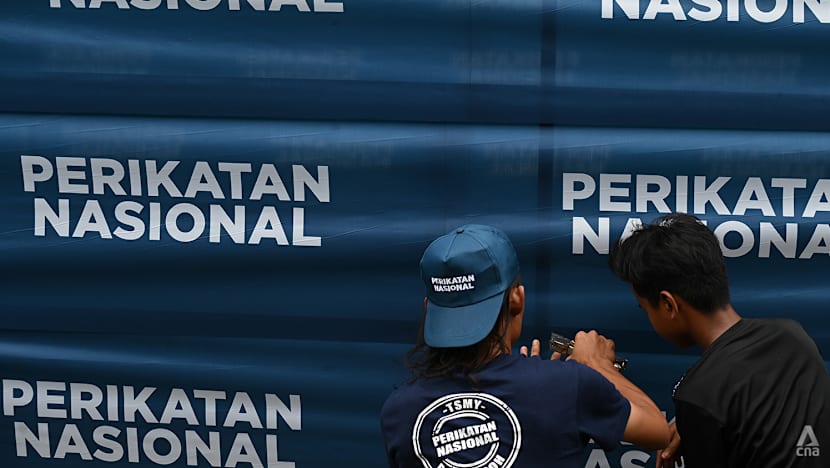
PAS-Bersatu break-up paves way for new Malay-centric pact, with implications for Malaysia politics
Key Points
analysis Asia PAS-Bersatu break-up paves way for new Malay-centric pact, with implications for Malaysia politics Analysts say Malaysia’s main opposition party PAS would prioritise a pact with a breakaway Bersatu faction, while a more formal cooperation with the United Malays National Organisation remains a longer-term possibility. The unilateral decision by Malaysia’s main opposition party Parti Islam Se-Malaysia (PAS) to sever ties with its coalition partner Parti Pribumi Bersatu Malaysia...
analysis Asia
PAS-Bersatu break-up paves way for new Malay-centric pact, with implications for Malaysia politics
Analysts say Malaysia’s main opposition party PAS would prioritise a pact with a breakaway Bersatu faction, while a more formal cooperation with the United Malays National Organisation remains a longer-term possibility.
KUALA LUMPUR: The unilateral decision by Malaysia’s main opposition party Parti Islam Se-Malaysia (PAS) to sever ties with its coalition partner Parti Pribumi Bersatu Malaysia (Bersatu) paves the way for PAS to seek new partnerships that could reshape the political battle lines ahead of the next general election, say analysts.
They view the split as an inevitable outcome - owing to the deepening rift between PAS and Bersatu - that signals the end of the Perikatan Nasional (PN) opposition coalition in its current form and the onset of a new Malay political realignment.
PAS’ move also reflects the Islamist party's strategic desire to assert its own direction, the experts say.
Analysts whom CNA spoke to said that in the short term, PAS would prioritise a pact with a breakaway Bersatu faction led by former opposition leader Hamzah Zainuddin, while a more formal cooperation with the United Malays National Organisation (UMNO) remains a longer-term possibility.
“The PAS-Bersatu split is not just about the end of one partnership; it is the beginning of a broader realignment that could redefine the opposition ahead of the next electoral cycle,” said political analyst Sivamurugan Pandian of University Sains Malaysia (USM).
On Monday (Jun 8) night, PAS announced an end to its political cooperation with Bersatu, saying that it is exploring potential electoral pacts in the interest of ummah unity ahead of the upcoming state polls and general election. Ummah is the Arabic word for nation or community.
Sivamurugan believed that this is a significant political development that reshapes the opposition landscape.
“It suggests that PAS is seeking greater strategic autonomy and wants to reposition itself ahead of upcoming state elections and the next general election. The decision also reflects that political alliances in Malaysia are increasingly driven by electoral calculations rather than permanent partnerships,” he said.
POTENTIAL ALLIANCE WITH "RESET" MOVEMENT
On Saturday, all eyes will be on the "Reset" convention in Tanah Merah, Kelantan - an event widely seen as the launching pad for a new political party led by former Bersatu deputy president Hamzah.
Analysts believed the timing of this convention was no coincidence.
Ahmad Fauzi Abdul Hamid, a political science professor at USM, told CNA that PAS - having severed its ties with Bersatu - has effectively cleared the path for a closer partnership with Hamzah’s movement.
"It seems the declaration was timed specifically for this. And the convention is being held in Kelantan, a true-blue PAS state," he said.
“I think PAS has more chemistry with Hamzah rather than Muhyiddin,” he said, referring to Bersatu chairperson and former prime minister Muhyiddin Yassin.
Hamzah had launched the “Reset” movement on Feb 14, alongside other Members of Parliament from Bersatu and grassroots members, a day after he was sacked from the party.
Signs of a deepening rift between PN’s two largest component parties were on display as early as last December, when eight Perlis assemblymen, five of whom were from Bersatu, withdrew support for a PAS chief minister in a move widely seen as orchestrated by figures aligned with Muhyiddin.
The fallout deepened mistrust between PAS and Bersatu and ultimately preceded Muhyiddin’s resignation as PN chairman. The PN coalition - which was formed in February 2020 - also includes two smaller parties: Parti Gerakan Rakyat Malaysia (Gerakan) and the Malaysian Indian People’s Party (MIPP).
PAS currently holds 43 seats in Malaysia’s lower house of parliament. A minimum of 112 seats is needed to form a simple majority in Malaysia's 222-seat parliament.
Critics have said that to broaden its appeal beyond its traditional conservative base and capture the federal government, PAS requires a bridge to make it more acceptable to the electorate.
While popular in the Malay heartlands, PAS has often been criticised for failing to appeal to the non-Malay population or address non-Muslim fears of an Islamic theocracy, in part due to its leaders’ comments on race and religion.
There has also been speculation that PAS is trying to woo UMNO, but analysts are sceptical that any tie-up would happen now. UMNO is a component party that anchors the Barisan National (BN) coalition and is part of Prime Minister Anwar Ibrahim’s unity government.
Amid calls for PAS and UMNO to revive their defunct Muafakat Nasional (MN) alliance, UMNO president Ahmad Zahid Hamidi said on Tuesday that there was no intention to revive the pact.
“Whether it is 1.0 or 2.0, that is over, and we have closed the book,” he was quoted as saying by the News Straits Times.
Formed in September 2019, MN was a short-lived political pact between PAS and UMNO, led by ex-UMNO member Annuar Musa. The pact was later disbanded over disagreement on whether to collaborate with Bersatu.
At its general assembly earlier this year, UMNO had said that it will form a “unity committee” in a bid to reunite the country’s Malays politically.
Zahid had said then that the move would facilitate the return of former members and political rivals - whether individually or en bloc - as part of a broader mission to reposition UMNO as the “grand home for the Malays”.
Sivamurugan said that a direct alliance between PAS and UMNO cannot be completely dismissed, as Malaysian politicians have demonstrated a high degree of pragmatism.
“However, historical rivalry, grassroots sentiment and competition for the same Malay electorate make such a partnership more difficult. My expectation is that PAS will first consolidate a new opposition configuration before considering broader political realignments,” he said.
Ahmad Fauzi echoed these views and believed that it was unlikely that PAS and UMNO would enter into any pacts for the Johor and Negeri Sembilan state polls respectively.
Both the state assemblies were dissolved in early June, with the Election Commission due to announce the date of the polls on Friday.
“If there is any pact with UMNO, it will only happen before the general election. But if PAS wants to help UMNO, they could withdraw from the Johor (state) election and let Pakatan Harapan (PH) and BN go at one another,” said Ahmad Fauzi, adding that PAS would, however, want to contest in Negeri Sembilan where UMNO is not as dominant.
Malaysia’s 16th general election must be held by February 2028, but Anwar had warned at a PH convention last month that he could call it in the near term.
Political scientist Syaza Shukri of the International Islamic University Malaysia (IIUM) believes that UMNO remains PAS' primary preference as partner although they would be open to collaborating with all other Malay political parties with the exception of Bersatu.
This collaboration would include Hamzah’s faction and other parties such as Parti Pejuang Tanah Air (Pejuang), Parti Barisan Jemaah Islamiah Se-Malaysia (Berjasa), Parti Bumiputera Perkasa Malaysia (Putra) and the National Indian Muslim Alliance Party (Iman).
“So it would be a Malay-based pact led by PAS and UMNO. But we have to remember that could also be the cause of a future break-up. Between PAS and UMNO, who has the upper hand? Our suspicion is that UMNO would get the Prime Minister’s post and PAS would be ok with that. But would the grassroots (accept it)?” she said.
WHAT ABOUT BERSATU?
Analysts told CNA that Bersatu faces the most significant fallout from PAS’ decision, warning that the party now faces a daunting challenge to maintain its political relevance without the support of the Islamist party’s formidable grassroots machinery.
Ahmad Fauzi said that if Bersatu fail to forge a new relationship with one of the stronger axes in Malaysian politics - whether it be PH or BN - then the party will “slowly but surely” fade away from mainstream politics, eventually into oblivion.
“With PAS out of the picture, and the former Bersatu number two bringing with him a majority of Bersatu's elected representatives and thinkers into (potentially) another coalition with PAS, Bersatu will (not) have sufficient grassroots to muster a credible political challenge to anyone,” he said.
Ahmad Fauzi believes that as UMNO splinter parties - of which Bersatu is one of them - disintegrate, UMNO will inevitably become stronger.
“In general, the Malays have always been stuck politically between the ideology of UMNO and PAS. No other political play can captivate the Malay audience as much as these two parties have, with PKR and Bersatu coming in during the interregnum,” he said, referring to Anwar’s Parti Keadilan Rakyat - another UMNO splinter party.
Ahmad Fauzi suggested that a return to PH is not entirely off the table for Bersatu, despite the lingering bitterness and historical friction between the two sides.
The animosity stems largely from the 2020 “Sheraton Move” which triggered the collapse of the then-PH administration led by Mahathir Mohamad in his second outing as Malaysia’s prime minister.
The plot, reportedly hatched at the Sheraton Hotel in Petaling Jaya, saw more than 30 MPs defect from the then-ruling coalition, effectively toppling the government after just 22 months in power.
This led to the appointment of Muhyiddin as prime minister, as Bersatu, PAS, and BN joined hands to form a new ruling coalition. But Muhyiddin’s tenure lasted only until August 2021 when some MPs from UMNO pulled their support, ultimately leading to Ismail Sabri Yaakob replacing Muhyiddin as prime minister.
“Politics is the art of the impossible. Things you wouldn’t imagine yesterday, can become reality tomorrow. Before the 2022 elections, did you think that PH and UMNO could be in a government together? It is now almost four years,” said Ahmad Fauzi.
“Even erstwhile enemies can become friends temporarily. That is Malaysian politics now.”
Syaza, however, believed that it would be “risky” for Bersatu to go back to PH and that it would attempt to lead another more “moderate” and multiracial coalition.
“That’s just to survive. I can’t see them being electorally influential except for the few big names they have,” she said, adding that she believed that Muhyiddin still harboured hopes of returning to power.
WHAT HAPPENS TO PN?
Another lingering question concerns PN’s future. The coalition had enjoyed surprise success at the 15th General Election in 2022 that was characterised by the "green wave" featuring significant electoral gains largely propelled by PAS.
PN had won 74 seats in the 222-seat parliament, establishing itself as the second-largest bloc behind PH, which won 82 seats.
PAS was the driving force behind PN's success, securing 43 parliamentary seats - a substantial gain of 25 seats - while Bersatu had then secured 31 seats, representing a gain of 17 seats.
Bersatu’s numbers have since dwindled. Its representation first fell to 25 after six MPs were sacked for supporting Anwar’s administration. It fell further to 19 following Hamzah’s sacking and those aligned to him.
Despite the official count, media reports suggest that the number of Bersatu MPs backing Muhyiddin is less than that.
Syaza said that since PAS had ceased cooperation with Bersatu, it would be assumed that PN no longer existed, or Bersatu was kicked out.
“I am not sure if PAS can make such a unilateral decision, but practically, I cannot see how PN can proceed without Bersatu,' she said.
“If PAS intends to move forward with Gerakan and MIPP - provided those parties are willing - it would likely require a completely new platform.”
PAS information chief Ahmad Fadhli Shaari had on Tuesday said that both PAS and Bersatu could no longer remain under the same umbrella.
"The status of PAS and Bersatu within PN will be managed according to constitutional provisions and the appropriate channels,” he said.
Muhyiddin, however, said that as a founding member of PN, Bersatu would continue to be in the coalition and strengthen its core struggle.
“Bersatu will further advance the people-centred agenda championed by PN since its establishment, while supporting the aspirations of Malaysians who seek change and leadership that reflects the hopes and ambitions of all citizens,” said Muhyiddin.
Ahmad Fauzi said that inevitably, there could be only room for either Bersatu or PAS in PN.
“Which party will leave the coalition? We will have to see how things develop over the next few days,” he said.
PAS-Bersatu (ORG)
Malay (ORG)
Malaysia (LOCATION)
Asia PAS-Bersatu (LOCATION)
Bersatu (ORG)
the United Malays National Organisation (ORG)
KUALA LUMPUR (LOCATION)
Islam Se-Malaysia (PERSON)
Pribumi Bersatu (PERSON)
PAS (ORG)
Nasional (ORG)
the Islamist party's (ORG)
CNA (ORG)
Hamzah Zainuddin (PERSON)
the United Malays National Organisation (UMNO (ORG)