
Politics
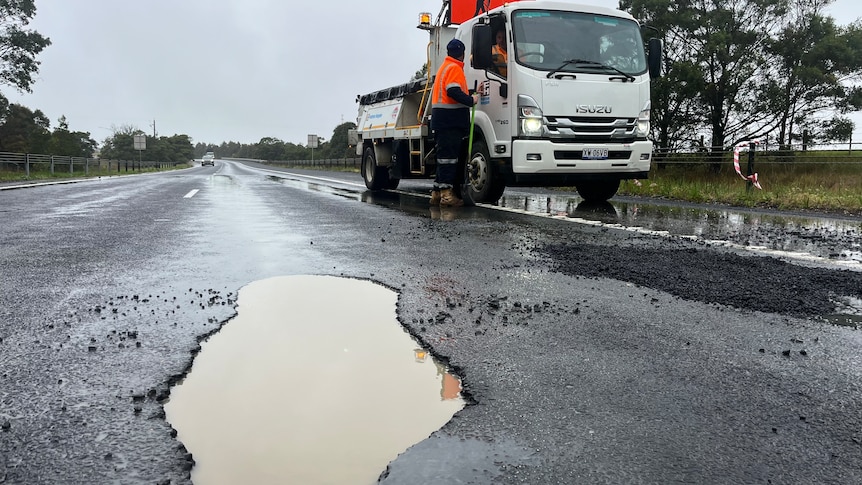
Election promises not enough to fix Victoria's crumbling roads, experts say
Key Points
Election promises not enough to fix Victoria's crumbling roads, experts say In short: Victoria's major political parties have laid out their promises to address the state's worsening roads. However, some experts and industry bodies have warned it will not be enough to restore Victoria's roads. Experts and industry bodies say the new government should look at new technologies and longer-term strategies to address crumbling roads.
Election promises not enough to fix Victoria's crumbling roads, experts say
In short:
Victoria's major political parties have laid out their promises to address the state's worsening roads.
However, some experts and industry bodies have warned it will not be enough to restore Victoria's roads.
What's next?
Experts and industry bodies say the new government should look at new technologies and longer-term strategies to address crumbling roads.
The phone at Jonny Ravet's regional car repair shop has barely stopped ringing.
His business in Seymour, in central Victoria, has been busy repairing cars damaged by potholes on Victoria's roads.
Mr Ravet said he has seen more vehicles damaged this year due to the state of the roads.
"We're still getting a fair stream, at least three to four cars a week, coming in with damage," Mr Ravet said.
While he is seeing an increase in the number of cars damaged by the roads, Mr Ravet is not impressed by the road repairs he has seen.
"Shovelling a little asphalt into a pothole is like a bit of a band-aid for a bullet wound,"he said.
Potholes have caused growing anger over the quality of the road network across Victoria leading into the state election.
In September, motorcyclist Peter "Tiki" Mason, 71, died after reportedly hitting a pothole on the Western Highway and in August, dozens of cars were forced off the road after hitting large potholes that opened up along the Princes Freeway at Bunyip in Victoria's east.
Former VicRoads staff told the ABC that privatisation was partly to blame for the deterioration in road quality.
Both major parties have put potholes at the centre of their pitch to voters.
In this year's budget, Labor allocated $1 billion for pothole repair, with most of the money earmarked for regional Victoria.
It has promised an extra $352 million if it wins the election.
The Coalition has promised to spend $5 billion addressing the problem over the next term of parliament if it wins.
Mr Ravet says the state of the roads was bound to be a major issue this election.
"People talk about the cost of living crisis, the cost of food and electricity and all that sort of stuff," he said.
"If you've got to pay for a tyre that's $200 … that can be someone's grocery bill for a whole week."
What are the parties pledging?
Here is what the parties have proposed to improve Victorian roads:
Labor
Read moreThe Labor government announced an extra $352 million to double the number of potholes fixed from 250,000 to 500,000 this financial year.
This brings the total money allocated to road asset management this year to $1.39 billion.
Labor has promised to bring road maintenance back under government control, launch a website for reporting potholes and track repairs, and trial supervised prisoners doing roadside work.
The party has also promised billions for road upgrades, including $893 million for 25 more roads, mostly in the regions.
Coalition
Read moreThe Coalition is promising $5 billion over four years to repair and rebuild the state's roads, including fixing potholes.
It said it would eliminate 1 million potholes and re-establish preventative road maintenance.
The Coalition plans to establish a new division of the Department of Transport and Planning called Better Roads Victoria, which aims to rebuild the government's technical and engineering expertise.
It has promised Victoria's 48 regional councils $288 million to fix local roads and bridges at their own discretion.
The Coalition has also matched Labor's funding promise to ease traffic congestion in Geelong.
Greens
Read moreThe Greens have promised to bring road maintenance and VicRoads back into public hands.
The party said it would start with an urgent inquiry to map out how, and put any savings into fixing potholes and roads.
The Greens argue that outsourcing maintenance to private companies sends money to profits instead of repairs.
One Nation
Read moreOne Nation has promised to publish the condition and funding of every major regional road and create a public pothole portal for Victorians to make reports.
The party has pledged to lock in ongoing funding for regional roads and fix the state's maintenance backlog.
Will it be enough?
Despite the parties' promises, an auditor-general's report in September found almost half of Victoria's road network was in poor condition and crumbling faster than can be fixed.
It found it would cost more than $3 billion a year to maintain the state's roads in their current condition.
Swinburne University associate professor of vehicle engineering Ambarish Kulkarni said the parties' promises were not enough to fix the underlying problems affecting the state's roads.
"We still follow the old techniques of just going and fixing the potholes. That's not going to address our issues," Dr Kulkarni said.
"The strategy should be long-term because roads are critical infrastructure, which run for 20 to 40 years."
Dr Kulkarni said the current approach was reactive rather than proactive, and if processes did not change, the same conversations about road maintenance would continue.
He said Victoria should invest in research and new technologies, AI and drones, as well as upskilling workers to keep up with Australia's growing population and road network.
Victorian Transport Association chief executive Peter Anderson agreed, saying throwing money at repairing potholes would not fix the problem.
"Everyone's trying to find a quick answer and just go bang, bang; the roads aren't very good, so therefore just throw money at it.
"We think that's a very shallow response from all parties because that's the media response.
"We actually need to change the system and the processes."
The association wants a review of current practices, including how well they are working and what technology could be used.
It also wants a regional roads commissioner to be accountable and have a two-way conversation with the community.
Loading...