
Politics
Art collector loses legal fight over sculpture featuring 165-year-old elephant tusk
Key Points
Art collector loses legal fight over sculpture featuring 165-year-old elephant tusk Eileen Agar’s The Obelisk of Satisfied Desire fell foul of the 2018 Ivory Act - Bookmark - CommentsGo to comments An art collector has lost a legal battle with the government after being prohibited from selling a rare surrealist sculpture due to its inclusion of a 165-year-old elephant tusk. Devon-based art expert Victor James was blocked from selling Eileen Agar’s 1930s creation, The Obelisk of Satisfied...
Art collector loses legal fight over sculpture featuring 165-year-old elephant tusk
Eileen Agar’s The Obelisk of Satisfied Desire fell foul of the 2018 Ivory Act
- Bookmark
- CommentsGo to comments
An art collector has lost a legal battle with the government after being prohibited from selling a rare surrealist sculpture due to its inclusion of a 165-year-old elephant tusk.
Devon-based art expert Victor James was blocked from selling Eileen Agar’s 1930s creation, The Obelisk of Satisfied Desire.
Ms Agar, a British surrealist who died in 1991 at the age of 91, is renowned for works that can fetch over £100,000.
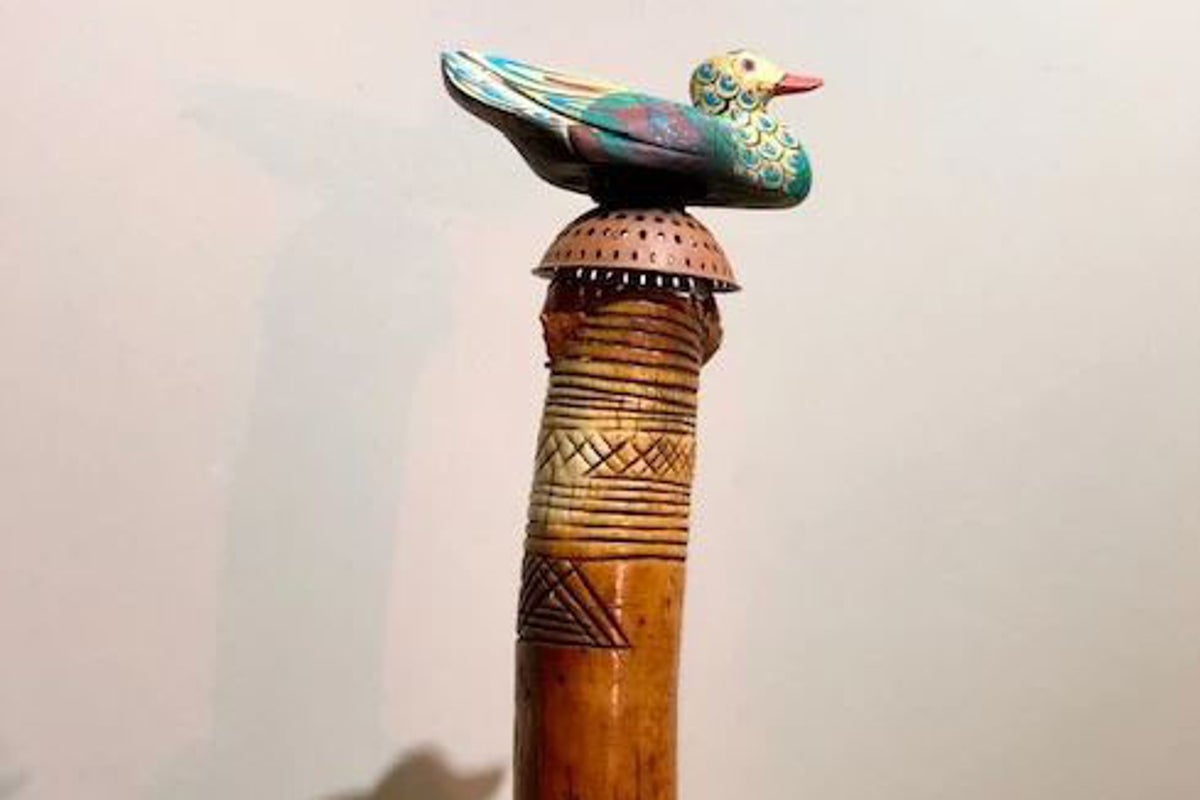
The phallic sculpture, described as “an assemblage of five objects: a metal dish, a decorated candle, a small colander, a model duck and the tusk”, was deemed by authorities to fall foul of the 2018 Ivory Act.
The legislation bans dealing in ivory or objects containing it, except under specific, exceptional circumstances.
An exemption exists for pre-1918 items considered “of outstandingly high artistic, cultural or historic value”. However, Mr James, whose gallery is located in Colyton, Devon, challenged the Department for Environment, Food and Rural Affairs’ decision to deny him an exemption certificate for the “exceptionally rare” piece.
He argued that the ivory element of the sculpture was a distinct, pre-carved African artefact dating from 1860, and that this should qualify the entire sculpture for exemption. The court ultimately upheld the government's ban.
But a tribunal judge has now rejected his case.
Judge Sophie Buckley, sitting in a division of the First Tier Tribunal dealing with the welfare of animals, said: “If the tusk were separated from the sculpture and were the ‘item’ in relation to which the exemption were made, it is accepted that it would, subject to assessment, satisfy the condition of being pre-1918.”
But she went on to say: “The sculpture is clearly the ‘item’. The sculpture is more than a collection of separate objects. Eileen Agar has made a new object.”
Rejecting his case, she concluded that any other decision, “would make it easier for new or modern illegal ivory to be laundered in the guise of antique ivory, as it would be more difficult to determine the age of the ivory in the item when it is positioned in a modern setting”.
Eileen Agar was a London-based British surrealist with an Argentinean mother and a Scottish father born in 1899, who died aged 91 in 1991 and whose sculptures have previously sold for over £100,000.
In a critique of the piece, drawing on a note written about it by the artist and left in the Tate archives, art history and surrealism expert Michael Remy says: “The whole conception of the object is phallic: the central piece, a majestic erection, is an elephant's ivory tusk which, Agar says, was used in Africa as a torch – with the link between the tusk and fire transforming the former into the source of flamboyant desire.
“The tusk springs forth from an inverted kitchen bowl and vigorously penetrates a kind of colander, on top of which a duck, Indonesian according to Agar, stands for the erotic symbol, so she says, of a pagan deity, all these exotic references reinforcing the erotic undertones and erasing, as in all primitive artefacts, the distinctions between the animal, the material and the human.
“Objects are literally making love to create this one inimitable object.”
Describing the art collector's arguments in favour of an exemption from the rule allowing the piece to be sold, the judge said: “Mr James described the sculpture as a ‘surrealist assembly’ which consists of five separate objects that are fully formed and worked pieces in their own right, including the tusk, which he referred to as a piece of 19th century African tribal art.
“He submitted that he made the application for the tribal work of art specifically within the context of the sculpture.
“His intention in making the application is to obtain an exemption certificate to enable him, if he wishes, to sell the sculpture. He does not want to sell the tusk. He cannot, at present, sell the sculpture because it has ivory in it, and...dealing in ‘ivory’ is prohibited.
“He submitted that the relevant item was the tusk itself and not the sculpture and therefore the item satisfied the pre-1918 criteria. The application related to the tusk itself within its unique context, as an integral part of the sculpture.
“He argued that the tusk meets the second criterion - outstanding artistic, cultural or historical value - by virtue of its context, namely its incorporation within the sculpture.
“Mr James emphasised that the tusk was not reworked ivory but an independent object incorporated into an assemblage.
“He submitted that this was an unusual case. He said that it was unlikely to ‘open the floodgates’...because it was unlikely that others would attempt to deal in ivory by creating a masterpiece and setting the piece of ivory within that.”
Government barrister Daniel Cashman however had argued that the art collector's “approach would undermine the purpose of the Act”, she continued.
He had argued that, “if the appellant’s approach were correct...it would permit the incorporation of pre-1918 ivory into modern artworks, which, provided that they were of outstandingly high artistic value, would be exempt items.
“That would create a new market in ivory items in a manner contrary to the aim of the legislation. He submitted that it would also be more difficult to age ivory if it was positioned in a modern setting, which would make it easier for modern illegal ivory to be used.”
Ruling in the government's favour, the judge concluded: “The 2018 Act is clear that the relevant ‘item’ is not the ivory alone but can be an item that ‘has ivory in it’. The ‘item’, where it is constructed of mixed materials, one of which is ivory, is to be assessed as a whole.
“A clear indication that the appellant’s proposed approach is wrong is that it would run counter to the policy and legislative purpose of the 2018 Act, because it would mean that any post-1918 item was capable of exemption...so long as the ivory itself was pre-1918, and it would create an incentive to continue to re-work pre-1918 ivory into artistic or cultural items for the purposes of dealing in them.
“Further, it would make it easier for new or modern illegal ivory to be laundered in the guise of antique ivory, as it would be more difficult to determine the age of the ivory in the item when it is positioned in a modern setting.
“The sculpture is clearly the ‘item’. The sculpture is more than a collection of separate objects. Eileen Agar has made a new object, as she states in her notes, the elements of which are all objects that she had in her studio.
“The piece written by Michel Remy notes: ‘Objects are literally making love to create this one inimitable object.’
“Having concluded that the sculpture is the relevant item, it is clear that it does not satisfy the condition ... because it was made in the 1930s.
“We find that the secretary of state was right to treat this as an application for an exemption certificate in relation to the sculpture and the conclusion that the condition ... was clearly not met was not based on an error of fact, wrong in law, or unreasonable.”
Join our commenting forum
Join thought-provoking conversations, follow other Independent readers and see their replies
Comments
Eileen Agar’s (PERSON)
Ivory Act - Bookmark - CommentsGo (EVENT)
Devon (PERSON)
Victor James (PERSON)
Ms Agar (PERSON)
British (ORG)
James (PERSON)
Colyton (LOCATION)
the Department for Environment, Food and Rural Affairs (ORG)
African (ORG)
Sophie Buckley (PERSON)
Eileen Agar (PERSON)
London (LOCATION)
Argentinean (ORG)
Scottish (ORG)