
Health
Fashion wasn’t designed for people with special needs or disabilities – this designer wants to change that
Key Points
Fashion wasn’t designed for people with special needs or disabilities – this designer wants to change that For people with muscular dystrophy, stroke, autism and other conditions, getting dressed can mean struggling with buttons, zippers or sensory sensitivities to fabric. At Will and Well, Singapore designer Elisa Lim creates adaptive clothes for people – even though she has earned little to no salary for the past nine years. From afar, it seemed like just a T-shirt – the simplest of...
Fashion wasn’t designed for people with special needs or disabilities – this designer wants to change that
For people with muscular dystrophy, stroke, autism and other conditions, getting dressed can mean struggling with buttons, zippers or sensory sensitivities to fabric. At Will and Well, Singapore designer Elisa Lim creates adaptive clothes for people – even though she has earned little to no salary for the past nine years.
From afar, it seemed like just a T-shirt – the simplest of clothing staples. But the OneTee took a year to come together.
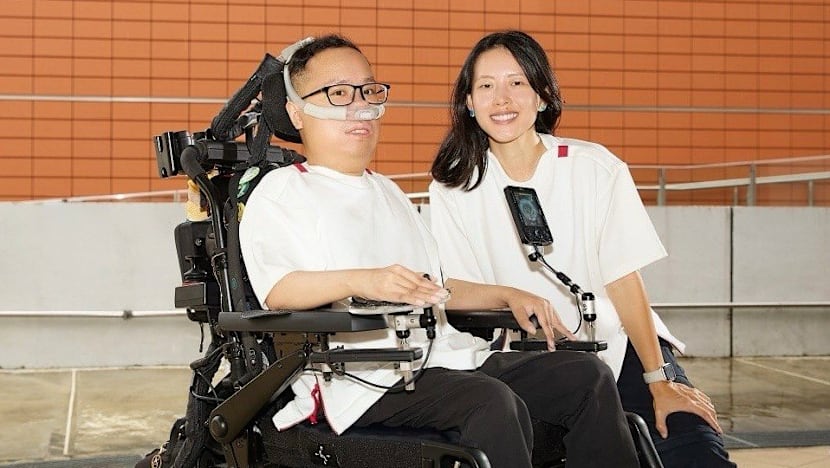
Designed by Elisa Lim, founder of adaptive fashion label Will and Well, the details on the garment are the combined wish-list of 20 people, most with disabilities or other conditions, such as visual impairment, muscular dystrophy, stroke, attention-deficit hyperactivity disorder and dwarfism.
For many of them, even wearing a T-shirt could be difficult. So on a Saturday morning last year, they came together, some in their wheelchairs and with caregivers, to reinvent it.
The wide head opening makes the T-shirt easier to slip on, even with physical limitations, brain tumours, or breathing and feeding tubes attached to the face. Waist slits keep the fabric from bunching up in a wheelchair. Extra fabric at the back covers bottoms fully while seated.
The words “Project OneTee” are embossed in braille for the visually impaired. Three pop-its are sewn in to soothe anxiety.
Some who came that day had life-limiting conditions, said Lim. “They are well aware of their timeline, so when they choose to be here, you know that it means something to them,” she said quietly.
Timothy Chan, who modelled the first edition of the T-shirt, had muscular dystrophy and died two days before CNA Women met Lim. She was heading to his wake after the interview.
THE PEOPLE MAINSTREAM FASHION FORGETS
Most clothing is not designed to be inclusive, said 32-year-old Lim. A dress with back zippers that you have to stretch to reach. A shirt with tiny buttons down the front and at the cuff. Pants that require balance to put one foot into at a time.
For people living with disabilities or special needs, these can turn getting dressed into a daily obstacle.
Indeed, Lim recalls how as a fashion student, she was approached by a doctor trained in geriatric medicine, who wanted to make clothes for his elderly and bedridden patients.
This inspired her to found Will and Well in 2017, where she offers ready-to-wear clothes, as well as customisation and bespoke designs, available online and at HIVE @ Enabling Village, at 20 Lengkok Bahru.
She remembers how a worried daughter reached out to her eight or nine years ago after her elderly mum was hospitalised for hip surgery. How would they help her get into pants after her discharge?
After visiting the patient in hospital, Lim designed pants with two front zippers, allowing the garment to open completely flat so the patient could be dressed while lying down.
Today, these pants have been adapted into the brand’s ready-to-wear Adjustable Shorts and can be worn lying down or standing without having to balance on one leg and risking a fall.
Lim also makes dresses with zippers in the front instead of back, blouses with soft, easy-to-use fastenings along the shoulder, and shirts with magnetic snaps instead of buttons. She is currently in the process of designing bras and underwear with magnetic snaps.
These elements make it easier for caregivers to dress those who are bed- or wheelchair-bound. They also enable individuals with limited mobility due to conditions such as arthritis, stroke and other physical disabilities to dress themselves more independently, Lim said.
WHEN FASHION BECOMES PERSONAL
Lim remembers a teen, Amelia Ng, who had infantile neuroaxonal dystrophy, a rare life-limiting disorder causing progressive loss of motor skills. At 13, she was bedbound, relied on a breathing support machine and used a feeding tube.
For her 14th birthday, Amelia wanted a dream dress that lit up. Lim visited her twice to co-create it with her.
First, she found out what the young teen liked and then returned with fabric options for her to choose from. Non-verbal, Amelia would blink to indicate her preference.
One month later, Lim returned with a pink dress with a rainbow tulle and removable fairy lights. It had an opening at the top and side so caregivers wouldn’t have to disconnect Amelia’s breathing machine to put it on, and a water-resistant under-layer so that the liquid from her feeding tube would not stain the dress.
Before showing Ng the dress, Lim remembers chatting with Amelia’s parents in the living room when an alarm suddenly went off in the house. This usually happened when Amelia stopped breathing.
There was general panic, but when they rushed into the room, they realised Amelia was fine. She held her breath because she could not wait to see her dream dress.
In fact, Amelia loved the dress so much that she refused to take it off, even for washing.
The teen died five years later in 2024 at the age of 18. Her parents have kept the dress in remembrance.
Amelia is not the only one for whom fashion carries personal meaning.
Lim’s late friend Chan also had a beloved old hoodie. She created a slit in it to make space for his breathing tube and made the long sleeves detachable so he would be comfortable in warm or cool weather without having to change out of the hoodie.
Another frequent modification Lim makes for clients is enlarging openings and replacing regular closures with easier fastenings.
For clients with neurodevelopmental conditions and intellectual disabilities, she also adapts clothing to ease challenges and behavioural issues.
A 12-year-old client living with autism could not focus in his school uniform because he found it too pricky and uncomfortable. Lim duplicated the uniform in lightweight sports fabric so that he was able to sit through his primary school leaving examination.
Another teen on the autism spectrum had the habit of smearing faeces on the wall every morning before his caregiver woke up. Lim made a jumpsuit with a zipper at the back so that he could not reach into his diaper on his own.
CHOOSING PASSION OVER PRESTIGE
Most of Lim’s clients are based in Singapore, though she also gets orders from Malaysia, the United States, Germany and France.
However, the disability community in Singapore is relatively small to sustain a business like hers, Lim said. In fact, 60 per cent of her clients are able-bodied – and buy her clothes either because they resonate with the cause or like the convenience of design elements like magnetic buttons.
Hence, although the business is financially sustainable, it is not profitable, Lim said.
Revenue covers material, production and operating costs. However, since Lim started the business, she has not paid herself for most months.
Lim supplements her income by working weekends as a partner at WeCare, a health tech company that develops software to help care organisations such as nursing homes manage operational needs, and sells products like fall detectors.
Although her work at WeCare helps pay the bills, Lim admitted that it has been hard sustaining full-time work at Will and Well without earning a salary.
“Growing up in Singapore, there is so much emphasis on career progression, making money and pursuing comfort,” she reflected.
“When I was younger, I wrestled with my worth in relation to income and career. You spend all this time, and you don’t make an income. What’s your worth?
“But I’m over that. I no longer tie my worth to making money.”
One thing helped with her perspective shift: For a year-and-a-half in her late 20s, Lim joined a fintech company as associate director, earning an attractive income. But she gave it up because she could not find meaning in the job.
While Will and Well does not provide her with a stable income, Lim said she has gained so much in purpose and perspective. She now calls many of her clients, friends.
“We’re not much different,” she said. “What people with disabilities desire is the same as what you and I desire – companionship, marriage, children, career.
“But when you hang out with folks (with life-limiting conditions), they are very mindful of when their death is. So when they think of career or things they do, they look for what’s meaningful, not how much money they make out of it,” she said.
“It’s the same for me, too.
“I continue doing this because I have a skill set I can use to provide some form of comfort, ease and a solution to someone else. And that gives me meaning,” she said.
CNA Women is a section on CNA Lifestyle that seeks to inform, empower and inspire the modern woman. If you have women-related news, issues and ideas to share with us, email CNAWomen [at] mediacorp.com.sg.