
Technology
Blending form and function: A first look at 3 new MRT stations that will close the Circle Line loop
Key Points
Blending form and function: A first look at 3 new MRT stations that will close the Circle Line loop The stations form part of a broader trend in newer MRT developments, where architecture and public art increasingly draw on the identity and heritage of the communities they serve. SINGAPORE: With its curved ceilings and stained glass murals, commuters arriving at the new Cantonment MRT station may be forgiven for thinking they had stepped into a historical building. The familiar green of the...
Blending form and function: A first look at 3 new MRT stations that will close the Circle Line loop
The stations form part of a broader trend in newer MRT developments, where architecture and public art increasingly draw on the identity and heritage of the communities they serve.
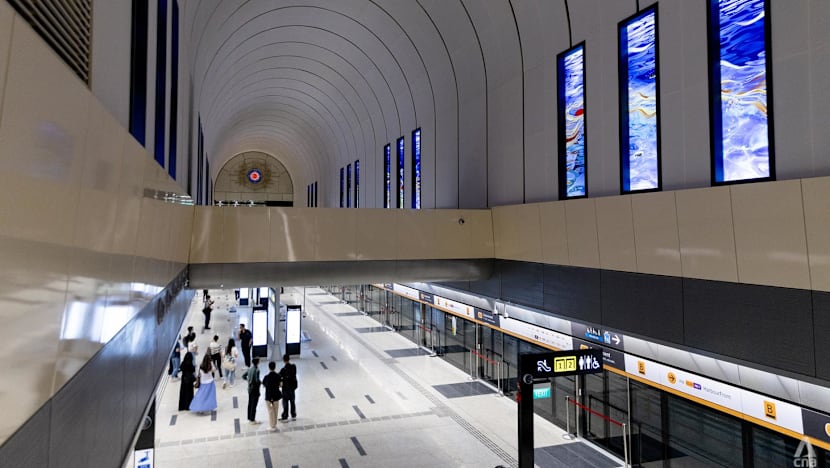
SINGAPORE: With its curved ceilings and stained glass murals, commuters arriving at the new Cantonment MRT station may be forgiven for thinking they had stepped into a historical building.
The familiar green of the walls at the station concourse and exits further evoke memories of the old Tanjong Pagar railway station, on which the new MRT station is designed.
Cantonment MRT station is one of three new additions to the Circle Line (CCL), each incorporating design elements that reflect the history and character of its surroundings.
At Prince Edward Road station, part of the concourse is shaped like a ship's hull in a nod to the area's maritime heritage, while Keppel station features metallic finishes that evoke the industrial landscape of the nearby port.
The media had a first look at the three new stations on Tuesday (Jun 9).
The stations are part of a broader trend in newer MRT station developments, where architecture and public art increasingly draw on the identity and heritage of nearby communities.
This differs from the approach taken for Singapore's earliest MRT stations, which opened in the late 1980s and were generally designed with a stronger emphasis on operational and functional considerations.
The main architect for the three stations, Ms Rita Soh, said that the individual station designs should draw inspiration from their “context”.
“The site context, with its historical, cultural significance as well as its geological challenges, ought to be considered in addition to the stringent technical requirements demanded of an MRT station,” she said.
The three stations will open for a public preview on Jul 4, with passenger service starting on Jul 12.
Their opening will complete the CCL loop, allowing trains to travel the entire circle without a designated terminal station.
OLD RAILWAY STATION HERITAGE
Cantonment Station is a 28m-deep underground station located beneath the former Tanjong Pagar railway station area.
Ms Soh, who is managing director for RDC Architects, said that the old railway station was built on shallow foundations, and so there was the challenge of keeping these structures intact while digging underground.
This was achieved by “diving deep underground” below the railway station structures to avoid any movement that may destabilise the national monument, she said.
The three-storey platform ceiling is a result of this added depth.
“Given the much deeper depth, it became an opportunity for me to ‘recreate’ the double volume hall of the existing railway station and incorporate vertical glass mural design for the current volume space above the new platform,” she said.
Other than its platform with the curved ceiling, the walls and roofs of the Cantonment station entrances are a distinctive green – the same hue as the roof of the old Tanjong Pagar railway station.
“Together, these elements create a travel experience that blends heritage character with contemporary design,” said the Land Transport Authority (LTA) in a statement on Wednesday.
It will serve the Everton, Spottiswoode Park and Cantonment districts. It will also connect to the Tanjong Pagar Distripark, where the Singapore Art Museum is located.
At the station concourse is an artwork stretching 75m by sculptor Han Sai Por. Titled "A Journey Between", it features flowing stainless steel sculptures of various colours.
Speaking to the media, the 82-year-old, who is a recipient of Singapore’s Cultural Medallion, said she moulded miniatures of the artwork using clay, before it was 3D scanned and fabricated into larger sculptures.
Ms Han said the aluminium sculptures are curved to represent the curves of train tracks on the MRT system. Being reflective, the sculpture would also prompt commuters to look at their own reflection as they walked past.
“It's almost as if you become part of the artwork,” said Ms Han. “In a way, the sculpture needs you to complete it.”
She said that the reflections then represent the everyday lives of commuters. “Everyone has their own story … these small individual stories come together to form the larger story of society,” she added.
“This is something we often don't think about, but in reality, we are all taking small steps that connect us to a much larger system and way of life.”
KEPPEL STATION
Keppel Station, located along Keppel Road, is a 20m-deep underground station designed to serve future developments along the Greater Southern Waterfront, as well as nearby business hubs.
The station will have three entrances, including a 24-hour underpass to improve pedestrian connectivity in the area.
Keppel Station will also be the only station along the CCL to include an underground bicycle park, with 312 parking lots.
The parking area was initially a designated space to launch the tunnel boring machines that carved out the tunnels.
While these spaces are usually filled with soil, it was converted to underground bicycle parking to primarily serve future residents and visitors to the area.
Other design features include skylights and hybrid fans to improve natural lighting and ventilation. There are also "green roofs" at some station exits, where plants have been grown on rooftops to "improve thermal comfort", said LTA.
The station’s above-ground ventilation shafts also resemble cable cars, which operate from the nearby Mount Faber and HarbourFront to Sentosa.
Constructing the tunnel between Cantonment and Keppel stations came with its unique challenges, as the tunnel had to pass under the foundations of the Keppel Viaduct.
The artwork featured at Keppel station’s concourse area is by 43-year-old artist and architect Kenneth Koh.
Titled "Uncontainable Dreams", the piece features floating shipping containers that carry aspects of Keppel’s past as a fishing village, its present as a container port, and hopes for its future.
Mr Koh said he hopes to show how “the entire city of Singapore is built from things in boxes from overseas that are then unboxed and assembled”.
He also hopes the artwork helps commuters think about the future of Keppel, where the Greater Southern Waterfront will mean residential living and commercial activities.
HOMAGE TO AREA’S MARITIME HERITAGE
The 30m-deep underground station located in the Shenton Way area is designed with the area’s maritime history in mind, as the surrounding land is reclaimed.
A 100m area of the station is shaped like a ship’s hull. It comprises the passenger service centre, a baby care room, toilets, and other amenities at the station.
Due to space constraints between the Keppel Viaduct and nearby high-rise developments, Prince Edward Road Station will feature stacked tunnels and platforms.
The upper platform will serve trains heading towards Marina Bay in the anticlockwise direction, while the lower platform will serve trains heading towards HarbourFront in the clockwise direction.
The station will have two entrances. One is directly connected to 78 Shenton Way, while the other provides access to the Haji Muhammad Salleh Mosque and the Hock Teck See Temple.
In the station is an artwork by 42-year-old Gerald Leow along a 60m stretch.
Titled "Doppler", it comprises circular shapes in stainless steel, which were heated under different temperatures to form various hues.
“I hope for them (commuters) to be able to, as they look at the work, be intrigued at how the colour would change, and be able to experience some further, deeper thought,” said the visual artist.
With the CCL loop closed, commuters can expect shorter travel times between areas in the west, such as Pasir Panjang and Kent Ridge, and the city centre.
For example, a commuter travelling by train from Telok Blangah to Marina Bay currently needs to transfer between the CCL, North East Line and North-South Line. Once the CCL is completed, the same journey can be made without transfers on a single train ride, saving around 10 minutes of travel time.
“This will provide more convenience for commuters, strengthen connectivity and resilience across the rail network, and improve access to key employment nodes, residential areas and lifestyle destinations,” said LTA.
With the CCL operating as a complete loop, trains will display their direction as “clockwise” or “anticlockwise” loops, rather than by terminal station.
To help commuters get used to the new system ahead of the opening, updated wayfinding signs have appeared at Promenade, Esplanade, Buona Vista and Paya Lebar stations since May.