
For too long, the debate over permitting reform has been confined to the wonky world of Washington insiders — endless discussions about transmission lines, pipelines, lawsuits, and administrative procedures. Policymakers fixate on the bark while missing the trees, let alone the forest. The stakes are far higher than connecting a natural gas plant, wind farm or data center to the grid. The most important reason for permitting reform is to grow the U.S. defense industrial base at the speed, scale and cost efficiency needed to deter a major conflict with China, and to quickly prevail if deterrence fails.
This imperative requires a sustained U.S. capability to outperform our adversaries in the production of weapons, ships, munitions, and material. Yet for more than two decades, America’s national security, economic policies, and stifling environmental review processes hollowed out domestic manufacturing and largely transferred our defense-related industrial capabilities and control of global supply chains to China.
The results are stark. China dominates global manufacturing, particularly those industries indispensable to defense. Its steel production exceeds America’s by roughly 12-to-1. In shipbuilding, China possesses capacity roughly 230 times that of the United States. A single major Chinese shipyard can exceed the total output of the entire U.S. commercial shipbuilding industry. American policymakers — both Democrats and Republicans — have been comatose on this front for far too long.
'THIS IS NO DRILL': CHINA'S DOMINANCE OVER US SHIPBUILDING SPARKS BIPARTISAN EFFORT
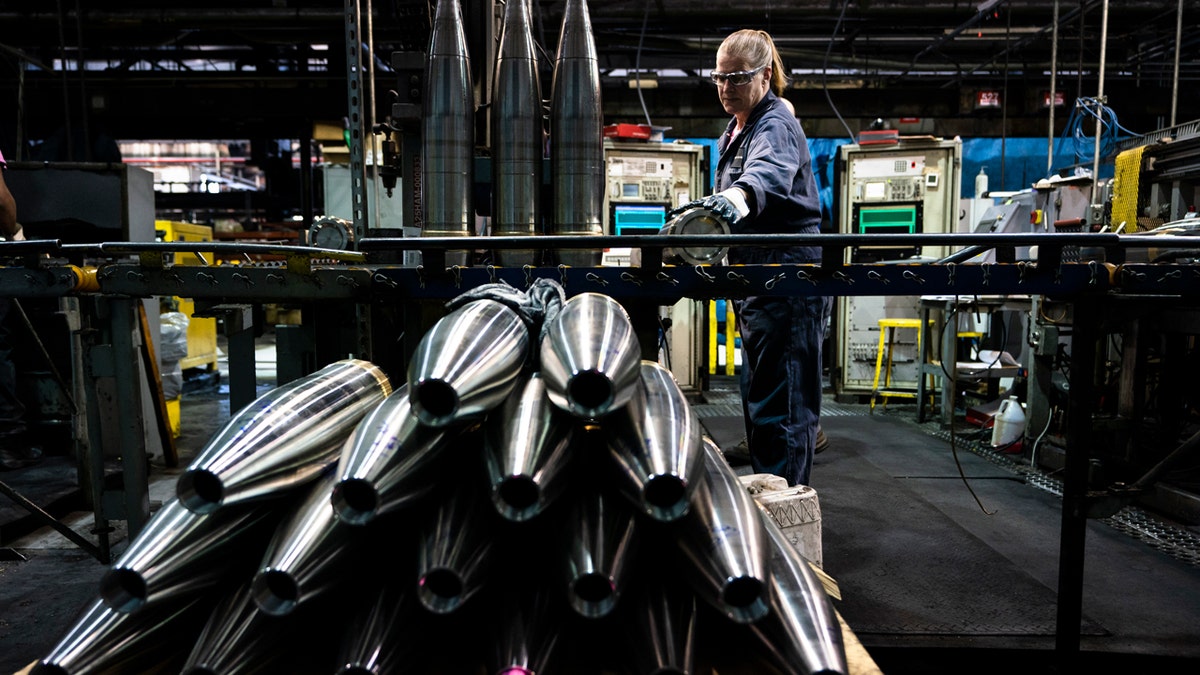
Recent conflicts offer sobering previews of how profoundly these disparities matter in wartime. In Ukraine, U.S. and allied munitions production has struggled to keep pace with demand. For example, America ramped 155mm artillery shell output from about 14,000 per month to around 40,000, falling far short of Ukraine’s needs — estimated at 150,000–200,000 shells monthly — and exposing fragile, just-in-time supply chains. Similar constraints appear in meeting our own requirements and supporting Israel against Iranian-backed threats. Peacetime atrophy — dormant production lines, retired skilled workers, overseas dependence, and regulatory bottlenecks — has left the U.S. defense industrial base ill-equipped for sustained, high-intensity conflict.
History underscores the danger of underestimating industrial power. Nazi Germany developed formidable new technologies during World War II: the Me 262 jet fighter, V-2 ballistic missiles, and advanced tanks. These "wonder weapons" stunned Allied forces when they appeared on the battlefield. Yet America’s overwhelming manufacturing juggernaut is what proved decisive. Mobilizing factories across the heartland, the United States produced nearly 300,000 aircraft, 86,000 tanks, and thousands of ships, vastly outproducing the Axis powers combined.
Similarly, in the Civil War, 90 percent of our manufacturing economy was in the North — which produced 20 times more pig iron and 32 times more firearms than the South — which was still primarily an agrarian economy. Perhaps more ominously is the lesson we can draw from the North’s embrace of mechanization, which allowed threshing to be done 12 times faster than slave labor. Today’s corollary is Artificial Intelligence (AI) — the Great Power which dominates AI will gain the upper hand easily in any conflict, just like the North did, dominating the South which clung to the morally repugnant — but also ineffective — manual labor. Both mechanization and AI need reliable, dispatchable power to provide their economic and industrial benefits.
Today, China enjoys the advantage once held by America. China’s defense industrial base and supporting infrastructure can much more easily shift to a wartime footing, surging output of ships, munitions, and material with little or no bureaucratic or legal constraints.
RAPID RISE OF AI PUTS NEW URGENCY ON CONGRESS TO UNLEASH AMERICAN ENERGY
Reversing America’s defense industrial decline requires more than a tweak to an administrative process, increasing permitting staff, or changing deadlines for filing lawsuits. It demands a fundamental change in mindset of how, and why, government places so many obstacles in the way of the rapid expansion and rebuilding of our defense industrial base. Roads, bridges, ports, rail, power generation and delivery and computing infrastructure are foundational infrastructure. Factories cannot hum without affordable and reliable power. Mines and processing facilities for critical materiels — essential for munitions, electronics, and advanced weapons — cannot secure funding and achieve necessary scale amid regulatory paralysis.
Without this complex industrial ecosystem, we risk strategic vulnerability no amount of technological innovation can offset. American spirit and ingenuity are real assets, but cannot conjure raw materials and weapons systems from thin air when supply chains falter and projects languish in endless reviews. Congress and the administration must treat permitting modernization as a core national security priority.
CLICK HERE FOR MORE FOX NEWS OPINION
The most important element is time. Time is power — China builds three times faster than we do. Time is money — Chinese defense output costs a fraction of ours. Every year a U.S. defense infrastructure project is hung up in permitting adds 10-20 % to its final cost. Typical delays of more than five years lead to projects costing two or three times more than they need to. Eliminating this delay would not only unleash defense production with the speed and scale needed to keep the peace, but deliver it while saving hundreds of billions of dollars in defense spending.
To accomplish this, Congress and the states must reach across the aisle and legislatively approve maintenance, replacement and new construction of defense industrial supply chains and preclude any further environmental review, permitting, and judicial review of such process.
I’ve worked with sincere Democrats like Martin Heinrich (D-NM), Sheldon Whitehouse (D-RI) and John Hickenlooper (D-CO) to build consensus and extend my thanks and trust to them. We all are committed to assuring environmental protection and reaffirm these industries must comply with all specified environmental performance requirements. They will remain subject to the full array of legal requirements for monitoring, reporting, inspection, enforcement, citizen suits, judicial review and punitive civil, criminal, and damages liability for any noncompliance. Ample bipartisan precedent for this approach has long been in place in non-security related laws such as health and safety, financial transactions, and border construction, while recent targeted federal and state laws waived permitting for public housing, fracking, pipelines, and chip manufacturing plants.
The need to tackle the challenges of this permitting reform forest is clear: America’s ability to deter conflict, or to win if deterrence fails, rests on American industrial might. Permitting reform is the essential first step toward rebuilding it. The time for tepid measures and insider debates is over.