
World News
Bugs and black mold: What some mobile home park residents see after investors buy in
This article is part of “Unaffordable America,” a series examining rising economic inequality in the U.S. and the policies that drive it.
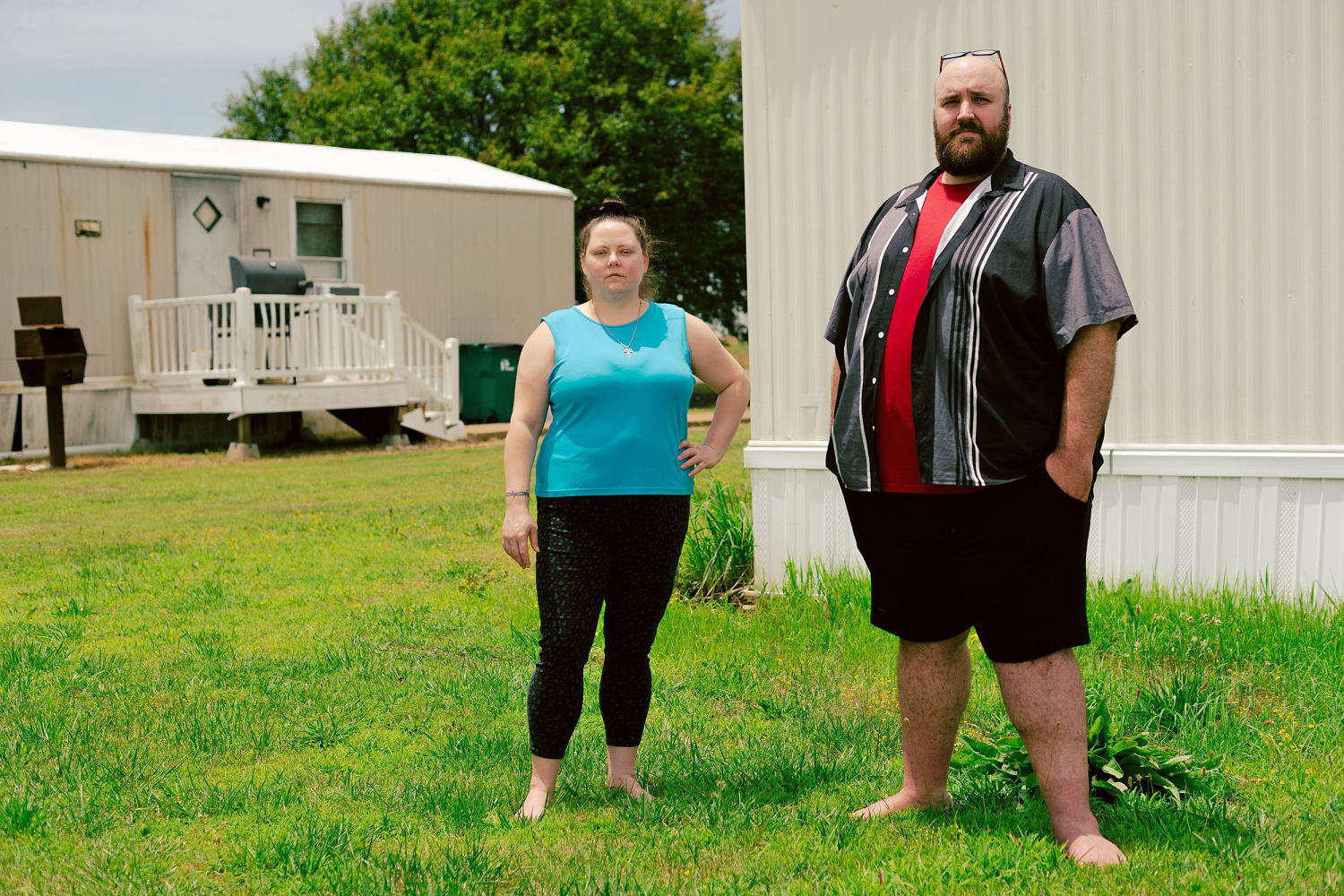
Soon after Aliea Brown rented Unit 62 at the Buck Island Manufactured Home Community in northern Mississippi in 2023, it became clear she couldn’t stay.
The front door was hung upside down, Brown said, black mold began growing throughout the unit and the windows weren’t sealed properly. Termites and ladybugs invaded. Then when it turned cold, a sewer pipe burst, increasing her water bill and causing putrid wastewater to collect under the unit for months.
“The rancid sewage smell came up through the cracks in the edge of the floor in the bathroom,” said Brown, 41, who pays $675 a month for the two-bedroom home she shares with her partner, Mason Obradovich, 39. “Unfortunately, the closest scent that it could be compared to would be a dead body.”
Lacking the funds to move out, Brown and Obradovich asked repeatedly for repairs while putting up with the harsh conditions as best they could. But this past February, Homes of America, the corporate owner of the park, sent Brown a letter saying the costs associated with repairing the mobile home “exceed the current value of the unit” and it was no longer available as a rental.
Buck Island offered to sell the dilapidated unit to Brown for $1,000, funded partially with her security deposit. The park is transitioning from a rental property, the manager said in an email, to a community in which residents must own their units.
After the couple declined to purchase the unit, they were told to leave by April 30. But they said they had nowhere to go.
“I’m disabled and the company is well aware of this,” said Brown, who has chronic obstructive pulmonary disorder, or COPD. “Our credit’s not great. We’re stuck here.”
About 22 million people live in mobile home communities across the U.S. They are among the only options for Americans unable to afford a house or higher-cost rentals. But in recent years, mobile home properties have become less affordable as an influx of large corporations and investment firms have bought up the parks and raised rents and fees, experts and residents say, further endangering some of the most economically vulnerable Americans at a time of rising income inequality.
NBC News interviewed 20 residents of manufactured home communities in Florida, Illinois, Mississippi and New Hampshire. They described significant changes and challenges in their communities after they were purchased by investment firms or large corporations. In addition to higher rents and fees, these people said, maintenance and services declined and relations between management and residents sometimes became toxic.
“Some of the new owners seem to deal with their residents in a fairer way and some are just ruthless,” said John Calabrese, president of the Florida Federation of Manufactured Home Owners and head of the Colony Cove Homeowners Association in Ellenton, Florida. “They have no concern whatsoever for the people that live there. The main focus is generating revenues.”
Buck Island, a 192-lot mobile home property, is located 35 miles southwest of Memphis. It’s one of 170 manufactured housing communities across 22 states owned by Homes of America, an affiliate of Alden Global Capital, an investment firm best known for buying newspaper properties, selling their assets and laying off workers.
Jessica Calvert, manager of the Buck Island community, declined to comment on questions about Brown’s experience there.
Homes of America’s main office did not respond to an email from NBC News containing detailed questions about its operations and parks. Alden Global Capital did not respond to phone messages seeking comment.
Jennifer Ludovice, a spokeswoman for Equity LifeStyle Properties — the owner of Colony Cove, where Calabrese lives — said the company works hard to “provide a community that residents are proud to call home.”
She added that rent increased an average of 4.2% annually between 2017 and 2026 and that its costs are “attractive compared to other housing options in the area.”
No bar on takeovers
There are 7.2 million occupied mobile homes across the U.S., accounting for 5.4% of the nation’s housing, according to census data. Many park residents are seniors on fixed incomes, people with disabilities and families with limited means. Most of the communities are in Southern states, such as Florida, Louisiana and Mississippi; in New Mexico, 15% of homes are manufactured housing, the highest percentage in the nation.
Although the costs of buying a manufactured home are rising, they remain well below what it costs to buy a new single-family home, data shows. The U.S. census says the cost of a new mobile home averaged $131,200 in 2025, compared with $530,000 on average for a new single-family home in 2025, according to the Federal Reserve Bank of St. Louis, which includes the cost of the land. Owners of mobile homes typically rent the land under their units and pay for utilities and homeowners association fees.
In January, President Donald Trump called for a moratorium on the purchase of single-family homes by institutional investors, contending that those purchases make it harder for people to achieve the American dream of homeownership. The 21st Century Road to Housing Act, which is moving through Congress, includes a ban on institutional investors purchasing single-family homes.
The bill contains no such prohibition on mobile home takeovers, and the president did not mention such purchases in his January order.
Some states are taking up the issue. Maine recently passed four laws protecting mobile home residents, including giving them the right of first refusal when their parks are for sale, allowing them to purchase the communities themselves. And the Michigan Senate recently passed a bill that would increase the regulation of mobile home parks, beefing up protections for residents. The bill is in the Michigan House.
‘Abandoned Trailer’ scheme
The black mold and eviction threats Brown says she experienced at Buck Island are not uncommon among residents at Homes of America communities in Mississippi, Louisiana and Texas, according to a lawsuit filed by a former employee in March.
Elvin Zapata, a regional manager overseeing Homes of America properties in those states from 2024 to 2025, filed suit against the company in 2025 alleging it fired him after he criticized its practices.
Zapata’s court filing said it was a company practice to conceal mold in units from residents, skipping professional remediation to save costs and prohibiting written documentation of mold in company records. He also said the company targeted renters with poor credit and low incomes to achieve occupancy quotas for its parks and that when the residents missed rent payments, it carried out immediate evictions.
Zapata also described what he called Homes of America’s “Abandoned Trailer” scheme in which the company sold ramshackle units to low-income buyers for $1,000 to offload the financial burden of rehabilitating them.
Homes of America has not responded to the complaint and has until mid-June to do so, according to a court filing.
Zapata did not return a voicemail seeking an interview.
For more than a decade, Jim Hodgkins has lived with his daughter at Greenmount Station, a mobile home community in Belleville, Illinois. The property’s owners kept it clean and neat and made repairs quickly, he said, but that changed in 2022, when Homes of America bought the park.
It went “completely downhill,” Hodgkins said, with huge potholes in the roads and repair requests ignored.
On Thanksgiving 2024, Hodgkins’ heat went out when it was 18 degrees, he recalled. “I couldn’t get ahold of anybody for nine days,” he said. “I went nine days with no heat.”
Late last year, Homes of America began informing residents they’d have to buy their units or move, Hodgkins said. He chose to buy his unit solely to avoid uprooting his daughter, who has mental health issues, he said. He secured a long-term loan from Homes of America to buy the unit.
“What will happen in the future is a bit worrisome, as I cannot afford to handle any big-ticket repairs,” he told NBC News. “They raised the lot rent $100 and still are not making any needed repairs. Lots of homes are vacant.”
Greenmount Station did not respond to a request for comment.
A year into their stay at Buck Island, Brown and Obradovich contacted a state nonprofit, Housing Education and Economic Development, or HEED.
After reviewing their case, a HEED official sent a letter to Buck Island management.
“The maintenance and repair of her home has been grossly neglected for over a year” and has “deteriorated to the point of uninhabitability,” it read, according to a copy reviewed by NBC News.
HEED asked that Buck Island move Brown and her partner to a renovated unit. But the alternative homes offered to the couple were equally problematic, Brown said.
“We went and looked at the places and they were no better,” she told NBC News. “One had a bigger black mold spot.”
Facing eviction, the couple is working with a local Legal Aid attorney. Buck Island, meanwhile, has refused to accept rent payments for amounts owed, Brown said.
Many residents faced with having to buy their units are leaving the community, Brown said.
“But we don’t have the credit or money to go anywhere else,” she added.