
Science
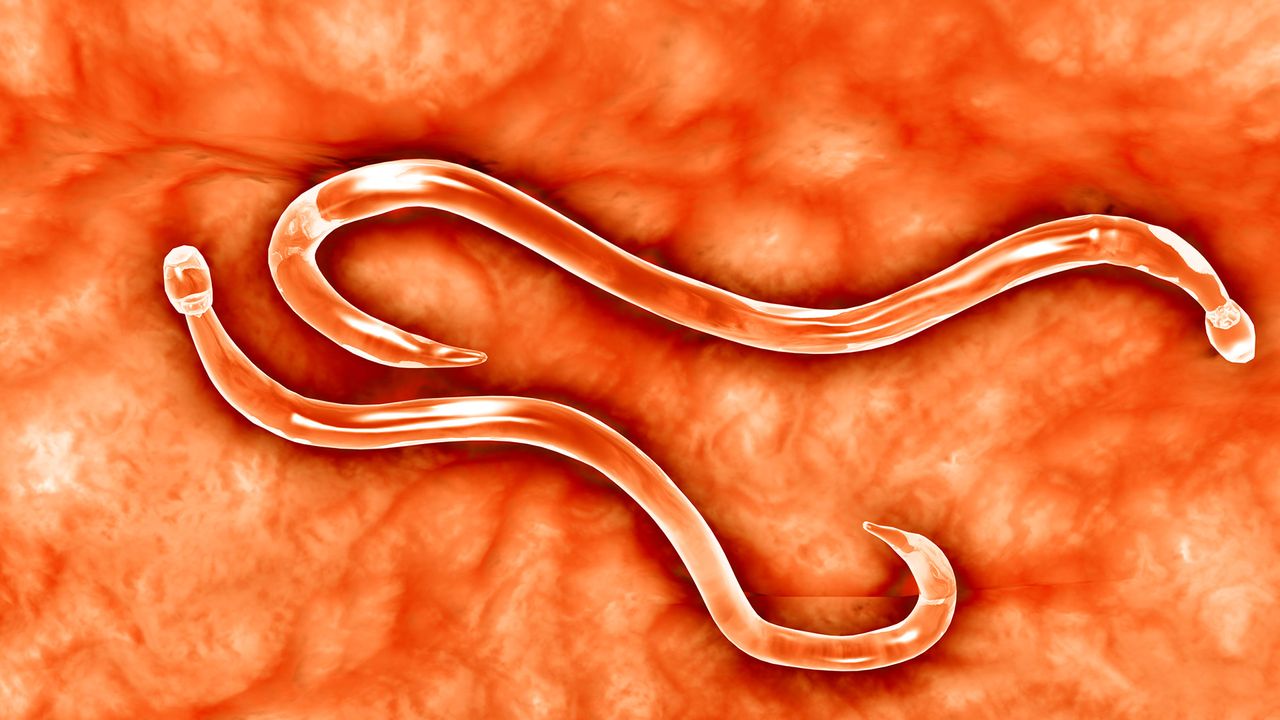
Genetically modified worms can now produce and deliver drugs inside a living body, scientists say
Key Points
Genetically modified worms can now produce and deliver drugs inside a living body, scientists say In a proof-of-concept lab experiment, scientists demonstrated that intestinal parasites could make and release therapeutic agents inside a living host. Scientists genetically tweaked a tiny, worm-like parasite to produce a life-saving antitoxin from inside a living host. In a first-of-its-kind study, researchers modified the hookworm Ancylostoma ceylanicum so that it produces antibodies that...
Genetically modified worms can now produce and deliver drugs inside a living body, scientists say
In a proof-of-concept lab experiment, scientists demonstrated that intestinal parasites could make and release therapeutic agents inside a living host.
Scientists genetically tweaked a tiny, worm-like parasite to produce a life-saving antitoxin from inside a living host.
In a first-of-its-kind study, researchers modified the hookworm Ancylostoma ceylanicum so that it produces antibodies that partially neutralize the potent pufferfish poison tetrodotoxin.
The approach has so far been tested in hamsters, but the ultimate aim is to use it in people. In fact, the study was funded by the U.S. Department of Defense with a view to developing protective treatments for military personnel exposed to chemical or biological threats, such as tetrodotoxin, study co-author Alex Loukas, director of the Australian Institute of Tropical Health and Medicine at James Cook University, told Live Science.
That said, future work could see these worms engineered to produce a variety of other medications and excrete them inside the human body, the study authors wrote in a report published June 3 in Nature Communications. For instance, they could deliver long-term treatments for chronic diseases, such as type 2 diabetes or inflammatory bowel syndrome, Loukas suggested.
From parasite to antitoxin factory
Hookworms are one of humanity's oldest parasites and infect upwards of 400 million people globally, primarily in tropical regions. Like an internal leech, these small intestinal worms latch on to the inner wall of the gut to feed on blood, simultaneously releasing a variety of anti-inflammatory and immunosuppressant compounds to prevent the body from flushing them out.
Each worm is about 0.4 inches (1 centimeter) long and consumes less than two drops of blood a day, and healthy hosts often don't experience any symptoms of infection. The hookworm used in this study, A. ceylanicum, infects humans, dogs and cats.
"The hookworm has spent millions of years perfecting how to assure long-term survival inside a human host and how to get molecules out of its body and into ours," study co-author Makedonka Mitreva, professor at Washington University School of Medicine in St. Louis, Missouri, said in a statement.
Get the world’s most fascinating discoveries delivered straight to your inbox.
The cocktail of compounds produced by these parasites has already shown some promise in treating metabolic disorders such as metabolic syndrome and type 2 diabetes, as well as celiac disease. However, studies so far have been restricted to molecules produced by the hookworms naturally.
The new work pushes this concept one step further. "We asked: What if we could add one more molecule to the roughly 1,000 things the worm already secretes, something therapeutically useful to people?" Mitreva said. "This study shows that's not just a concept. It works."
Using CRISPR gene-editing technology, the team inserted a gene coding for an antibody known to counteract the deadly pufferfish poison tetrodotoxin into the hookworm's genome at the egg stage. Mitreva's team had to carefully consider the placement of the gene, ensuring it didn't interfere with other critical regions of DNA, yet still promoted production and secretion of the new protein.
The team then infected hamsters with 80 to 100 of the modified parasite larvae. Upon maturation, the adult worms containing the newly inserted gene were able to produce the antibody and then secreted it into the hamster's bloodstream. Blood samples later taken from the infected hamsters partially neutralized the tetrodotoxin poison in lab experiments, showing compounds produced by the worm were active in the hamster.
On paper, the same approach could be used to secrete other antibodies or peptide drugs — which are short bits of protein — to directly treat gastrointestinal disorders, Loukas said.
"We're thinking about actively introducing antibodies that neutralize inflammatory hormones or cytokines," to treat conditions such as inflammatory bowel disease, he said. "You can also think about the possibility of a worm that secretes very very small quantities of food allergens to desensitize the host for childhood food allergies,” he added.
Looking forward, the team wants to extend the durability of the therapeutic molecules the worms release, since they can only make so much at a time, he noted.
While it may sound counterintuitive to infect a person with a parasite to help them feel better, hookworms actually have an excellent safety profile, Loukas said. A quirk of their biology means there is no chance of the infection getting out of control.
Related stories
Hookworm larvae enter the body through the skin and migrate to the small intestine where they mature into adults, often living for years without noticeably impacting the host. Any eggs the adult parasites produce must hatch outside of the host; they exit in the host's stool. That means the number of adult worms in the body remains fairly constant.
What's more, with a single dose of a standard anti-worming treatment, the infection clears within 24 hours. So any hookworm-based treatments could be easily cleared from a person's system.
"It's exciting and it's really opening up an entirely new way of delivering and producing therapeutic molecules," Loukas said.
Singh, K.S., Bharti, S., Rosa, B.A. et al. (2026) Transgenic hookworm secretes anti-tetrodotoxin human single chain antibody. Nature Communications. https://doi.org/10.1038/s41467-026-73447-9
Victoria Atkinson is a freelance science journalist, specializing in chemistry and its interface with the natural and human-made worlds. Currently based in York (UK), she formerly worked as a science content developer at the University of Oxford, and later as a member of the Chemistry World editorial team. Since becoming a freelancer, Victoria has expanded her focus to explore topics from across the sciences and has also worked with Chemistry Review, Neon Squid Publishing and the Open University, amongst others. She has a DPhil in organic chemistry from the University of Oxford.
You must confirm your public display name before commenting
Please logout and then login again, you will then be prompted to enter your display name.
the U.S. Department of Defense (ORG)
Alex Loukas (PERSON)
the Australian Institute of Tropical Health and Medicine (ORG)
James Cook University (ORG)
Live Science (ORG)
Nature Communications (ORG)
Loukas (PERSON)
Makedonka Mitreva (PERSON)
Washington University School of Medicine (ORG)
St. Louis (LOCATION)
Missouri (LOCATION)
Mitreva (PERSON)
CRISPR (PERSON)