
Science
'Geminid Symphony' and 'Galactic Gandalf': See the breathtaking views of our home galaxy from the 2026 Milky Way Photographer of the Year contest
Key Points
'Geminid Symphony' and 'Galactic Gandalf': See the breathtaking views of our home galaxy from the 2026 Milky Way Photographer of the Year contest Stunning views of the night sky abound in photographs worldwide submitted to this year's Milky Way Photographer of the Year contest. The winners of the 2026 Milky Way Photographer of the Year contest are here — and they are stunning.
'Geminid Symphony' and 'Galactic Gandalf': See the breathtaking views of our home galaxy from the 2026 Milky Way Photographer of the Year contest
Stunning views of the night sky abound in photographs worldwide submitted to this year's Milky Way Photographer of the Year contest.
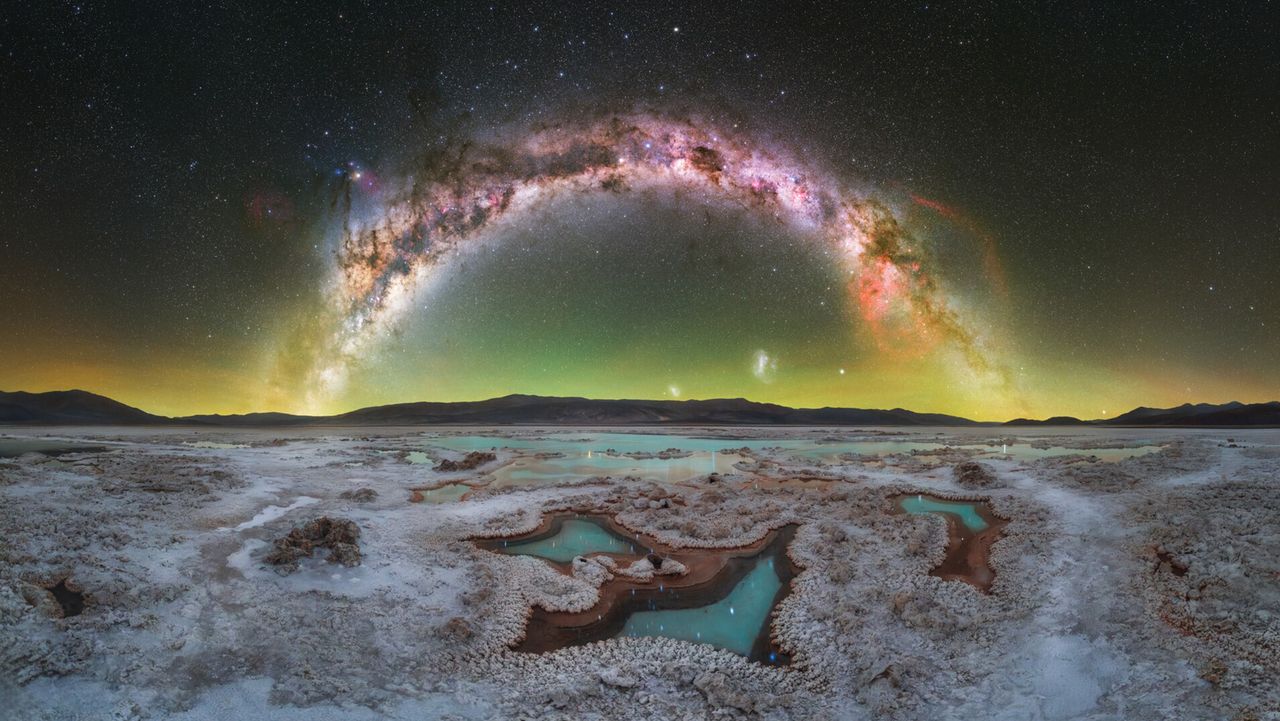
The winners of the 2026 Milky Way Photographer of the Year contest are here — and they are stunning. Each image captures a different angle of our galaxy's center, showing the complex mixture of gases and stars that forms our cosmic home.
The contest was established in 2018 by photographer Dan Zafra to highlight the different facets of the Milky Way galaxy. While this year's winners include a variety of images from across the globe — from New Zealand to Yellowstone National Park — they all had one thing in common: an appreciation for the universe around us.
Here, we present a handful of our favorite honorees that capture the magic of the Milky Way.
"Geminid Symphony Over La Palma's Guardian of the Sky"
Photographer: Uroš Fink
Location: Roque de los Muchachos Observatory; La Palma, Spain
This panorama captures the Geminid meteor shower in the skies over La Palma, one of Spain's Canary Islands. La Palma is home to the Gran Telescopio Canarias, the largest optical telescope in the world. Also captured in this image is the Gum Nebula, found between the southern constellations Vela and Puppis.
"Galactic Gandalf"
Photographer: Evan McKay
Get the world’s most fascinating discoveries delivered straight to your inbox.
Location: Wairarapa Coast, New Zealand
Leaning on New Zealand's reputation for being where much of the "Lord of the Rings" series was filmed, photographer Evan McKay reveals a stunning night sky enjoyed by the wizard Gandalf, added in later.
"When I first discovered this location, I immediately envisioned creating something special beneath the night sky," McKay said in a statement. "Given the complexity of the scene, I knew the final image would require a significant amount of work. Over the following weeks, starting in November, I returned whenever possible to collect the necessary data for this panorama, carefully building the image piece by piece under the night sky."
"Sodium Milky Way"
Photographer: Julien Looten
Location: Very Large Telescope; Paranal, Chile
Chile's Atacama Desert hosts many different telescopes, including the Very Large Telescope (VLT) on Mount Paranal. There, the high altitude and dry desert air make observing the night sky much easier than in areas with lots of city lights.
In this image, both the Large and Small Magellanic Clouds — dwarf galaxies that orbit close to the Milky Way — can be seen toward the left.
"Subtle airglow adds another layer to the scene, a natural emission produced by chemical reactions in the upper atmosphere at altitudes of 80 to 100 kilometers [50 to 62 miles]," Looten said in the statement. "In this image, it reveals a range of colors, with green tones on the left and warmer reddish hues toward the right."
In the foreground, one of the VLT's telescopes shoots four sodium laser beams into the sky, creating four guide stars that astronomers can use to calibrate the observation systems.
"Firewater"
Photographer: Baillie Farley
Location: Grand Prismatic Spring, Yellowstone National Park, Wyoming
Like the VLT image, this photo of our home galaxy above Yellowstone National Park has a subtle airglow to it. It also captures the colorful Grand Prismatic Spring, a 121-foot-deep (36.8 meters) hot spring whose bacteria give the spring its colorful appearance.
"Perseid Meteors Over Durdle Door"
Photographer: Josh Dury
Location: Durdle Door; Dorset, England
Astrophotographer Josh Dury is known for his stunning night-sky images, and this one does not disappoint. The long-exposure photo captures the streaks of meteors from the Perseid meteor shower, which happens annually from mid-July to late August as debris from Comet Swift-Tuttle moves across Earth's atmosphere.
"'Ancient fireworks' from Comet Swift-Tuttle hurtled through the atmosphere to document this ultra-wide angle composite image above the natural limestone arch of Durdle Door," Dury said in the statement. "In the foreground, a singular glow worm was documented amongst reeds along the sea cliff edge."
"Galaxy on the Rise"
Photographer: Anastasia Gulova
Location: Tenerife, Spain
It took over four hours for photographer Anastasia Gulova to find the perfect place to document the Milky Way's beauty from inside a cave on Tenerife in Spain's Canary Islands.
"Capturing the image proved just as challenging," Gulova said. "Composing and shooting the panoramic foreground required careful positioning, while properly illuminating the upper section of the cave was particularly difficult. To manage this, I used focus stacking across different planes, including the upper edge, the horizon, and the lower foreground, all in near-total darkness, where the brief blue hour offered little assistance."
Gulova's persistence was worth it, as she snapped the brilliant colors of the Milky Way mixed with the night sky and beginning sunrise.
"Salto del Agrio"
Related stories
Photographer: Alejandra Heis
Location: Salto del Agrio; Caviahue, Argentina
The glowing Milky Way isn't the only stunning part of this image; it frames a 148-foot (45 m) waterfall that feeds into a large canyon, created by the lava flows from the Copahue volcano.
"Despite the harsh conditions, I waited for the precise moment when the Milky Way aligned above the waterfall, forming an arch suspended over this ancient terrain," Heis said in the statement. "Working with the tripod close to the ground and repeating exposures, I was finally able to capture the scene I had envisioned for so long."
Can you name all the animals, objects and mythological figures hiding in the night sky? Find out with our constellations quiz!
Kenna Hughes-Castleberry is the Content Manager at Live Science. Formerly, she was the Content Manager at Space.com and before that the Science Communicator at JILA, a physics research institute. Kenna is also a book author, with her upcoming book 'Octopus X' scheduled for release in spring of 2027. Her beats include physics, health, environmental science, technology, AI, animal intelligence, corvids, and cephalopods.
You must confirm your public display name before commenting
Please logout and then login again, you will then be prompted to enter your display name.
Geminid Symphony' (ORG)
the 2026 Milky Way Photographer of (EVENT)
Dan Zafra (PERSON)
New Zealand (LOCATION)
Yellowstone National Park (ORG)
Geminid Symphony (ORG)
La Palma's (PERSON)
Roque de los Muchachos Observatory (ORG)
La Palma (LOCATION)
Spain (LOCATION)
Geminid (LOCATION)
Canary Islands (LOCATION)
the Gran Telescopio Canarias (LOCATION)
the Gum Nebula (ORG)
Vela (PERSON)