
Science
Office landlords dangle pickleball and retail pop-ups, as competition for tenants intensifies
Key Points
Office landlords dangle pickleball and retail pop-ups, as competition for tenants intensifies Buildings that offer stronger workplace experiences can command rental premiums of up to 20 per cent as companies seek to bring employees back to the office, analysts say. Pickleball courts, fitness classes and retail pop-ups are becoming increasingly common in Singapore's office buildings as landlords compete for tenants in a tight market. Analysts say buildings that offer such amenities and foster...
Office landlords dangle pickleball and retail pop-ups, as competition for tenants intensifies
Buildings that offer stronger workplace experiences can command rental premiums of up to 20 per cent as companies seek to bring employees back to the office, analysts say.
SINGAPORE: Pickleball courts, fitness classes and retail pop-ups are becoming increasingly common in Singapore's office buildings as landlords compete for tenants in a tight market.
Analysts say buildings that offer such amenities and foster a sense of community can command rental premiums of up to 20 per cent.
Such initiatives – often referred to as placemaking – transform shared spaces such as plazas, atriums and rooftops into areas for wellness, leisure and social activities.
Property owners say the trend is being driven by changing workplace expectations and companies' efforts to encourage staff back to the office after the COVID-19 pandemic.
MORE THAN JUST A PLACE TO WORK
At Frasers Property Singapore, placemaking has become an integral part of the way its office developments are managed.
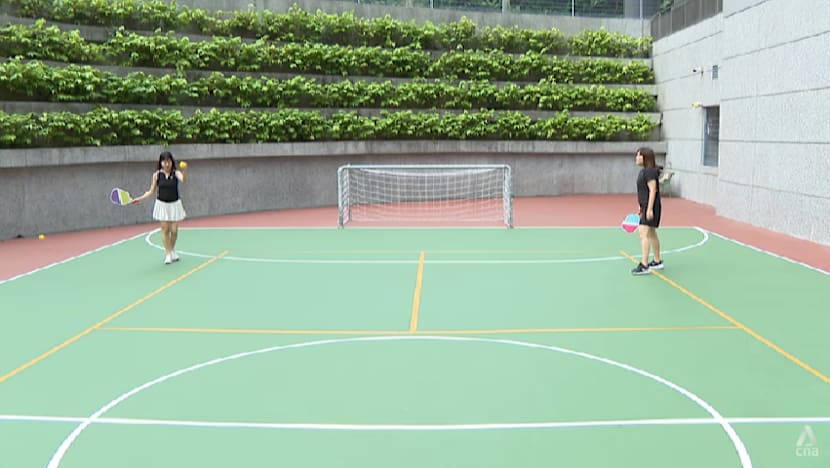
The company has introduced amenities including urban farming plots, food truck events, fitness programmes and pickleball courts across several properties.
Rather than setting aside large amounts of new space, the landlord has sought to repurpose existing areas for multiple uses.
At some Frasers developments, hot-desking areas can be converted into event spaces, while pickleball courts share space with existing futsal courts.
"We constantly look out for opportunities to provide new amenities and facilities for our tenants, but not everything requires additional floor area," said Mr Jack Lam, the firm's senior director of commercial.
Mr Lam said demand for such facilities has been strong across different types of tenants, as companies look for ways to improve workplace experiences.
Shared amenities can also help companies that may not have the resources to provide such offerings on their own, he added.
“Big companies may have the resources to provide such spaces, (but) not every company can do it. So, as landlord or property manager, we create common spaces ... for all our tenants.”
This can also help foster interaction between workers from different organisations and strengthen workplace communities, Mr Lam said.
CURATED WORKPLACE EXPERIENCES
At CapitaLand's properties, placemaking initiatives include workplace experiences and events organised through the landlord's wider retail network.
One recent example involved a collaboration between office tenants and fashion retailer Love, Bonito, which brought styling sessions and a fireside chat with the brand's leadership team into the workplace.
Other programmes have included wellness activities with sportswear brand Adidas and a pop-up event centred on wildlife conservation.
“There's a shift towards work, live and play integration, so office buildings are no longer just places for work,” said Ms June Tan, head of digital platforms, strategic marketing and business partnerships for Singapore commercial management at CapitaLand Investment.
AMENITIES BECOMING A RENTAL DRIVER
Analysts say such efforts are increasingly influencing leasing decisions.
Mr David McKellar, head of leasing and office services for Singapore at CBRE, said companies emerging from the pandemic realised that offices needed to offer more than just desks and meeting rooms.
“The driver for employees needed to be around amenities, access, conveniences. When a landlord can do heavy lifting to facilitate these initiatives, then that becomes an attractor,” he noted.
“What we've seen in the Singapore market is that the best buildings in town offer those amenities.”
Landlords that successfully create such offerings can command rental premiums of about 10 to 20 per cent, while also benefiting from higher occupancy and tenant retention, Mr McKellar added.
"It's really the highest quality buildings that are easiest to access with the greatest level of amenities that have the highest occupancy, and that's driving rental growth.”
TIGHT SUPPLY SUPPORTING RENT GROWTH
Singapore's office market remains supported by limited new supply and steady demand from sectors such as financial services.
Mr McKellar noted that vacancy rates in prime office buildings have fallen from 5.5 per cent at the start of last year to 3.3 per cent currently.
Demand is also coming from artificial intelligence firms that initially incubated in co-working spaces before moving into conventional offices as they expand.
While many began with small teams, some are now taking up between 10,000 sq ft and 100,000 sq ft as their operations grow, Mr McKellar noted.
Analysts say the tight market is expected to persist.
Mr Alan Cheong, executive director for research and consultancy at Savills Singapore, said around 609,000 sq ft of new office space is expected to be completed this year, below the annual average of 1.12 million sq ft delivered between 2021 and 2025.
Supply is expected to remain below 1 million sq ft in 2027 before rising to 2.3 million sq ft in 2028, he added.
With supply constrained and tenants continuing to favour prime CBD locations, analysts expect office rents to continue rising in the coming years.