
World News
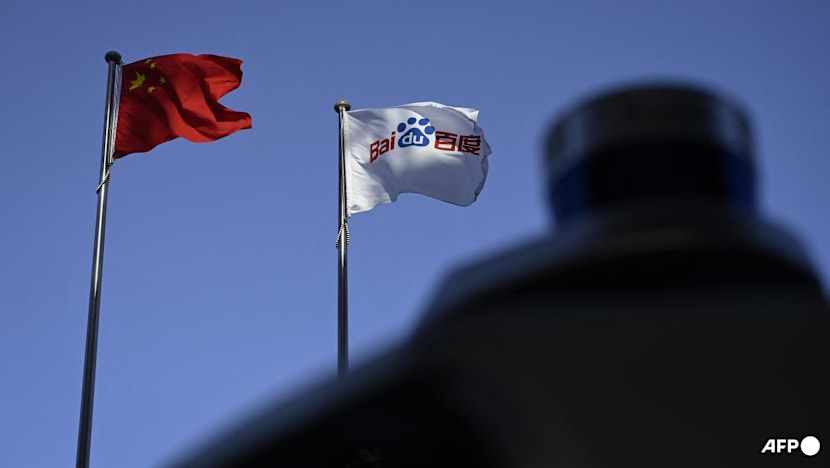
Why Alibaba, Baidu and BYD are on Pentagon’s list of 'Chinese military companies'
Key Points
analysis East Asia Why Alibaba, Baidu and BYD are on Pentagon’s list of 'Chinese military companies' The newly updated index offers a glimpse into how Washington views the relationship between China's commercial sector and military development as geopolitical competition intensifies, say analysts. BEIJING: The United States on Monday (Jun 8) added e-commerce giant Alibaba, internet search provider Baidu, carmaker BYD and dozens of other Chinese companies to a list of firms it says are linked...
analysis East Asia
Why Alibaba, Baidu and BYD are on Pentagon’s list of 'Chinese military companies'
The newly updated index offers a glimpse into how Washington views the relationship between China's commercial sector and military development as geopolitical competition intensifies, say analysts.
BEIJING: The United States on Monday (Jun 8) added e-commerce giant Alibaba, internet search provider Baidu, carmaker BYD and dozens of other Chinese companies to a list of firms it says are linked to China’s military, drawing sharp criticism from Beijing and the affected businesses.
The Pentagon designation thrusts some of China’s best-known corporate names into Washington’s crosshairs, highlighting its expanding scrutiny of commercial technology that could support Beijing’s defence capabilities, say analysts.
The move comes just weeks after the high-stakes summit in Beijing between US President Donald Trump and Chinese counterpart Xi Jinping that sought to stabilise ties between the world’s two largest economies.
What is this list, why does it matter and how could it impact US-China relations? Here’s what you need to know.
WHAT IS THIS LIST?
Known as the 1260H or CMC list, it is maintained by the US Department of Defense to identify Chinese companies that Washington says are connected to the People’s Liberation Army (PLA). The 1260H designation comes from the relevant section of the 2021 National Defense Authorization Act.
Inclusion does not prevent companies from operating in the US. But it can lead to investment restrictions and increased scrutiny, as the designation signals that these firms are considered strategically sensitive.
First published in June 2021, the list has been updated several times since. It now covers 188 entities spanning sectors such as artificial intelligence, e-commerce, semiconductors, electric vehicles, batteries and advanced manufacturing.
The latest list added around 60 companies. Notable inclusions are Alibaba, Baidu, electric-vehicle manufacturers BYD and Nio, as well as Chinese biotech firm WuXi Apptec and robot maker Unitree. Network equipment maker TP-Link and battery makers CALB and EVE Energy have also been designated.
“The inclusion of PRC (People’s Republic of China) tech giants on the Pentagon’s entities list is the latest round in mutual restrictions of technology between the United States and PRC,” said Chong Ja Ian, an associate professor at the National University of Singapore (NUS) and a non-resident scholar at Carnegie China.
The listed firms qualify for designation as “Chinese military companies” and operate either directly or indirectly in the US, the Pentagon said in its filing, which is required at least annually under US law. Companies on the list can petition for removal, it added.
Ten entities were dropped from the updated index, including China International Information Services, China National Chemical Engineering, China Traffic Construction USA and two subsidiaries of state-owned energy giant CNOOC.
Most of the firms on the list are described as having links to Chinese state organs. Alibaba, Baidu and BYD are among those further identified as “military-civil fusion” contributors to the Chinese defence industrial base.
The US State Department describes military-civil fusion as an “aggressive, national strategy” of China’s Communist Party, with a key part being the elimination of barriers between China's civilian research and commercial sectors, and its military and defence industrial sectors.
China has set a goal of building a “world-class” military by mid-century. Under Xi, military-civil fusion was elevated to a national strategy and embedded across government and industry, although the term itself has featured less prominently in official messaging in recent years.
WHY DOES IT MATTER?
The designation offers a glimpse into how Washington views the relationship between China's commercial sector and military development as geopolitical competition intensifies, said analysts.
“In a way, (the list) reflects the strategic thinking of the US towards China - (that) the Chinese government is using commercial companies to support its military research and capabilities,” said Benjamin Ho, an assistant professor at the S Rajaratnam School of International Studies (RSIS) in Singapore.
Some of the designated entities are consumer product companies, Ho noted, citing EV maker BYD as a notable example.
“It’s almost like the Pentagon saying that traditionally Chinese consumer product companies are not spared from this investigation, and the fact they are being tied or linked to the PLA,” said Ho, who is also coordinator of RSIS’ China programme.
“So it’s almost like a whole-of-government approach against China, that anything that can be linked back to the PLA will be seen as a threat to the United States.”
The Pentagon list states many of the designated firms as having links to the State-owned Assets Supervision and Administration Commission of the State Council and other Chinese state organs.
Wang Haolan, a research associate at the Asia Society Policy Institute’s (ASPI) Center for China Analysis, pointed out that the Pentagon did not provide “detailed evidence” to support its assertions.
“This is like saying that all US companies are tied to the military because they have contacted and fall under the jurisdiction of the FCC (Federal Communications Commission ) or the Commerce Department,” Wang told CNA.
“This is a political statement more than any substantial national security-driven pursuit,” he added.
Analysts also highlighted the timing of the move.
The Pentagon briefly posted an updated index in February - ahead of Trump’s China visit in mid-May - before abruptly withdrawing it with little explanation.
The new version released on Monday largely mirrors that list, except for retaining the inclusion of top Chinese memory chipmakers ChangXin Memory Technologies and Yangtze Memory Technologies.
The publication of the list now could reflect the Trump administration’s confidence that it will not derail the overall trajectory of US-China relations, Wang suggested.
WHAT'S THE IMPACT ON THE FIRMS?
It'll be limited, according to analysts.
“I don’t think this listing of these companies as linked to the Chinese military would change much in substance,” Zenobia Chan, an assistant professor of government at Georgetown University, told CNA.
She noted that BYD has been effectively excluded from the US market due to Washington’s 100 per cent tariffs on Chinese EVs. Baidu, meanwhile, has little presence in the US as a search engine, with a research and development centre serving as its key footprint there.
As for Alibaba, its cloud business has “never had a huge presence” in the US, Chan added.
“(Alibaba’s) B2B e-commerce business is its biggest strength in the US, but this is unlikely to be hugely affected by the designation,” Chan said.
Many of the newly designated firms have strongly rejected being labelled as Chinese military companies. Alibaba, Baidu, and Wuxi AppTec are among the companies that have said the Pentagon’s assertion lacks basis, and that they will challenge it.
BYD said it firmly opposed being labelled a military company and would use all "feasible administrative and legal means" to safeguard its rights and interests. In a statement to Reuters, it added that the decision harms "its development achievements in the United States”.
ASPI’s Wang said the list carries little legal weight.
It’s more of a reputational thing, potentially scaring investors or potential collaborators,” he said, adding that it could put universities and institutions that collaborate with the designated firms in a “tough position”.
NUS’ Chong said the implicated Chinese firms could face higher costs should restrictions also apply to contractors and subcontractors working with the Pentagon in and outside the US.
“The real complication would fall on these intermediaries and third parties in terms of keeping their systems free from PRC tech,” he said.
The designation could also create challenges for jurisdictions where the affected firms have established a significant presence.
For instance, BYD is a “big player” in the Singapore market, noted RSIS’ Ho. “The worry is that the US will come down on countries that house these companies,” he said.
WHAT ABOUT THE IMPACT ON US-CHINA RELATIONS?
So far, China’s response has not gone beyond words.
Beijing on Tuesday urged Washington to “correct its erroneous practices”, warning that it will "take necessary measures to firmly safeguard the legitimate rights and interests of Chinese companies".
"China has consistently and firmly opposed the United States' generalisation of the concept of national security ... and its unreasonable suppression of Chinese companies," Chinese foreign ministry spokesman Lin Jian added at a regular news briefing.
The back and forth highlights “real suspicion and contention” between the US and China beneath the language of stability and cooperation, said Chong from NUS.
Georgetown University’s Chan suggested that the list could serve as political leverage.
“This can be a bargaining chip ahead of President Xi’s visit to the United States in September,” she said.
During their summit in Beijing last month, Trump invited Xi to pay a reciprocal visit to Washington on Sep 24. China’s top diplomat Wang Yi subsequently said that the Chinese supremo would make a state visit to the US in autumn this year, without confirming the exact date.
In the meantime, analysts expect China’s response to remain restrained, even as it has cards in hand.
“If there is a tit-for-tat response, Boeing is also arguably linked to the US military, you could argue that the Chinese could … (decide) to scale back on its purchase of Boeing jets,” said RSIS’ Ho.
Trump said after his summit with Xi that China had committed to buying at least 200 Boeing aircraft. A subsequent statement by China’s commerce ministry confirmed an agreement with the US over the purchase of aircraft, jet engines and components, although it did not mention the amount.
“But it really remains to be seen. The US could just be floating this as a test balloon to see how the Chinese will respond, Ho said.
“If the Chinese just carry on business as usual, then you might just see the situation die down.”