
Technology
Indonesia seeks to diversify network routes, reduce 90 per cent internet connectivity dependence on Singapore
Key Points
Indonesia seeks to diversify network routes, reduce 90 per cent internet connectivity dependence on Singapore Indonesia's dependence on Singapore stems from the island state’s position as Southeast Asia’s primary digital hub, hosting major subsea cable networks - cables laid on the seabed between land-based stations - data centres and global cloud services. Indonesia aims to reduce its heavy reliance on Singapore for its internet and digital connectivity by diversifying network routes, said...
Indonesia seeks to diversify network routes, reduce 90 per cent internet connectivity dependence on Singapore
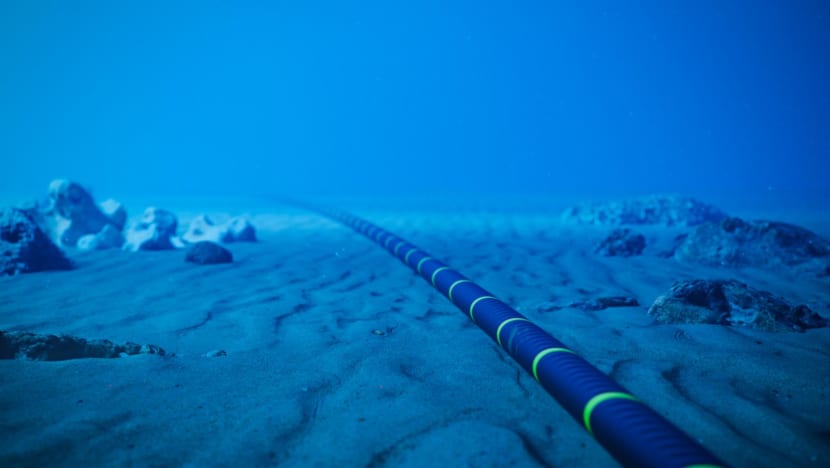
Indonesia's dependence on Singapore stems from the island state’s position as Southeast Asia’s primary digital hub, hosting major subsea cable networks - cables laid on the seabed between land-based stations - data centres and global cloud services.
JAKARTA: Indonesia aims to reduce its heavy reliance on Singapore for its internet and digital connectivity by diversifying network routes, said the Indonesian communication and digital affairs ministry.
"Honestly, 90 per cent of our (internet) traffic now depends on Singapore,” said Denny Setiawan, the ministry’s director of strategy and policy for digital infrastructure, during an awards ceremony in Jakarta on Monday (Jun 8).
This dependence stems from Singapore's position as Southeast Asia’s primary digital hub, hosting major subsea cable networks - cables laid on the seabed between land-based stations - data centres and global cloud services.
Subsea cables are seen as critical information and telecommunications technology infrastructure.
Often described as the "backbone of the global internet", they can carry more than 99 per cent of the world's data traffic, including email, webpages and video calls.
Denny added that Indonesia needs to build more alternative digital routes so internet connectivity does not rely on a single corridor, as concentrating resources can pose risks.
Indonesia's potential as a digital economy hub in Southeast Asia must be supported by adequate connectivity so that digital technologies can reach the world’s largest archipelago, with more than 17,000 islands, he added.
"We need diversity in subsea cables and terrestrial (land-based) cables, and the same applies to each island," he said, adding that digital sovereignty is increasingly important as demand for network capacity grows to support artificial intelligence (AI) and data-driven centres.
Denny added that the government is working to align development plans for data centres, subsea cables, terrestrial networks and radio frequency spectrums.
Indonesia is exploring a strategic partnership with Singapore to develop regional data centre infrastructure through the Singapore-Johor-Riau growth corridor, said Chief Economic Minister Airlangga Hartarto on Tuesday, as quoted in local media.
The partnership is part of the country’s broader efforts to strengthen regional supply chains and grow Southeast Asia’s digital economy, he said, adding that the global community was shifting toward the digital sector as a new economic growth source, relatively unaffected by current geopolitical tensions.
RISKS FOR INDONESIA WITH SINGAPORE DEPENDENCE?
Analysts said Indonesia's dependence on Singapore for digital connectivity carries risks despite the city state's position as the regional digital hub.
Muhamad Erza Aminanto, assistant professor and cybersecurity programme coordinator at Monash University, said Indonesia’s reliance on Singapore as a regional digital hub is inevitable because of its proximity to the nation.
"Geographically, Jakarta is very close to Singapore. From the perspective of companies building subsea fibre-optic cables, if they want to reach Jakarta, they might as well connect to Singapore because it is already a global internet hub," he said.
Indonesia has 72 subsea cables, consisting of 42 domestic cables and 30 international cables, of which almost all connect to Singapore, according to data from independent subsea cable infrastructure platform GeoCables.
The island state’s dominance in international data traffic ties back to its history as a key transit point for subsea telegraph tables linking Australia, Hong Kong and India in the late 19th century, according to a report by United States nonprofit think tank Centre for Strategic and International Studies (CSIS).
This means that more than a century of communications infrastructure development laid the foundation for Singapore’s current role as a regional internet hub.
Singapore is also a regional hub for data centres and cloud services, with major investors for cable systems including Amazon Web Services, Google, Microsoft and Meta.
Yet observers warn that dependence on Singapore carries risks caused by natural disasters and accidents, which have encouraged Indonesia to diversify its international connectivity.
Muhammad Arif Angga, chairman of the Indonesian Internet Service Providers Association (APJII), said that natural disasters could cause cable disruptions affecting Indonesia’s internet connectivity.
Subsea cable damage can also be caused by ships, anchors, and fishing activities, with around three cable failures weekly, which amounts to 150 to 200 cable failures globally every year, according to the International Cable Protection Committee.
Indonesia inaugurated a new internet connectivity route in Papua in May 2026, giving Papua two independent digital routes that will create new opportunities and accelerate digital transformation, said Indonesia’s Vice Minister of Communication and Digital Affairs Angga Raka Prabowo.
The first route connects through Sulawesi-Maluku-Papua while the second links Vanimo in Papua New Guinea to Jayapura then connects Manado to Los Angeles in the United States.
CHALLENGES TO DIGITAL SOVEREIGNTY
Analysts said that the government's move to develop subsea cable infrastructure also includes maintaining domestic communications infrastructure, though this has challenges.
This means that Indonesians should be able to be connected through national networks rather than be routed through another country’s networks or interconnection points, said Erza of Monash University.
"If 90 per cent of internet infrastructure passes through Singapore via submarine cables, there are several risks," he said, citing data security as one of them.
Reducing dependence on Singapore will not be easy however, as Indonesia is not a small territory with closely clustered cable landing stations like Singapore, and has to build and connect digital infrastructure across a vast archipelago stretching from Aceh to Papua.
"We need to become more self-reliant, but that won't be easy because the required investment is enormous," Erza added.
Arif of APJII added that only few companies can build subsea cable infrastructure due to high costs and the specialised technical expertise involved.
"From a business perspective, this is a high-level industry. I only know of one or two players interested in opening new routes," he said, adding that obtaining permits for constructing maritime corridors was also a lengthy process.
Arif Perdana, an associate professor of data science at Monash University, stressed that diversifying connectivity routes is not enough, and the government should identify critical services, map single failure points and better understand dependencies on cloud providers and technology vendors.
"Diversification of submarine cables, landing stations, regional internet exchanges, and data centres must be accompanied by measurable service recovery requirements," he added.
Meanwhile, Erza at Monash University’s cybersecurity programme said that Indonesia does not need to pursue absolute digital independence.
"It is impossible to be 100 per cent free from foreign connectivity. If we did that, we would become isolated," he said.
Agreeing, Persana said the goal should be to reduce excessive dependence, not to sever connections with Singapore and surrounding countries.
"What we need is not digital isolation. We need to transform concentrated dependence into balanced interdependence," he said.
"Indonesia should remain connected to Singapore and the global ecosystem, while also having alternative routes, domestic capacity and policy options when crises occur."
On May 30, 17 countries, including Singapore, launched a framework to protect critical underwater infrastructure - including subsea cables - at the annual defence forum Shangri-La Dialogue in Singapore.
Indonesia was not among the participating countries.
The countries, which are from Europe, the Middle East, Oceania and Southeast Asia, launched the Guiding Principles for Underwater Infrastructure Defence Exchanges that aims to bring together nations with common interests in the security of critical underwater infrastructure.
Indonesia (LOCATION)
Singapore (LOCATION)
Southeast Asia’s (LOCATION)
JAKARTA (LOCATION)
Indonesian (ORG)
digital affairs ministry (ORG)
Denny Setiawan (PERSON)
Jun 8) (PERSON)
Denny (PERSON)
Southeast Asia (LOCATION)
the Singapore-Johor-Riau (LOCATION)
Airlangga Hartarto (PERSON)
Muhamad Erza Aminanto (PERSON)
Monash University (ORG)
Si (PERSON)