
The sentry box at the royal governor’s residence in Boston was a too-inviting target for young Americans with an urge to kick, throw, or swing at something British. The regiments who occupied the city to enforce the Crown’s taxation were accustomed to dodging snowballs, oyster shells, and burning coals. Then, one January day in 1769, a gang of boys found a novel form of harassment: They launched an unruly game of “foot-ball” in the street facing the sentry box. As the boys played, the action came ever closer to grazing the redcoat on duty. What happened next infuriated Royal Governor Sir Francis Bernard, a meaty-faced, tilt-chinned baronet. Somehow, probably by piling into it, the boys toppled the sentry box onto the street.
That foot-ball game was more than just a “little rude boyish trick,” as a newspaper account, often attributed to Samuel Adams, put it. It was a barrier-crashing act, an early sign of a belligerently rule-testing national character. To Bernard, it was “another Proof of the Necessity of Regular Troops, to keep the Inhabitants in Order.”
But keeping young Bostonians in order wasn’t so easy. In February 1770, another throng of boys, which may have included Paul Revere Jr., amused themselves in the street by practicing their aim with rocks and snowballs, which they threw at a Loyalist merchant’s windows. When their stones began hitting people inside the house, a British customs agent fired a shotgun at the boys, killing an 11-year-old named Christopher Seider. Just a week later, another street altercation resulted in the Boston Massacre, immortalized in Paul Revere Sr.’s engraving. “As Boston simmered on the eve of Revolution,” the scholar Daryl Leeworthy has observed, “even little things like footballs kicked at soldiers could bring the city dangerously close to the edge.”
Viewed from the present, these young athlete-patriots seem to possess a quintessentially American mix of pride, irreverence, and subversion. The Sons of Liberty channeled these energies in the fight for independence from England, but the energies hardly dissipated with the signing of the Treaty of Paris. Instead, our rebellious, rambunctious approach to athletic endeavor became part of the American ethos. You can see it in the sports we play and the way we play them. You can even see it in the way we spectate and celebrate. Victory is marked by the scaling of lampposts (Philadelphia), drunken parading through the streets (and a river, in Boston), and light property damage (everywhere). To understand America as it marks a big birthday, you could do far worse than consider its long history of sport, and of fandom.
Long before the war for independence began, colonists played with a streak of exploratory defiance, rebelling against the constraints of their own Puritan governors. The first mention of an athletic contest in colonial America comes from the separatist Pilgrim leader William Bradford, whose journal records that in 1621—just a year after the Mayflower landed—he disciplined a group of young men for evading work on Christmas to instead engage in games such as “pitching the bar,” a contest to see who could throw a heavy rod the farthest.
Settlers may have been inspired to new forms of play by their encounters with members of the Wampanoag Nation, who had occupied coastal Massachusetts for some 12,000 years. In 1634, a colonist named William Wood wrote about their exuberant, rugby-like games of “footeball” that could last for a mile along the flat beaches, in which they displayed “swift footemanship” and “curious tossings of their Ball.”
By 1735, rowdy games of foot-ball were already associated with political rivalries in Boston. During elections, these games were used to express “the animosities of several contending parties,” The New England Weekly Journal reported. The newspaper added, “Whilst these opposite sets of angry men are playing at football, they will break all the windows and do more hurt than their pretended zeal for the nation will ever make amends for.” The statement could apply today.
Once the Revolution was launched, even General George Washington had difficulty containing the games of his troops. According to soldiers, including the painter John Trumbull, who served during the siege of Boston in 1775, Continental Army officers offered small rewards (usually alcohol) for the retrieval of any cannonballs fired from British batteries at the American lines. This set off daring races to pick up the ordnance. During a British cannonade at Roxbury in July 1775, it became something of a spectator sport to watch Yanks vie to pick up the balls and carry them to officers. “It is diverting to see our people contending for the balls as they roll along,” one witness wrote. Soon, however, the game became dangerous, as soldiers began trying to stop the cannon shot with their feet, like soccer balls. This led to terrible wounds. “Several brave lads lost their feet, which were crushed by the weight of the rolling shot,” Trumbull related. The reward offer was withdrawn.
Washington himself was a formidable athlete. According to a French officer who visited the general’s headquarters, Washington “sometimes throws and catches a ball for whole hours” with his men. On at least one occasion, he joined them at Valley Forge in a game of “wicket,” a kind of poor man’s cricket that didn’t require a groomed lawn or special equipment. And he was apparently a champion at pitching the bar. The artist Charles Willson Peale related that one day, before the outbreak of the war, Washington was strolling around Mount Vernon when he came upon some young men playing the game. Washington asked where the farthest throw was marked and then, without taking off his coat, smiled and heaved the bar. It “whizzed through the air, striking the ground far, very far, beyond our utmost limits,” according to Peale. As the other players gaped, Washington said, “When you beat my pitch, young gentlemen, I’ll try again,” and strolled away.
With Washington’s encouragement, the men of the Continental Army became sports-mad. Diaries and letters refer to a dizzying variety of contests they played to break up the tedium of camp. A lieutenant named Ebenezer Elmer made repeated references to “ball play” and to a contact game called “whirl,” in which another man gave him “a severe blow on my mouth which cut my lip, and came near to dislocating my under jaw.” One of Nathan Hale’s diary entries for 1775 simply recorded, “Clean’d my gun—pld some football, & some checquers.”
These pickup games seem to have exemplified the spirit that the British poet W. H. Auden would later describe as “the peculiar American mixture of Puritan conscience and democratic license”: They were conducted according to agreed-upon rules, yet those rules were highly flexible depending on the players’ surroundings and the implements at hand. As the scholar Thomas L. Altherr wrote in an authoritative work on early American sport, “A Place Leavel Enough to Play Ball,” the games were makeshift affairs that married old English-village games to the New World landscape. Americans played “tip cat,” which involved using a long stick to flip a short piece of wood in the air and bat it. They played “long bullets,” a bowling contest. They played rounders, trap ball, base, baste, three o’cat, sting ball, barn ball. Game equipment was fashioned from whatever was available—tree branches; broom handles; planks; rocks; stumps; stakes; and balls of rags, feathers, or buckshot covered in leather.
By 1779, Washington had grown concerned that his men were finding excuses to avoid duty in order to play. Inspecting a camp near West Point during what were supposed to be drilling hours, he discovered that scores of them were instead rampantly chasing after balls. Washington issued an order saying that soldiers could not shirk military duty by claiming inadequate shoes or clothing when they had just been “employed at games of exercise much more violent.” Washington was late to notice what Abigail Adams already had. “This continent has paid thousands to officers and men who have been loitering about playing foot-ball and nine pins, and doing their own private business whilst they ought to have been defending our forts,” she wrote to her husband in 1777.
American games didn’t evolve into the more formal exercises we now recognize, with demarcated fields, written rules, clocks, and sophisticated strategies and counterstrategies, until the late 19th century. With the West largely closed, and with machines outstripping bodies, how could American men prove their manhood? One answer: maul each other.
Beloved of boys and young men on Boston Common in the 1860s was “punk,” a version of dodgeball in which they hurled a semisoft homemade ball at fellow competitors with the intention of “plugging” someone, and scrimmaged for the ball until a new possessor turned on another human target.
Then there were the mass “rushes” that were early forerunners of American football, in which whole classes at Harvard, Yale, and Princeton battled for possession of a field. From 1862 to 1865, about 50 boys who frequented Boston Common belonged to a short-lived institution called the Oneida Football Club, most of them Brahmin sons bound for Harvard. For three years they reigned supreme on the Common, and they have been identified by some scholars as perhaps the first organized ball team in America. One of their balls is preserved in Boston. It doesn’t resemble anything used in any other game; it’s seamed, but neither truly round nor oval.
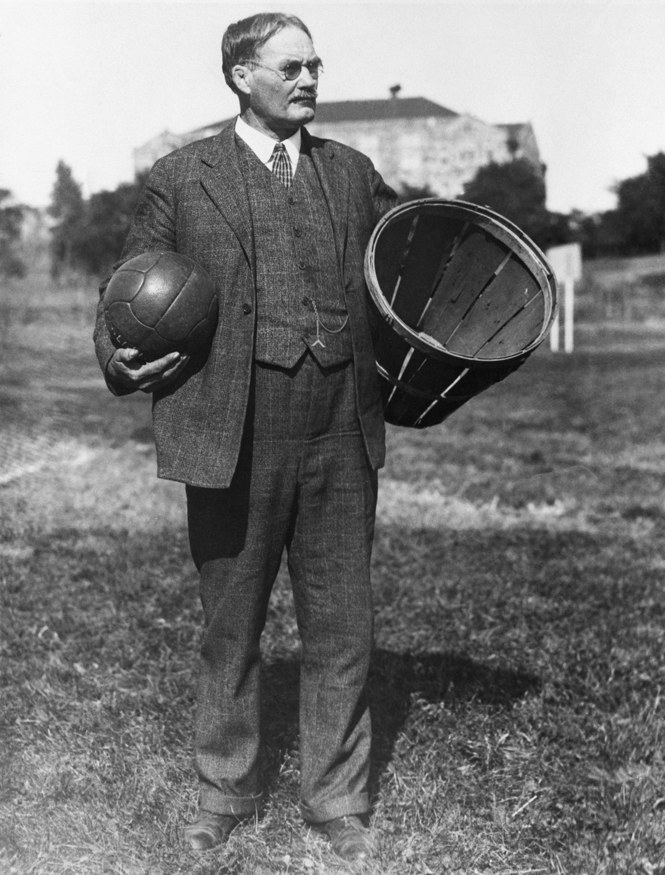
Even basketball began as a game in which young men pushed others aside to reach a goal. James Naismith first presented it as a winter-semester activity at Springfield College during a blizzard in 1891. Growing up in Ontario, Naismith had played “duck on a rock,” a game that involved tossing a rock in high, arcing throws at a target stone set on a tree stump. Naismith improvised a version of it for Springfield students by nailing up two peach baskets in the gymnasium, dividing the class into two teams, and telling them to throw a ball into their opponent’s basket. But as soon as he blew the whistle, “the boys began tackling, kicking, and punching in the clinches; they ended up in a free-for-all in the middle of the gym floor,” Naismith recalled in a radio interview toward the end of his life. “Before I could pull them apart, one boy was knocked out, several of them had black eyes, and one of them had a dislocated shoulder. It certainly was murder.” Naismith had to ban running on the court until he could develop some rules to curb the violence.
Even basketball, invented by James Naismith in 1891, began as a game in which young men pushed others aside to reach a goal. (Bettmann / Getty)In the 20th century, there was an unmistakable sense of accelerated growth in American play that mirrored the country’s expansion. This was an era of empire. Every nation uses sport as an identity-forming exercise, but only modern Americans play with such an aggressive sense of clearing out space. The deepest point of the center-field home-run fence at Boston’s Fenway Park, built in 1912, is 420 feet—150 feet deeper than the boundary of a cricket ground.
Cricket had never taken hold in America. According to James D’Wolf Lovett, a Boston athlete of the Civil War era, “Somehow American soil is not congenial” for it. But it was more than just the dirt: The length of a cricket match, which could last two days, was utterly impractical for hardworking, efficiency-minded Americans, especially as the nation’s modern economy emerged.
More congenial to the American mindset was football. In 1903, Harvard Stadium was completed; it used a new technique of reinforced concrete to accommodate crowds of 25,000 or more. In 1907, in the ultimate act of seizing ground, the forward pass was developed by the marvelously experimental Pop Warner–coached teams of the Carlisle Indian Industrial School, which opened the field to ever more creative strategy, and made football more popular. Every form of football, from Gaelic to Australian, involves gaining ground, but only in our version can a competitor gain 50 yards at a time by flinging the ball downfield—the forward pass, in all its wild optimism, is a purely American invention.
In 1908, all of America went aloft when the federal government contracted with the Wright brothers to produce the fixed-wing aircraft. At the same time, Henry Ford revolutionized the automobile with the first mass-produced Model Ts. This laid the groundwork for the great rituals of the American stadium experience: the parking-lot tailgate and the military flyover.
Before Game 1 of the 1918 World Series, between the Boston Red Sox and the Chicago Cubs, 60 U.S. Army biplanes roared over Comiskey Park, in what is believed to be the first such demonstration ever performed above a stadium. It was intended to bolster Americans’ morale, show off their combat strength in World War I, and evoke a fighting spirit. It succeeded: As Babe Ruth worked on a shutout for the Red Sox, feelings ran so high that the entire stadium joined in singing “The Star-Spangled Banner” during the seventh-inning stretch, long before singing the song at the ballpark was de rigueur. (Later in the series, soldiers at Camp Devens, near Boston, were so anxious for updates that a flyover of another sort was employed: Military carrier pigeons flew between Fenway and the camp, relaying the score.)
The first American tailgate may well have been at the Battle of Bull Run, in 1861, when civilians packed picnics to watch Union and Confederate troops fire on each other. But Ford’s invention was what made it into an American pastime. The New York Times described the pregame crowd at the 1906 Harvard-Yale football game: “Small parties of automobilists eating tempting viands that had been brought in hampers spread out in picnic fashion on a table cloth on the ground.”
By mid-century, the mass stadium spectacle was a firmly established American ritual—for white Americans, at least. The breaking of the color line in the major pastimes, and the desegregation of bleachers, concessions, and bathrooms, was slow and painful work, sometimes slowest in the oldest cities.
Players themselves were instrumental in pressing their teams, leagues, and cities to live up to the nation’s founding ideals. While delivering 11 NBA championships for the Boston Celtics from 1956 to 1969, Bill Russell led boycotts, marched on Washington with Martin Luther King Jr., protested segregation in Boston schools, and endured the vandalizing of his home; intruders smashed his trophy case, spray-painted epithets on his walls, and defecated in his bed. When the Celtics named him to succeed Red Auerbach in 1966, he became the first Black head coach in a modern major American sport.
Today, American stadiums have become immense, many of them too large to be situated in the cities that their teams represent, moored instead on suburban plains or on the outer, warehouse-populated margins. It’s therefore remarkable, the degree to which they’re still hothouses of cultural memory, and not just through quaint reenactments, such as the New England Patriots’ “End Zone Militia”: men in tricorn hats firing muskets after touchdowns at Gillette Stadium (in suburban Foxborough). More is going on in the parking-lot tailgates than just swilling by hardy fans huddled around weak charcoal-grill fires as they get day-drunk headaches. In 2025, attendance at Major League Baseball games was more than 71 million; 22 million at NBA arenas; and about 19 million at NFL stadiums. Why do so many of us go to such trouble and expense? A strong desire to relive our national story seems to be one answer.
A Philadelphia Eagles fan celebrates the team’s victory in Super Bowl LII. (Mitchell Leff / Getty)American sports enact “the liturgy of empire,” Tim Suttle, a Kansas pastor and essayist, has written. The modern stadium spectacle is rife with enormous flags, salutes to service members, and flyovers by supersonic warplanes. Fans feel they are active participants in the quest for victory. Roaring spectators are more involved than the word fan allows; we fervently believe that we’re “contributing psychic and emotional energy to a prospective victory,” as the scholars Tonya Williams Bradford and John Sherry have put it. Any fan of an opposing team who has dared to fly their colors at a stadium in Boston, Philadelphia, or New York can attest to this.
So can anyone who followed the celebrations after the Philadelphia Eagles’ Super Bowl triumphs in 2018 and 2025. Even in victory, Eagles fans are their bellicose selves. Light poles were scaled (and traffic lights torn down) and windshields busted. During the team’s most recent processional, up Broad Street toward Ben Franklin Parkway, general manager Howie Roseman was hit in the head by a beer, leaving a half-moon cut on his forehead.
Something else distinguishes our forms of play, too: the extent to which the contests lend themselves to retellings. American sports have “a special, intensified narrativity,” in the phrase of the NFL player turned historian Michael Oriard. Play in soccer, rugby, and cricket is continuous, often indeterminate. American games tend to have neat structures with a beginning, a middle, and an end, and stakes that ratchet accordingly, with a “more pronounced rhythm or pace, and a dramatic structure (situation, rising action, climax, and denouement),” Oriard writes in his book Reading Football. In a sense, they’re stories that we tell ourselves about who are—or would like to be.
But the simple truth is that American sports began as wildflowers. They were the products of seeds blown on the wind and buried in the mud until strange green shoots jumped up out of the ground. They were initially cultivated by men with foaming seas at their back and seemingly endless forests in front of them, who had an instinct to swat something—hard enough to sail over rail fences and into that unending wood.
This article appears in the July 2026 print edition with the headline “The Rebellious Origins of American Sports.” When you buy a book using a link on this page, we receive a commission. Thank you for supporting The Atlantic.