
Science
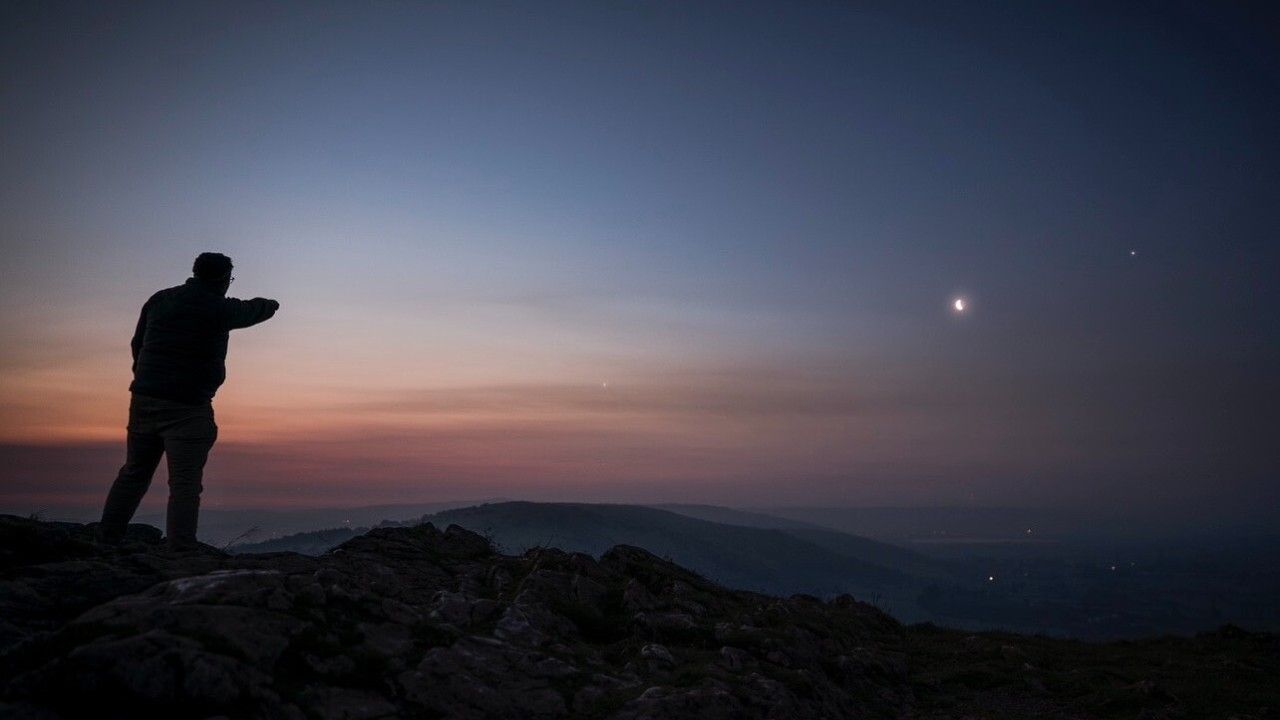
Don't miss this beautiful 3-planet parade after sunset on June 12 — it won't last long
Key Points
Don't miss this beautiful 3-planet parade after sunset on June 12 — it won't last long Mercury, Venus and Jupiter will form a striking 3-planet parade low above the western horizon after sunset on June 12, offering a brief but beautiful show. Mercury, Venus, and Jupiter align low over the western horizon after sunset, creating a satisfying mini planetary parade and a perfect astrophoto opportunity using a wide-angle lens or even just a smartphone. Even though Venus and Jupiter have drifted...
Don't miss this beautiful 3-planet parade after sunset on June 12 — it won't last long
Mercury, Venus and Jupiter will form a striking 3-planet parade low above the western horizon after sunset on June 12, offering a brief but beautiful show.
Mercury, Venus, and Jupiter align low over the western horizon after sunset, creating a satisfying mini planetary parade and a perfect astrophoto opportunity using a wide-angle lens or even just a smartphone.
Even though Venus and Jupiter have drifted apart slightly since their tight embrace on June 9, Mercury has climbed up beautifully from the sun's glare to join the party. Together, they form a striking slanted line along the ecliptic in the west-northwestern sky right after sunset.
This is a high-speed game. The optimal viewing window starts exactly 30 minutes after your local sunset and lasts for only about 30 to 45 minutes before Jupiter and Mercury follow the sun below the horizon.
Look for blazing Venus first — it will pop out while the sky is still bright. Drop your eyes down and slightly to the right to easily spot Mercury and Jupiter.
For observers using telescopes or imaging equipment, June 12 also offers an interesting opportunity to compare the appearance of the three worlds. Venus will show a small, intensely bright, 80%-illuminated gibbous disk, while Mercury will present a stark contrast with its 50%-illuminated "half-moon" phase. Resolving a clean, tiny half-Mercury in twilight is an elite visual feather in any amateur's cap. Jupiter will appear as a much larger disk, although its low position above the horizon means atmospheric turbulence may blur some detail. Under steady conditions, advanced imagers may be able to capture hints of the planet's famous equatorial cloud belts alongside Mercury's sharply defined silhouette.
For photographers, however, June 12 is all about landscape composition. Put away the prime-focus telescope adaptors and grab a 50 mm to 85 mm prime lens on a DSLR/mirrorless camera. Expose for the deep twilight sky colors and frame the three planets as a slanted cosmic ladder ascending over a crisp local silhouette — like a mountain ridge, a distant city skyline, or a line of pine trees.
If you're looking for a telescope or binoculars to observe the night sky in more detail, our guides for the best binocular deals and the best telescope deals can help. Our best cameras for astrophotography and best lenses for astrophotography can help you get ready to capture the next stunning skywatching event.
You must confirm your public display name before commenting
Please logout and then login again, you will then be prompted to enter your display name.
In 2005, Jules-Pierre quit a promising aerospace engineering career to become a freelance writer. He's been an avid amateur astronomer, model rocketeer and space enthusiast since he saw the Eagle land on the moon. When he is not writing technical procedures, newspaper and magazine articles or web content, he is out there watching the sky or launching rockets into it.