
World News
They were driven from their homelands by violence – now Belfast riots have placed refugees under fresh attack
Key Points
They were driven from their homelands by violence – now Belfast riots have placed refugees under fresh attack Women and children are in hiding in fear of waves of racist attacks fuelled by hatred spread on social media, as Sam Kiley reports from Belfast - Bookmark Children who have fled their homes in fear after their address appeared on fascist social media sites arrive sobbing at a community care centre. Women forced into hiding send out desperate appeals for food, nappies, the very basics...
They were driven from their homelands by violence – now Belfast riots have placed refugees under fresh attack
Women and children are in hiding in fear of waves of racist attacks fuelled by hatred spread on social media, as Sam Kiley reports from Belfast
- Bookmark
Children who have fled their homes in fear after their address appeared on fascist social media sites arrive sobbing at a community care centre. Women forced into hiding send out desperate appeals for food, nappies, the very basics of life – sugar, pasta, cooking oil.
In the language of foreign aid these are the pleas from Internally Displaced People – refugees so often the victims of ethnic violence and hatred abroad. But this is the United Kingdom.
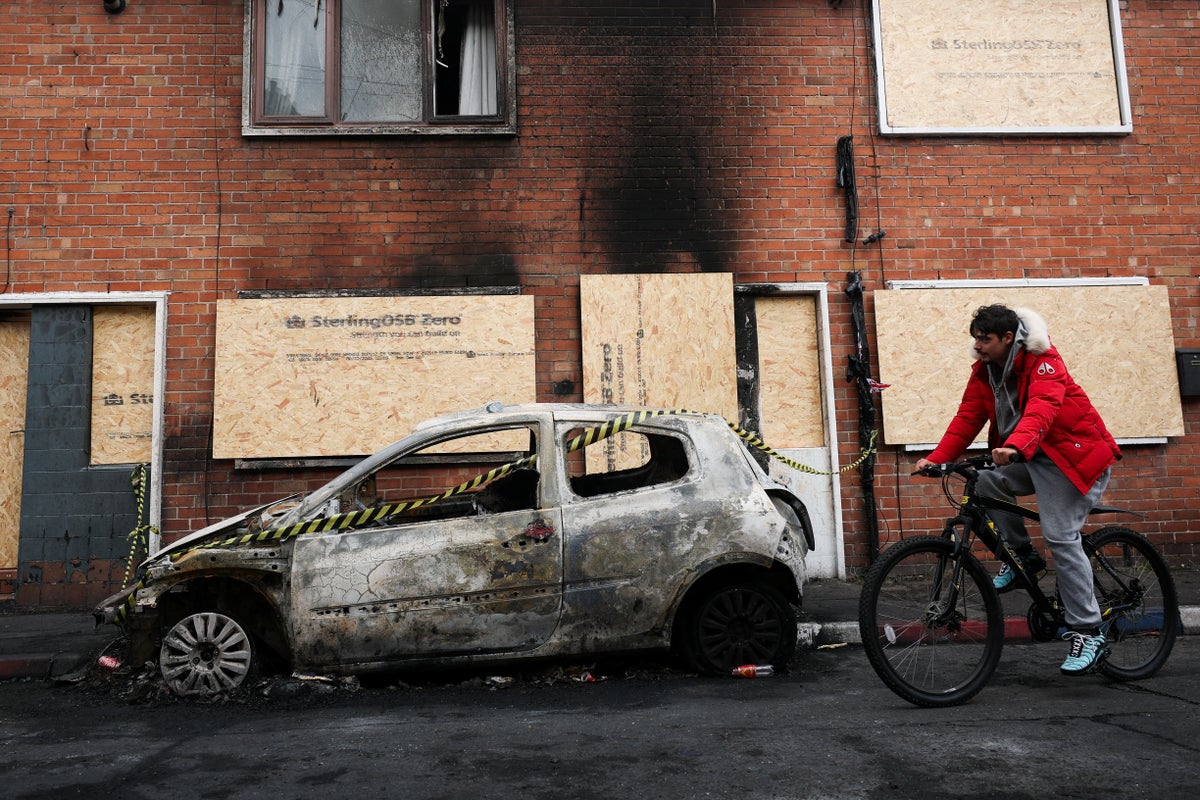
Two nights of riots in Belfast, reinforced with a social media campaign of intimidation and the publication of the addresses of known immigrants have driven people of foreign descent from their homes and children from their schools.
The wave of unrest came as tensions over immigration flared when it was revealed that suspect in an alleged stabbing that saw the victim, Stephen Ogilvie, lose an eye, was an asylum seeker who had come to the UK from Sudan.
Mothers and children, pregnant women, toddlers, teenagers and their dads, who were targeted, mostly refugees from conflicts elsewhere and seeking asylum themselves, now find themselves hunted and haunted by the past and a racist present.
They fled to Northern Ireland, which had appeared to have put its sectarian past behind it, only to discover that much of the old hatred is now coming their way.
Danisa Khanyisa Hlaisi, a South African asylum seeker living in a terraced house just off the Falls Road in a once notorious area of Republican Catholic militancy, is safe.
Members of the Happy Women’s Group she is part of, which is made up immigrants, has been coordinating the rescue and relief effort for dozens of families either trapped in their homes, too scared to go out, or displaced by violence targeting mostly people of colour.
“We have more than 40 people yesterday that we had to get out of their homes. They call the police because they don’t feel safe and they are taken to a refuge. Some we collect with volunteers and they are always very, very scared,” she said from her living room which is now the group’s improvised headquarters.
On Monday night several homes occupied by immigrants were torched.
Notionally this was in “revenge” for the alleged alleged attempted murder that one witness to some of the worst of it, on Lendrick Street, said threatened the lives of people who were pulled from burning buildings by police and carried away in armoured Land Rovers.
Paul Doherty, a Belfast City councillor who runs a community centre in the west of the city said that the fact that rioters had ignited home fuel tanks outside the homes of others was a clear sign there was “an attempt to kill people in those houses”.
“We have seen no effort on the ground from community leaders to stop the hatred and the violence and to get people to calm down,” he said.
Meanwhile, messages from desperate women too afraid to leave for a short trip to a corner shop in neighbourhoods they have called home for years, were pouring in to other online groups who were trying to aid the most desperate.
“We need cooking oil and basic supplies such as pasta, lentils, eggs, fish, potatoes…” said one woman sheltering with four children and four adults in a small terraced house. She is sheltering in a staunchly protestant Loyalist area, where murals declare “No Surrender” to Irish nationalism, but where small groups of extremists have now weaponised British nationalism.
“We have run out of the food we were cooking, and we are afraid to go to the shops,” the text message added.
Another message from another victim said simply: “I want food”.
Racist activists publishing lists of locations and addresses for immigrants on social media have forced those helping them into keeping the locations of refuges secret.
There is a genuine concern they could be firebombed. Or worse. For the older generations this inevitably re-ignites memories of decades of violence and sectarian murder that engulfed Northern Ireland from the lates 1960s during the Troubles.
“People are harking back to the days when we saw Catholics being burned out of their homes and we are seeing very similar scenes where people are stepping over flames and hand in hand with parents are being taken away in police vans,” said Mr Doherty.
Blame for the tensions has been pointed at the issue of immigration to Northern Ireland, which has a much lower rate of asylum seekers and other foreign nationals compared to the rest of the UK, where the national average of foreign born residents is 16 per cent compared to 9 per cent in the north of Ireland.
But political paralysis, housing and education in crisis, growing homelessness and widespread unemployment has led to the scapegoating of those who have sought a better life here, Mr Doherty said. Social media campaigns – fuelled by the likes of tech billionaire and X owner, Elon Musk, and far-right agitator Tommy Robinson – have further “amplified" the hatred.
Danisa Hlaisi, who moved to the region 15 years ago, said people from Africa were being singled out and that her group had been "horrified and embarrassed” by the alleged attack by a Sudanese refugee.
“If they had been non-violent we would have been on the streets protesting too. We live here this is our community and we don’t want anyone to be attacked and if they commit these kinds of crimes they should face deportation,” she insisted.
But for now her task it to get help to families hiding in a nation they assumed had moved beyond the bigotry and violence they left very far behind.
Belfast (LOCATION)
Sam Kiley (PERSON)
Belfast - Bookmark Children (ORG)
the United Kingdom (LOCATION)
Stephen Ogilvie (PERSON)
UK (LOCATION)
Sudan (LOCATION)
Northern Ireland (LOCATION)
Danisa Khanyisa Hlaisi (PERSON)
South African (ORG)
the Falls Road (LOCATION)
Republican (ORG)
Catholic (ORG)
the Happy Women’s Group (ORG)
Notionally (PERSON)