
Health
How rare earth mining in Myanmar threatens Thailand’s rice and fish
Key Points
How rare earth mining in Myanmar threatens Thailand’s rice and fish Contamination linked to mining in Myanmar is raising fears over food safety, shrinking incomes and long-term health risks for people in Thailand who depend on the Mekong’s tributaries, CNA’s Insight finds. CHIANG RAI, Thailand: Thongkham Inprom has been farming for more than six decades, growing jasmine rice and sticky rice in Chiang Rai. The 71-year-old harvests about 60 tonnes each year and keeps 1 per cent for his family.
How rare earth mining in Myanmar threatens Thailand’s rice and fish
Contamination linked to mining in Myanmar is raising fears over food safety, shrinking incomes and long-term health risks for people in Thailand who depend on the Mekong’s tributaries, CNA’s Insight finds.
CHIANG RAI, Thailand: Thongkham Inprom has been farming for more than six decades, growing jasmine rice and sticky rice in Chiang Rai.
The 71-year-old harvests about 60 tonnes each year and keeps 1 per cent for his family. The rest is sent to a rice mill and eventually sold in central Thailand.
But now he is worried that he might not be able to sell his rice. Government agencies have found arsenic in the soil and water at his farm. It is already affecting his crops.
While his brown rice contains arsenic within the safety limit, his paddy is “right at the safety threshold”, said Somporn Pengkam, the director of the Community-led Health Impact Assessment Platform, who went through the results from tests on the produce.
Thongkham’s polished white rice has less arsenic, but there is still cause for concern.
“Even if the daily intake is within the limit, it still builds up. At first, the body says, ‘I can handle it and flush it out.’ After a week, ‘still manageable’. After a month, it starts to struggle,” said Somporn.
“After six months, ‘I can’t handle this any more’. The kidneys can no longer clear it. That’s when we start detecting it in the body. Arsenic poisoning can eventually cause cancer in many organs, especially the skin and bladder.”
Arsenic has already been found in Thongkham’s urine, with tests done months apart showing that the level has increased to double the acceptable exposure limit.
“I don’t really know what we can do,” he said. “It’s hard to avoid. We eat rice every day.”
It is not only his farm where arsenic — a naturally occurring but toxic chemical element found in soil, water and some minerals — has exceeded the levels expected.
In March, Thailand’s Pollution Control Department detected elevated levels in the sediment of the Mekong River, the lifeblood of a large part of Southeast Asia. More than 65 million people live in the Lower Mekong basin.
The highest reading was 296 milligrams per kilogram of sediment, nine times the 33 mg/kg safety threshold.
In fact, heavy metals including lead and manganese have been detected in the Mekong’s northern tributaries since last year. In some tests, the presence of these substances exceeded Thailand’s safety standards too, with arsenic the prime concern again.
The water that feeds Thongkham’s crops comes from the Sai River. Along with the Kok and Ruak rivers, it begins in Myanmar’s Shan state, across the border. There lies what experts say is the source of the pollution: rare earth mines.
“They’re doing mining without any standards, any laws, spilling all the chemicals and toxins (into) our river system,” said Rivers and Rights Foundation executive director Pianporn Deetes. “These activities are transnational organised crime.”
Myanmar’s civil war and the race for the world’s most critical minerals are at the heart of what is now a looming crisis as pollutants end up in the food Thailand produces, CNA’s Insight finds.
FISH NO ONE WANTS TO EAT
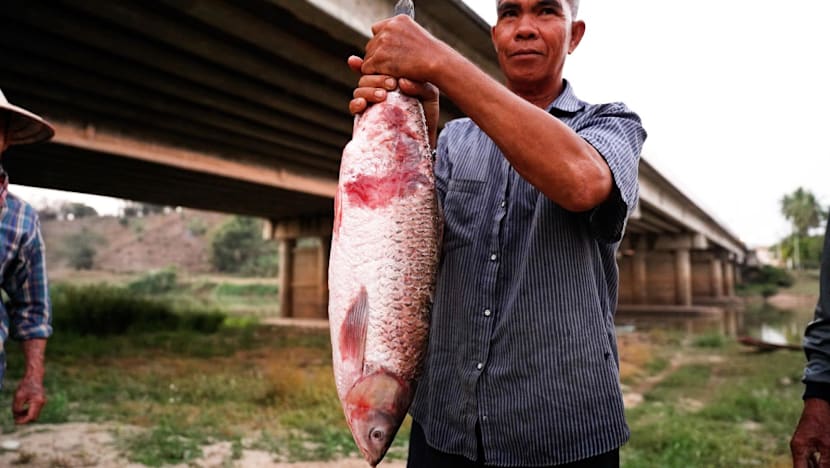
Before arsenic began showing up in rice, fish with unusual growths or lesions were turning up and sparking concern that something was wrong with the rivers.
Sukjai Yana, 75, who has fished in northern Thailand for more than five decades, caught “about four or five” deformed fish last year. When that happens, the fish cannot be sold and must be kept for authorities to examine them.
WATCH: Is your food safe? Inside Thailand’s toxic river crisis (45:54)
The fisheries department has established that these are infected fish, said Wan Wiriya, an assistant head at the Chiang Mai University’s Environmental Science Research Centre.
“Heavy metals or chemicals in the water may have weakened the fish’s immune systems, making them more vulnerable to infection,” he suggested.
Take humans. The more chemicals we’re exposed to, the weaker our immunity becomes and the more likely we are to fall ill. It’s the same for fish.”
In fish samples tested by Somporn’s health platform, arsenic was found “mostly in the belly and the head”, she said. “Shrimp tend to accumulate it in the head as well.”
Contamination may not come from mining alone, she added. “In some areas, agricultural chemicals could also be involved, so the water might be getting hit from two sources.”
The Insight team found out for themselves what was in the waters when they took samples from three areas for analysis: at Chiang Rai, Nong Khai and at Tha Ton in Chiang Mai, where the Kok River enters Thailand.
While arsenic was not detected in the sample taken in Nong Khai, which is farther down the Mekong, there was arsenic measuring 0.0159 mg/L — above the 0.01 mg/L safety standard — at Tha Ton.
The chromium level there was within the safety range, “but when they all come together, that’s a high level of heavy metals”, said Wan as he disclosed the results. “They accumulate because we don’t just eat one thing in life, right?”
The sample from Chiang Rai, meanwhile, returned higher values “across the board”, with arsenic measuring about 0.03 mg/L — thrice the safety limit. “Chemicals are piling up there,” he said. “It’s a ticking time bomb.”
Out by the river, people do not need a lab report to know things are not right. “The river used to be clear, not murky like this. It wasn’t yellow,” said Tha Ton resident Mae Ai Insaeng.
“People don’t want to go in or bathe there. … We used to wash our clothes in this river, but now I dare not.”
Fishermen like Sukjai have seen their catches shrink. Anxiety over contamination has also made it harder to sell fish.
“It was so quiet last year. The customers simply disappeared,” said fish seller Sangkham Ganjai. “This year, things are starting to look up, although not (by) much.”
To reassure customers, she has her fish tested and certified by the authorities. Customers can scan a QR code to see the test results. “I eat river fish every day, and I’ve been perfectly fine,” she said.
While she would like nothing more than for the mining operations in Myanmar to stop because of the impact on sales, she is not hopeful. “They’ll just keep going,” she said.
MINING BOOM IN CONFLICT ZONES
Rare earth extraction in Myanmar’s northeastern mountainous region — deep in conflict areas, where oversight is weak — is not only continuing but booming.
Close to 2,570 mines scar the landscape and river basins of Indochina. Nearly 80 per cent are in Myanmar, among which are 577 rare earth mines carved into the hills of Shan and Kachin states, according to Stimson Centre data.
The American think-tank has been using satellite imagery to map their expansion as extraction shifted from China — where stricter environmental standards have been rolled out since the mid-2010s — to its southwestern neighbour.
“You suddenly had a very willing actor on the Myanmar side … who was quite happy to have this dirty business migrate (across the border),” said Jason Tower, a senior expert with the Global Initiative Against Transnational Organised Crime.
“The head of the Border Guard up in the Kachin areas, Ting Ying, basically set up a web of … mining companies, over 100 of them.”
China is still the undisputed leader when it comes to rare earths, accounting for 69.2 per cent of global mining last year and about 90 per cent of refining output.
Myanmar, however, is now the world’s fourth-largest producer of rare earths, after China, the United States and Australia, according to US Geological Survey estimates. And the country is China’s biggest external supplier of rare earths.
In 2024, however, the Kachin Independence Army defeated the military-aligned Kachin Border Guard Force and seized the mines, seeking to bring their rare earths under its control.
“Of course, they’re very valuable, bringing in hundreds of millions, if not billions, in revenue,” Tower highlighted. “China saw these dynamics on the ground, and it started to look for alternative supplies.”
That is how rare earth mining has expanded in Shan state — where the United Wa State Army, another ethnic armed organisation, is one of China’s allies — and in the same catchments feeding the Mekong’s tributaries.
“A lot of these mines are financed … by Chinese companies,” said Stimson Centre research analyst Regan Kwan. “Chinese nationals who are experts on the chemical process … then help the process of injecting the chemicals on a technical level.”
Chemicals are needed to extract the rare earths, and mining just a tonne of these minerals can generate up to 2,000 tonnes of waste materials. Mining also amplifies the release of arsenic.
“In theory, if you were to have regulation, you’d somehow capture as much (waste water) as possible and then clean it before you put it back into the river,” said Kwan.
That’s not the case right now in Myanmar. Instead, that water is being directly pumped back into the river system.”
As the mines spread, Beijing faces questions about its role in the pollution.
Last year, the Chinese embassy in Thailand said it attached “great importance” to the reports on contamination and encouraged Thailand and Myanmar to conduct a scientific investigation and resolve the issue through “friendly dialogue”.
Chinese companies abroad must abide by local regulations, it added.
But in Myanmar, where the fighting between its military and its ethnic armed groups has intensified since 2023, it is not obvious who lays down the law.
AN ISSUE THAT “CAN’T BE FIXED IMMEDIATELY”
Downstream in Thailand, agencies are “working at full capacity to solve the problem”, said Department of Water Resources Management deputy director-general Pongpat Samerkum. “But these kinds of issues can’t be fixed immediately.”
His department mainly focuses on rainfed agriculture and water sources such as streams, ponds, canals and wetlands.
“We can use them, but the supply is limited. So we must plan our usage carefully to ensure the water provides a clear benefit,” he said.
“What we need to do quickly is find alternative inland water sources to bring into the area to support daily water use.”
Authorities say they are also continuing to monitor the rivers closely. So far, they have not found radioactive contamination linked to rare earth production. But in case of further problems, they are looking at treatment solutions for producing tap water.
“We’re looking into more advanced technical methods for monitoring as well, such as automated water testing stations,” said Chanan Tiranarat, the director of the Pollution Control Department’s water quality management division.
“They can generate reports every day. When something happens, we can immediately issue a warning, telling people the water quality is poor and (to) stop using it.”
These are only short-term fixes. To stop the pollution at source, the country has announced plans to have Australia and Japan — major importers of rare earths transiting through Thailand — act as intermediaries in negotiations with Myanmar.
“This includes technical solutions, such as implementing cleaner mining practices and public health monitoring for people in both our country and our neighbour,” said Chanan, adding that talks with Bangkok’s foreign counterparts have already begun.
“We also communicate through the Mekong River Commission, which involves several countries connected to the Mekong system.”
When asked if Thailand is also engaging Myanmar and China, he said they “participate primarily as observers”. He added: “Ultimately, it’s about cooperation. In terms of enforcement, … there are no legal mechanisms to compel each country to act.”
Myanmar also remains politically fragmented, notwithstanding the military-backed Union Solidarity and Development Party’s (USDP)’s landslide victory in elections earlier this year. Many ethnic armed groups and resistance forces reject the results and continue to challenge military rule.
“Even if the newly seeded USDP regime were to come in with stronger types of environmental safeguards,” said Tower, “it’s ultimately going to be up to the parties that control those minerals.”
That is why Udon Thani Rajabhat University environmental science lecturer Santiparp Siriwattanaphaiboon wants to see China step in and play a “positive role” — by “setting standards that protect neighbouring countries from the impacts of activities such as mining”.
“Myanmar listens to China. The ethnic groups listen to China too,” he said. “If what you gain comes from something harmful, then you should take responsibility for that harm.”
Rare earths are one of Beijing’s bargaining chips, however, as could be seen when it imposed export controls for leverage amid trade tensions with the US.
“China has effectively managed to consolidate some measure of strategic dominance in that area,” Tower noted. “Is it going to want to give up control over those supply chains? Not very easily.”
Today, rare earths are used in everything from smartphones to laptops to electric vehicles. And on the demand side, Kwan thinks society has a part to play too, by buying less and recycling.
“We don’t always need the newest phone every year it comes out because you’re just contributing to that global demand for materials like heavy rare earths,” he said, adding that consumers should also push companies to demand more responsible mining.
In the meantime, the people living along the Mekong and its tributaries must bear the brunt of the rare earth boom. “It’s not like how it was before,” said Sukjai, lamenting the low demand for fish. “My heart feels heavy.”
Thongkham the farmer frets about the future. “If one day we really can’t sell our agricultural produce any more, what will we do? What will we live on?” he wondered.
“If I think about it too much, it’s stressful. I feel sorry for all of us.”
Watch this episode of Insight here. The programme airs on Thursdays at 9pm.
Myanmar (LOCATION)
Thailand (LOCATION)
Mekong (LOCATION)
CNA (LOCATION)
Insight (ORG)
CHIANG RAI (PERSON)
Thongkham Inprom (PERSON)
Somporn Pengkam (ORG)
Community (ORG)
Somporn (ORG)
Arsenic (ORG)
Thongkham (ORG)
Pollution Control Department (ORG)
the Mekong River (LOCATION)
Southeast Asia (LOCATION)