
Health
Commentary: The real achievement behind 10 years of Project Wolbachia in Singapore’s dengue fight
Key Points
Commentary: The real achievement behind 10 years of Project Wolbachia in Singapore’s dengue fight Science breakthroughs don’t always become public health reality. Here’s how Singapore did it with mosquitoes and dengue, say NTU’s Lim Jue Tao and NEA’s Tan Cheong Huat, Chong Chee-Seng and Ng Lee Ching. SINGAPORE: In 2016, residents of Braddell Heights, community leaders and government officials lifted simple plastic tubs to the sky and set loose the first Wolbachia-carrying male Aedes aegypti...
Commentary: The real achievement behind 10 years of Project Wolbachia in Singapore’s dengue fight
Science breakthroughs don’t always become public health reality. Here’s how Singapore did it with mosquitoes and dengue, say NTU’s Lim Jue Tao and NEA’s Tan Cheong Huat, Chong Chee-Seng and Ng Lee Ching.
SINGAPORE: In 2016, residents of Braddell Heights, community leaders and government officials lifted simple plastic tubs to the sky and set loose the first Wolbachia-carrying male Aedes aegypti mosquitoes in Singapore - just 3,500 mosquitoes in a small field study.
Few could have predicted that a decade later, up to 15 million of these mosquitoes would be bred and released each week as part of a national strategy to control dengue. Releasing mosquitoes to prevent disease may still sound counterintuitive, but Project Wolbachia has quietly demonstrated its worth.
Dengue has challenged Singapore since long before independence. A record 35,315 dengue infections and 32 deaths were reported in 2020. In 2025, there were over 4,000 cases and four deaths reported.
In a large-scale trial published in the New England Journal of Medicine, areas treated with Wolbachia-Aedes mosquitoes saw 80 per cent to 90 per cent reduction in Aedes aegypti populations. Residents in treated areas had their dengue risk reduced by 72 per cent, while those living in adjacent untreated sites also benefited from a 45 per cent reduction.
Project Wolbachia is set to cover more than half of Singapore households by the end of 2026, making it one of the few countries to translate a laboratory discovery into a sustained public health programme.
SCIENCE ALONE IS NOT ENOUGH
Wolbachia-Aedes mosquitoes are a remarkable scientific achievement. Wolbachia is a naturally occurring bacterium found in many insect species, including other mosquitoes found in Singapore, but not in Aedes aegypti, the primary dengue and Zika vector here.
When male Aedes aegypti carrying Wolbachia are released to mate with wild females, something interesting happens: The resultant eggs do not hatch. So repeated releases should lead to a sustained suppression of the mosquito population over time.
But biology alone is not enough - the real test was whether Singapore could deploy it safely and efficiently in our dense, urban high-rise environment.
Early trials revealed that mosquitoes didn't fly high enough to protect residents across all floors and that initial release areas were too small, allowing mosquito migration from surrounding sites. These challenges drove innovation: expanded release areas and pioneering multi-storey deployment methods that ultimately achieved the sustained suppression today.
Other countries such as China and the United States have successfully trialled Wolbachia-based suppression technologies, but in smaller scale and primarily in suburban settings with different environmental factors.
Singapore became the first to translate this to a large-scale, efficient national intervention in a high-rise, high-density tropical environment.
TRUST AS THE FOUNDATION OF PUBLIC HEALTH INNOVATION
No public health intervention succeeds without public trust. Mosquitoes are generally seen as nuisances, so how could the public trust that releasing even more mosquitoes made sense?
Field trials in residential neighbourhoods were needed to move beyond controlled experimental settings, to understand how the bred insects interacted with the environment and wild mosquitoes.
Engagement had to be treated not as a one-off exercise, but as an ongoing process. It involved not just explaining the safety and purpose of the releases to residents and community groups but also taking in their feedback to understand the ground situation and improve communication materials.
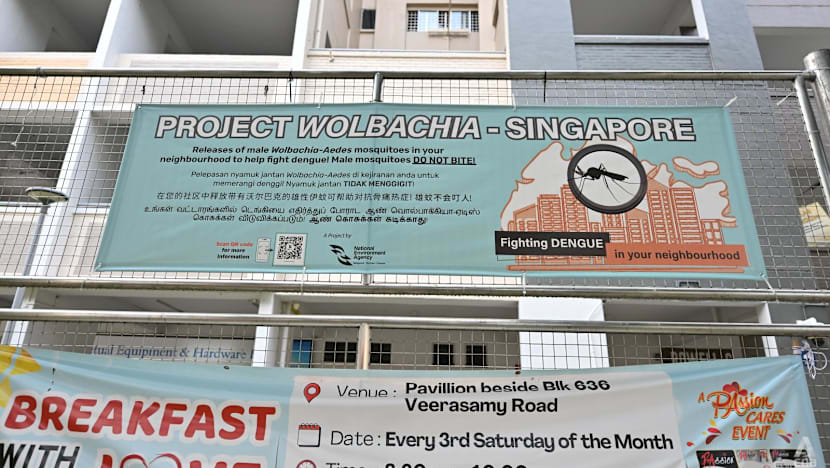
Residents needed reassurance that Wolbachia releases consisted of male mosquitoes that do not bite, and that they can continue with their usual mosquito control measures. It was also important to convey that residents maintain vigilance in preventing mosquito breeding. Success depended not just on the technology, but on sustained community participation.
It also helped not to rush Project Wolbachia from a small pilot directly to nationwide deployment.
A phased approach allowed more time to test safety, refine operational logistics and continue community engagement. Researchers built up their understanding of how mosquito populations respond in different urban settings, how deployment frequency affects outcomes and how residents perceive and accept the intervention.
As mosquito populations and dengue risk fell in intervention areas, public confidence grew.
ALL HANDS ON DECK
Besides engaging the public, scaling up Project Wolbachia across more neighbourhoods required significantly more mosquitoes.
To produce millions of mosquitoes each week, the National Environment Agency’s entomologists and engineers had to develop systems that could operate reliably at scale, including ways to automate mosquito rearing, to sort the males from females and to release them on site.
It also required unprecedented collaboration spanning continents and disciplines.
For example, Michigan State University provided the original Wolbachia-Aedes aegypti strain that made the programme possible. Production capacity and automation solutions developed through partnerships with Orinno Technology and Google Asia Pacific’s Debug demonstrated how public-private collaboration can accelerate public health innovation.
Then comes the data. Data scientists, modellers and epidemiologists analysed large volumes of entomological, epidemiological, and environmental data to ensure the best deployment strategies and rigorous impact evaluation. After that, public health, social science and communications experts at NEA were critical in translating those findings into practical insights and messaging.
The published large-scale trial generated gold-standard evidence that Wolbachia is safe, effective in reducing dengue risk and promotes public health. This led to the endorsement of its use in Singapore by the World Health Organization.
Getting to this point required deep multidisciplinary collaboration and a commitment to investment and expertise, especially when public health innovation rarely fits neatly within short funding cycles or immediate timelines.
BEYOND DENGUE AND MOSQUITOES
Ten years on from the first mosquito release in Braddell Heights, dengue remains a complex challenge shaped by climate, urban density and human mobility. Paradoxically, lower dengue exposure means Singapore has low population immunity and remains vulnerable to outbreaks.
It is why Project Wolbachia was never meant to replace source reduction or community vigilance, but to complement them as part of an integrated national strategy.
But the deeper impact of Project Wolbachia is not just about dengue or mosquitoes. It is about how Singapore turned a scientific possibility into a functional national reality.
Lim Jue Tao is Assistant Professor of Infectious Disease Modelling at the Lee Kong Chian School of Medicine, Nanyang Technological University, Singapore (NTU Singapore).
Tan Cheong Huat is Director of Vector Control and Biology Division and Chong Chee-Seng is Director of Environmental Epidemiology and Toxicology Division at the Environmental Health Institute, National Environment Agency (NEA), Singapore.
Ng Lee Ching is Group Director at the Environmental Health Institute, NEA
Project Wolbachia (ORG)
Singapore (LOCATION)
NTU (ORG)
Lim Jue Tao (PERSON)
NEA (ORG)
Tan Cheong Huat (PERSON)
Chong Chee-Seng (PERSON)
Ng Lee Ching (PERSON)
Braddell Heights (LOCATION)
Wolbachia (PERSON)
the New England Journal of Medicine (ORG)
Wolbachia-Aedes (ORG)
SCIENCE (ORG)
Aedes (PERSON)
Zika (LOCATION)