
Sport
Why do flying ants, bees and beetles keep ending up in your home – and how do you get them out humanely?
Key Points
Why do flying ants, bees and beetles keep ending up in your home – and how do you get them out humanely? Experts explain what attracts bugs indoors, why some species swarm, and the best ways to usher them back outside without harming them. As someone who is squeamish about squashing bugs, any insect (beyond the usual pests such as ants, cockroaches, mosquitoes and houseflies) that visits my apartment often has me in a quandary.
Why do flying ants, bees and beetles keep ending up in your home – and how do you get them out humanely?
Experts explain what attracts bugs indoors, why some species swarm, and the best ways to usher them back outside without harming them.
As someone who is squeamish about squashing bugs, any insect (beyond the usual pests such as ants, cockroaches, mosquitoes and houseflies) that visits my apartment often has me in a quandary. How do I evict it without resorting to chemical warfare?
Also, it would be cool to lure a whole swarm of flying ants out of my home with a reverse Ironman move like what this guy did:
So far, my home’s “exotic” visitor log has included a large, green praying mantis with judgy compound eyes. Once in a while, a dragonfly would appear on the floor right outside my front door. Occasionally, cricket-like bugs that twerk their abdomens like a K-pop starlet would flit into my realm. (I sure hope they are wasps that parasitise cockroaches like this Facebook group said.)
I’m lucky that my estate isn’t home to cicada swarms, like the ones experienced by Tampines residents. Still, it would be nice to know what to do when flying ants, bees and brown beetles that crash into everything – including human heads – drop in.
WHAT MAKES OUR HOME ATTRACTIVE TO INSECTS LIKE BEES AND FLYING ANTS?
Often, bugs show up at your window because of a few predictors: food, shelter and availability of nesting sites, said Dr Hwang Wei Song, the curator of entomology at the Lee Kong Chian Natural History Museum, and a senior lecturer at the Department of Biological Sciences, National University of Singapore. But “more often, they are just passing by and are accidentally trapped by glass windows”, he said.
Many species of bees, for instance, are generally active foragers during the day and will cover a large area in search of food, said Dr Hwang. “If your home has a lot of flowering plants and is near greenery, it is likely that more bees will be attracted to your house.” The presence of food sources such as sugary drinks can also attract bees indoors, noted a Science Centre Singapore (SCS) spokesperson.
At other times, the bees could be in search of new nests. “When a bee colony grows too large and begins to swarm, scout bees may enter homes in search of potential new hive sites,” said SCS, adding that the same goes for bees’ more aggressive cousins, wasps.
“Unfortunately, the very features that make our homes comfortable for us, such as shelter, warmth, and protection from the elements, also make them attractive to bees and wasps,” noted SCS.
Still, it is harrowing to come home to new housemates like this homeowner did (see the Instagram Reel below). Bee rescuer and beekeeper Clarence Chua from The Sundowner Nature Experience Centre, who relocated the hive in the video, said the bees were likely looking for a dark, quiet space to start a new hive. "So probably, the scouts found the kitchen cabinet on a quiet day when there wasn't any human presence," he said.
When it comes to wasps, “there are many different species of wasps in Singapore, so it’s difficult to generalise”, said Dr Hwang. “But the few common wasps that appear in homes are usually looking for suitable nesting sites, such as the potter wasps that build mud nests on walls and windows, or the ensign wasps that dig burrows in the soil of potted plants.”
Then, there's the haphazard flying antics of brown chafer beetles or “gu” as my Hokkien family calls them. From what I’ve been reading, these clumsy, harmless, rotund beetles are also attracted to the great indoors and artificial lights.
The cicadas that recently made the news are more likely to enter homes by accident. “They are naturally drawn to smooth vertical surfaces as these resemble tree trunks in the forest. The walls of our homes can confuse them in this way,” said SCS.
WHAT MAKE SOME INSECTS SWARM?
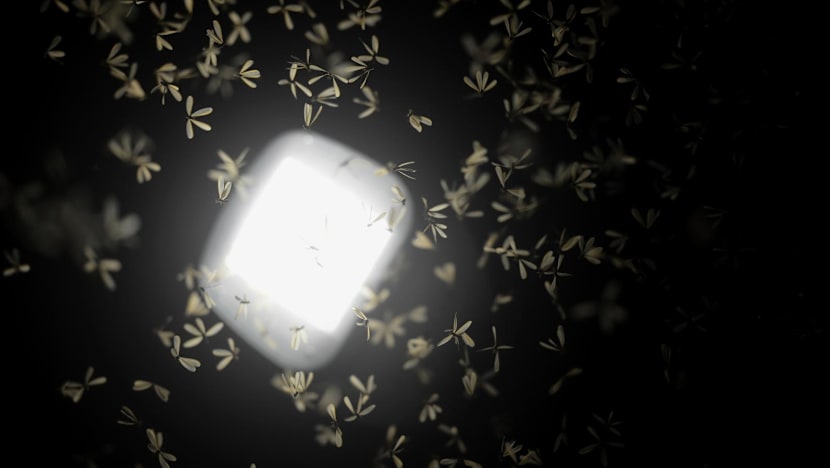
The flying ants (not to be confused with the wood-destroying flying termites) that often arrive en masse “accidentally fly into our homes at night because they mistake our artificial light for moonlight”, said Dr Hwang. “Many flying insects that are active at night use moonlight to navigate towards a common meeting point to mate in the sky.”
SCS explained the phenomenon as the dorsal light response. “In nature, insects orient themselves by keeping their backs towards light sources in the sky such as the moon. Artificial lights disorient insects, so they’ll continuously attempt to tilt their backs towards the light source, causing them to fly erratically and appear to circle around it.”
The swarming in your home can be a nightly affair triggered by the weather. “For example, if there is a long, dry and hot spell, followed by a massive, extended downpour that significantly cools the temperature down by a few degrees, you can expect to have mass emergences of flying ants in the next few evenings,” said Dr Hwang.
But the rain may cool off their amorous pursuits. “Very generally speaking,” he continued, “insects do not fly well under rainy conditions, so you can expect less insect activity on rainy days. As such, we do expect generally less insect activity during cooler monsoonal months and heavier rains.”
Sometimes, some insects can appear in greater numbers due to their developmental cycle or food resource changes, said Dr Hwang. “A good example is the chironomid midges that mass emerge in Pandan Reservoir and Bedok Reservoir due to the food availability during different times in the reservoirs.”
DOES LIVING ON A HIGH FLOOR MEAN FEWER BUG VISITS?
In nature, some flying insects can fly a few kilometres above ground, far exceeding any high-rise buildings, according to Dr Hwang. “But there is often a dilution effect as we go higher up, so homes on higher floors do generally receive fewer bugs.”
You’ll also be glad to know that most flying insects prefer to be nearer to the ground, and closer to suitable habitats or food sources, said Dr Hwang. “For flying insects that are attracted to light, the lower floors will naturally attract the bulk of them before they have a chance to fly higher up.”
WHAT’S THE BEST WAY TO GET THE BUGS OUT?
The trapped insect is probably as anxious as you to get out of your home. “If it’s in the day, open as many windows and doors as possible to let them to fly out themselves,” said Dr Hwang. “Guidance by sunlight is the easiest.”
For insects that are less keen on flying, are exhausted or injured, or sleepy, Dr Hwang suggested transferring them into a small container first. Then, bring the trapped insect out of the household to set it free.
“At night, for insects that are attracted to light, the easiest method would be to open all the windows, switch off all the light sources temporarily, and guide the struggling insect out,” said Dr Hwang. “If there are any early signs of mass flying ants, it would be best to close the windows or draw the curtains as much as possible to keep them out.”
What about that neat trick of using a lit handphone’s screen to lure flying ants out? “It would be possible to attempt that method,” said SCS’s spokesperson. Similarly, by switching off the lights in the room, where the flying ants congregate, and turning on the lights in another room, you can also lure the bugs out.
To keep the bugs out, SCS’s tip is to install window meshes. “Certain essential oils and spices may also help deter insects, including peppermint oil, vinegar and cinnamon,” said its spokesperson. They work by overwhelming the insects' senses with strong scents, rather than killing them.
If you're using essential oils, add 10 to 20 drops to water in a spray bottle and shake well; or use a diffuser. For vinegar (the vinegar smell will dissipate as it evaporates), mix equal parts white vinegar and water in a spray bottle. Then, spritz the essential-oil or vinegar mixture on windowsills and door frames; repeat every few days. Don't use certain essential oils if you have pets, and avoid spritzing directly onto furniture and fabrics to avoid discolouring them.
One thing to note when you report bee or wasp hives to the authorities or pest exterminators is that they will be killed. Consider contacting local professional beekeepers such as Nutrinest and Anticimex instead, who provide humane bee relocation services.
“Generally, removing or depriving the cues which the insects are drawn to could make homes less attractive to them,” said Dr Hwang. “However, it is easier said than done because different insects are attracted to different cues and some of these factors, such as greenery, are appealing to humans as well.”
A more meaningful approach, he said, is to understand and identify whether it is an urban ecological problem or a part of living close to nature.