
UK News
Former elite soldier sues Ministry of Defence for £75k claiming hearing was damaged during the Troubles
Key Points
Former elite soldier sues Ministry of Defence for £75k claiming hearing was damaged during the Troubles William Isherwood alleges he was provided with sub-standard ear protection - Bookmark A former elite soldier is suing the Ministry of Defence for over £75,000, claiming his hearing was permanently damaged during his 16-year military career. William Isherwood alleges that inadequate protection during training for riot duty in Northern Ireland during The Troubles led to his injuries. Mr...
Former elite soldier sues Ministry of Defence for £75k claiming hearing was damaged during the Troubles
William Isherwood alleges he was provided with sub-standard ear protection
- Bookmark
A former elite soldier is suing the Ministry of Defence for over £75,000, claiming his hearing was permanently damaged during his 16-year military career.
William Isherwood alleges that inadequate protection during training for riot duty in Northern Ireland during The Troubles led to his injuries.
Mr Isherwood, whose regiment, the Irish Guards, is known for protecting the Royal Family, claims that he was exposed to the deafening roar of helicopters, heavy gunfire, rockets, and explosions without proper ear defence.
He alleges that sub-standard ear defender plugs either fell out or were not issued at all during his service.
Mr Isherwood, who left the Army in 1999, has now launched legal action, citing lasting reduced hearing, persistent tinnitus, and heightened sensitivity to certain types of sound as a direct result of his service.
However, MoD lawyers are contesting his claim, arguing that his ear defenders were “reasonable and suitable” and that it is impossible to “police the wearing of hearing protection at all times”.
According to documents filed at the High Court, Mr Isherwood, now 60, of Widnes, Cheshire, joined up in 1983 and did his basic training at Pirbight, in Surrey, before joining the Irish Guards and serving initially in Germany.
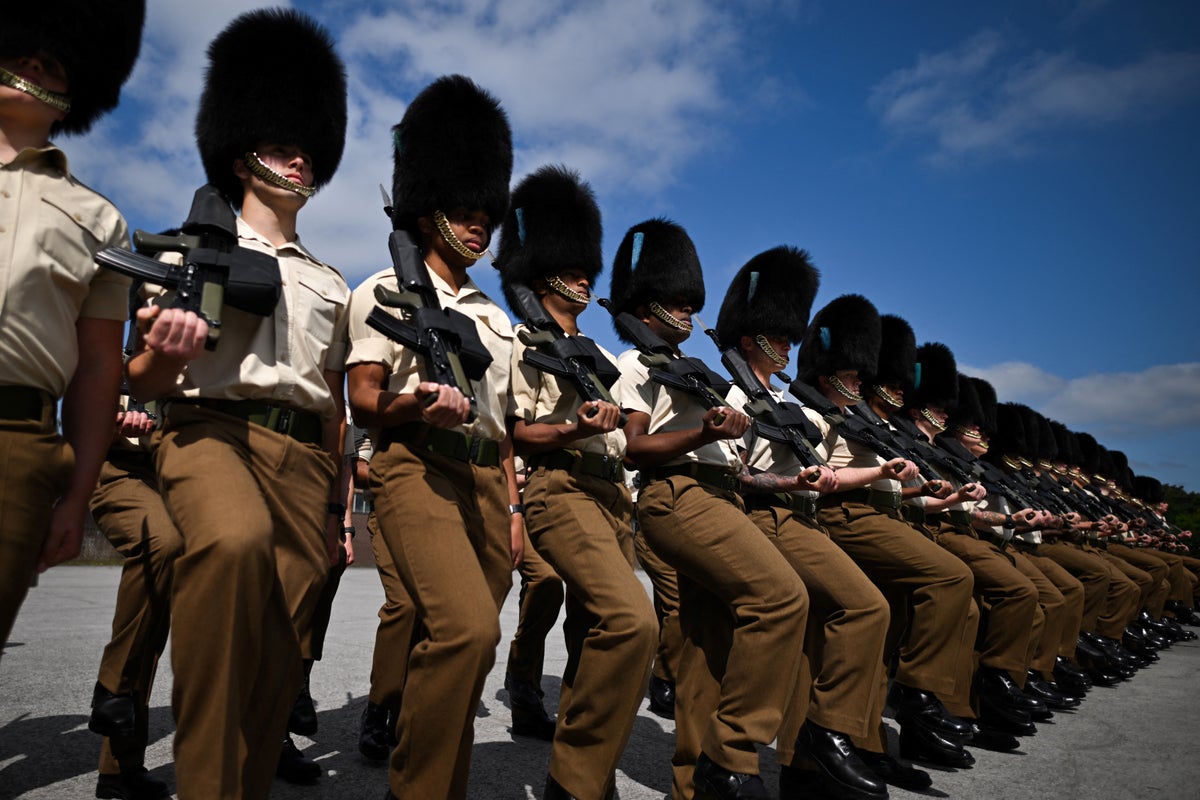
The Irish Guards – known in the forces as “The Micks” – are an elite infantry regiment of the British Army, which was formed by Queen Victoria in 1900 and perform a dual role as front-line combat soldiers and ceremonial guards for the Royal Family.
After some time performing ceremonial duties back in the UK, he served in Belize before conducting a tour of Northern Ireland in 1992 and later working as a physical training instructor at Chelsea Barracks until he left in 1999.
The ex-guardsman says the din from weaponry kicked off soon after he commenced basic training when he became familiar with a range of noisy firearms – including an SLR infantry assault rifle, Browning pistol, and general purpose machine gun which could fire up to 1,000 rounds per minute.
And although recruits were issued with ear defenders, his lawyers say they were generally sub-standard and liable to fall out during use.
Mr Isherwood says there was a respite from the intrusive noise during “ceremonial duties” as part of the royal bodyguard, but the exposure picked up again during his later years of service.
“The period back at Pirbright before touring Northern Ireland was noisy,” explained his barrister, Philip De Berry, in court documents.
“He went through pre-deployment training for Northern Ireland, which involved riot training, fighting in built up areas training, ambush exercises and various other scenarios.
“In Northern Ireland, the main exposure to noise came when the claimant was transported by helicopter – Chinook or Puma.
“This would be a few times per week. No hearing protection was provided or used.
“The main exposures during basic training involved using the range to fire weaponry and participating in field exercises.
“The claimant’s weapon was the SLR. He was also introduced to the GPMG, the Sterling machine gun and the Browning 9mm pistol.
“Further exposure came from training with grenades and the use of pyrotechnics during exercises.
“On the range, the claimant and his colleagues would each fire several magazines. Many more rounds would be fired using the general purpose and sub-machine guns.
“Green ear defenders or push-in ear plugs were available. The ear plugs would frequently fall out. Both types of ear protection were poor quality.
“Exercises typically involved firing blanks and exposure to pyrotechnics. Hearing protection was generally not used and a range of weaponry was used.”
Mr Isherwood alleges negligence on the part of the MOD in failing to provide effective ear protection, failing to carry out proper noise assessments and failing to test his hearing adequately.
Overall, his lawyers say the MoD “caused or permitted the claimant to be exposes to a harmful level of noise which damaged his hearing”.
Described by his lawyers as “both disabled and disadvantaged in the open labour market”, he is also a likely candidate for hearing aids due to his condition, it is claimed.
But the MoD is denying liability for any ear damage he may have sustained, insisting that his superiors did everything possible to minimise risks, that lethal weaponry is “inherently noisy”, and that in the context of realistic combat training “noise exposure cannot be reduced to zero”.
“The defendant was obliged to provide the claimant with demanding and realistic training which accurately – so far as possible « emulated the theatre of war,” said MOD barrister, Dominic Collingwood, in its defence to the claim.
“Accordingly, training exercises took place over large areas and for extended periods of time. They involved the use of weapons, pyrotechnics and explosives to mimic combat conditions.
“Close supervision so as to ensure the wearing of hearing protection at all times is impossible in many training scenarios.
“Training would take place across large geographical areas, at night, or in other circumstances when it would be difficult to see if hearing protection was being worn.
“Further, training would involve fast-moving combat-type situations in which it would be both invidious to the training objective and, frankly, impossible, to stop and check the wearing of hearing protection at frequent intervals.”
He added: “During training exercises, as on operations, members of the armed forces, including the claimant, needed to be able to communicate with each other and to maintain situational awareness.
“If noise exposure were reduced – by the provision of hearing protection – to such levels that situational awareness was lost and/or communication was compromised, operational capability would be significantly affected and the claimant and/or his colleagues, would be put at risk.
“The need for situational awareness is shared across the armed forces and its loss can compromise safety either in a combat situation or during training. Accordingly, noise exposure cannot be reduced to zero.”
As well as denying any fault, the MoD denies any link between weapons firing and Mr Isherwood’s condition and argues that his claim is “time-barred” anyway, as he has left it too late to sue.
On top of that, his hearing was routinely tested in line with the Army’s “programme of health surveillance”, said the barrister.
The trial of Mr Isherwood’s claim against the MoD has yet to reach court.
Ministry of Defence for £75k (ORG)
William Isherwood (PERSON)
the Ministry of Defence (ORG)
Northern Ireland (LOCATION)
Isherwood (PERSON)
the Irish Guards (ORG)
the Royal Family (ORG)
Army (ORG)
the High Court (ORG)
Widnes (LOCATION)
Cheshire (LOCATION)
Pirbight (PERSON)
Surrey (LOCATION)
Germany (LOCATION)
the British Army (ORG)