
Business & Finance
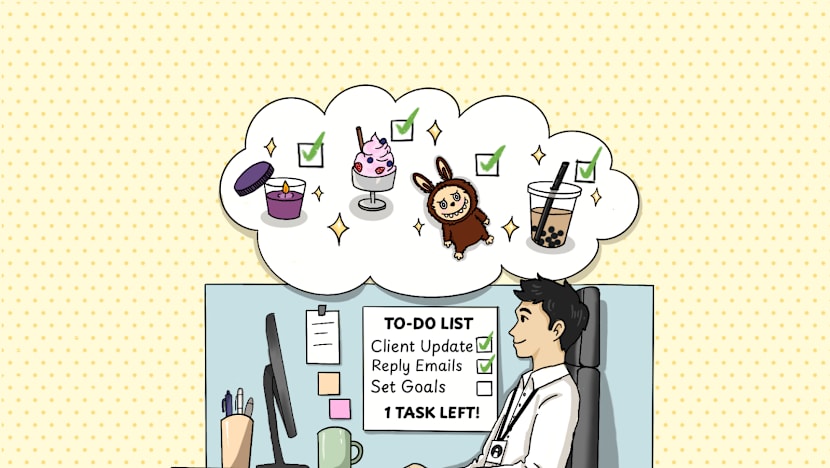
Sure, buy yourself a latte, but don't tell me you earned it by answering emails
Key Points
Sure, buy yourself a latte, but don't tell me you earned it by answering emails Everybody splurges on a little treat for themselves every now and then. But when does the occasional indulgence cross the line of being too frequent, CNA TODAY's Taufiq Zalizan wonders. I was raised in a frugal, single-income family.
Sure, buy yourself a latte, but don't tell me you earned it by answering emails
Everybody splurges on a little treat for themselves every now and then. But when does the occasional indulgence cross the line of being too frequent, CNA TODAY's Taufiq Zalizan wonders.
I was raised in a frugal, single-income family. Growing up, treats from my parents were infrequent and usually took the form of modest meals out.
Given our family circumstances, my parents always impressed upon me the importance of savings.
Consequently, as a child, I always felt a greater sense of achievement from emptying a full piggy bank to deposit into my savings account than from opening a newly-bought toy package.
Not that I'd go so far as to say that I had a deprived childhood, just a less indulgent one than many of my peers.
Even when I started earning my own money, I did not quite develop the habit of treating myself.
The first time I ever celebrated a major milestone in my life by treating myself was when I passed probation at my first job, when I was almost 25 years old.
What did I buy? A S$20 (US$15.50) watch with a brown, faux-leather strap at a shop in my office building that I chanced upon during lunchtime.
And now that I'm in my mid-30s, this is one trait that has stayed unchanged over the years. Or at least, I'd like to think so.
Given my upbringing and my frugal tendencies, imagine my surprise when I started hearing the term "little treat" or "treat culture" being tossed around casually among younger friends and colleagues, as if it were the most normal thing to do.
While my initial instinct was to worry about how much they were spending and whether the money could be better spent elsewhere, I eventually realised I was more worried about the underlying motivation.
Do we really need to rely on the sweet promise of a little treat just to get through the day and do the things that we should do?
A REWARD FOR EVERYTHING?
To be clear, I'm not entirely against the idea of treating yourself.
A quick holiday to feel better after going through a particularly rough patch in life or at work? I understand that. Buying a little gift as a tangible memento to commemorate a milestone? It makes sense to me.
From what I gather, though, four in 10 Gen Zers indulge in little treats a few times a week, and one in 10 makes it a daily ritual – all in the name of self-care. These treats could come in the form of expensive gourmet coffee, a lip balm, a scented candle or even a collectable doll like a Labubu.
Treating myself to a S$14 frozen yoghurt for getting through half a day at work? Or splurging on a collectable toy for sweeping the house? I'll admit that I struggle to relate.
When I asked some of my younger colleagues who partake in this culture, they said they do it to motivate themselves to get through tasks they particularly dislike.
And this is the part that worries me. Already, we are surrounded by things that condition us for instant gratification – short-form videos over full-length dramas, and food delivery at the tap of a button instead of spending time and effort cooking up a storm.
Have some of us become so uncomfortable with discomfort itself that we resort to little treats just to cope?
And if we are expecting a treat at the end of every unpleasant chore, what happens when there is none?
MY OWN VERSION OF A LITTLE TREAT
Then again, it would be unfair of me to pretend that I am somehow above spending money on things I do not strictly need.
I do enjoy a nice cup of coffee occasionally – like a S$6 latte from the cafe downstairs when I get tired of the free one at the office pantry.
And I recently enjoyed a S$12 affogato, the Italian dessert, with a friend after dinner without feeling guilty about it, either.
But, you see, that's how I have always justified it to myself: Spending a little more only on occasions where I'm out with friends, not as a frequent expensive pat on the back.
If it sounds like I'm taking the moral high ground, I have a confession. The truth is that I have my own version of a regular little splurge: taking private-hire cars to get around.
I've never justified giving myself these rides as a reward for folding laundry or answering emails, but it is still discretionary spending all the same.
I also don't actively budget. Instead, I go by feel and decide it's time to cut down on spending only after checking my banking app every now and then.
It is, admittedly, not a good system. Which is why I was genuinely a little humbled when I learnt that a significant portion of younger spenders I was judging actually set aside a budget for their little treats.
Compared with my vibes-based approach, that sounds considerably more disciplined.
Maybe the question isn't about whether spending on ourselves is problematic, but whether we're doing it intentionally.
After all, a Gen Z worker who budgets for a weekly latte may be exercising more discipline than someone like me, who takes private-hire cars whenever the mood strikes.
AM I READING TOO MUCH INTO THINGS?
It is one thing for a person to buy themselves small rewards to get through a difficult day.
But now, this habit is being enthusiastically celebrated online, and it can sometimes feel as though every small task completed warrants more spending.
To be fair, the younger generation did not invent this phenomenon.
Some have likened this "little treat" culture to the "lipstick effect" – the tendency for people to indulge in small luxury goods, particularly during economic downturns, because they are more attainable than other big-ticket purchases.
The difference, perhaps, is that today's "little treat" culture is actively packaged as self-care rather than occasional indulgences – a framing that can make it difficult to question.
Of course, perhaps I'm reading too much into it. There are people who buy themselves a treat, like dessert, after a long day, without believing they deserve a medal for responding to emails.
And I certainly do not think less of my younger friends for spending money on things that make them happy.
Still, I am unconvinced by the notion that we deserve a reward for every small hardship. Maybe that says more about me than it does about them.
In the meantime, I think I'll spend a little more time reading up on "little treat" culture before making up my mind.
Or maybe I won't. Depends on whether there's a S$6 latte in it for me at the end of it.
Taufiq Zalizan is a senior journalist at CNA TODAY.