
Science
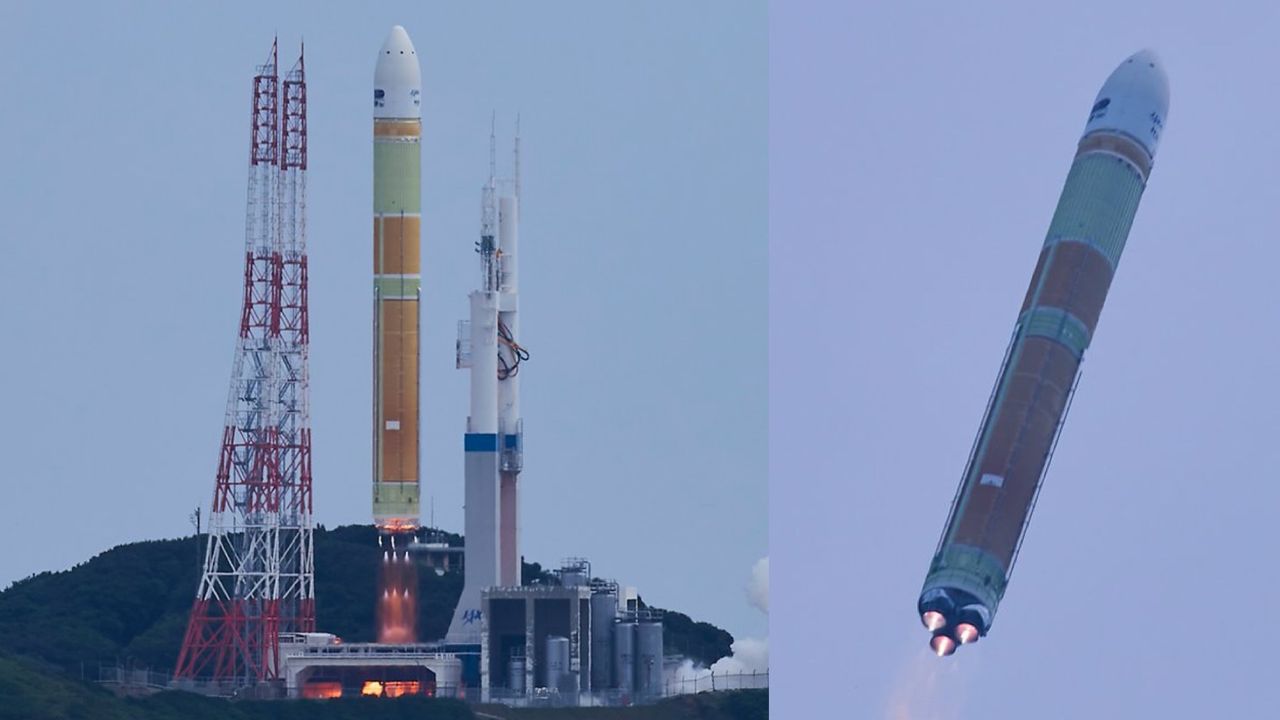
Japan's H3 rocket bounces back from failure with successful return to flight launch carrying 6 satellites
Key Points
Japan's H3 rocket bounces back from failure with successful return to flight launch carrying 6 satellites H3 has made a triumphant return. The Japan Aerospace Exploration Agency, JAXA, has successfully launched its H3 rocket on its first flight since a failure of the vehicle last December, which resulted in the loss of its payload. Liftoff occurred on Thursday (June 11), just before 8:54 p.m. EDT (0054 GMT), from the Tanegashima Space Center on the southeastern tip of Japan.
Japan's H3 rocket bounces back from failure with successful return to flight launch carrying 6 satellites
H3 has made a triumphant return.
The Japan Aerospace Exploration Agency, JAXA, has successfully launched its H3 rocket on its first flight since a failure of the vehicle last December, which resulted in the loss of its payload.
Liftoff occurred on Thursday (June 11), just before 8:54 p.m. EDT (0054 GMT), from the Tanegashima Space Center on the southeastern tip of Japan. It was H3's eighth-ever liftoff, and the first flight of the rocket's three-engine configuration, which delivered all six of its payloads to their respective orbits, according to a JAXA release.
H3 failed to deliver its payload, the Michibiki 5 satellite, during its last mission. The cause was ruled to be a damaged payload adapter, according to a JAXA investigation earlier this year, which led to the loss of the satellite and damage to the second stage's propellant tanks, causing ignition problems with the vehicle's engine. H3's first launch of 2027 went much smoother.
"The rocket flew as planned, successfully placing the second stage into its designated orbit, and separating PETREL and STARS-X approximately 16 minutes and 4 seconds after launch," the JAXA release said, and also confirmed the nominal separation of the BRO-22, VERTECS, HORN-L and HORN-R payloads.
H3 is a two-stage rocket designed as the successor to JAXA's H-2A, which was retired last year. It was developed by JAXA and Mitsubishi Heavy Industries, and is powered by LE-9 engines.
Yesterday's JAXA launch was the first H3 rocket to fly three of those engines, as opposed to the two-engined configuration it has relied on for previous launches. H3 had a rough start after its debut. H3 launched five successful missions before its mishap last December, but failed during its first-ever launch in March 2023.
The rocket's success on this most recent flight hopefully put the vehicle back on course for more nominal missions ahead.
"Thank you for your support and cheers," Tanegashima Space Center said in a post on X after the mission. "Please continue to cheer for the H3 Rocket going forward."
You must confirm your public display name before commenting
Please logout and then login again, you will then be prompted to enter your display name.
Josh Dinner is Space.com's Spaceflight Staff Writer. He is a writer and photographer with a passion for science and space exploration, and has been working the space beat since 2016. Josh has covered the evolution of NASA's commercial spaceflight partnerships and crewed missions from the Space Coast, NASA science missions and more. He also enjoys building 1:144-scale model rockets and spacecraft. Find some of Josh's launch photography on Instagram, and follow him on X, where he mostly posts in haiku.
Japan (LOCATION)
H3 (ORG)
The Japan Aerospace Exploration Agency (ORG)
JAXA (PERSON)
the Tanegashima Space Center (ORG)
Michibiki (ORG)
PETREL (ORG)
VERTECS (ORG)
HORN-L (ORG)
H-2A (LOCATION)
Mitsubishi Heavy Industries (ORG)
Tanegashima Space Center (ORG)
Josh Dinner (PERSON)
Space.com (ORG)
Spaceflight Staff (ORG)