
Education
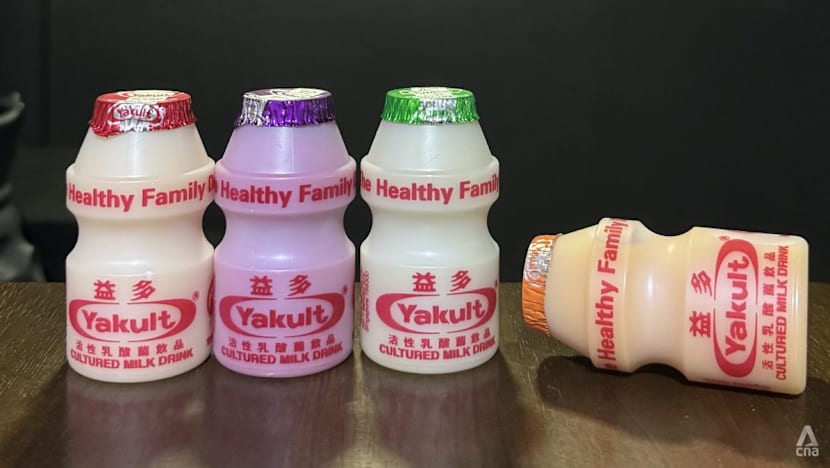
Less than peachy: Why Orange Yakult fans are mourning a classic
Key Points
Less than peachy: Why Orange Yakult fans are mourning a classic Experts say the strong reaction to Orange Yakult's impending discontinuation is less about the drink itself and more about the memories and routines it represents. SINGAPORE: “I’ll defend orange until the end,” wrote one netizen after Yakult announced this week that it would be replacing its orange-flavoured drink with a peach variant. The move, which marks Yakult's first major change to its flavour line-up in Singapore since...
Less than peachy: Why Orange Yakult fans are mourning a classic
Experts say the strong reaction to Orange Yakult's impending discontinuation is less about the drink itself and more about the memories and routines it represents.
SINGAPORE: “I’ll defend orange until the end,” wrote one netizen after Yakult announced this week that it would be replacing its orange-flavoured drink with a peach variant.
The move, which marks Yakult's first major change to its flavour line-up in Singapore since 1980, sparked spirited debate online.
While some welcomed the arrival of a new flavour, others lamented the loss of a drink they had grown up with.
The reaction raises a question: why do people get so emotional when a familiar food or drink disappears from the shelves?
Think KFC's Fish Ole burger, or 7-Eleven’s Mr Softee and mashed potatoes.
Experts say the reaction to Orange Yakult's impending discontinuation is less about the drink itself and more about what it represents.
Professor Sharon Ng, deputy dean of Nanyang Technological University (NTU)'s Nanyang Business School, said food and beverage products are highly tied to people's memories and identities. That’s especially so for a brand like Yakult, which is particularly associated with childhood.
"Taking it away may feel like a loss of a part of our memory," said Prof Ng, whose speciality is consumer behaviour.
As a result, consumers mourn what the product represents to them rather than the product itself.
Such feelings of nostalgia can persist even if people do not consume that particular product regularly, she added.
Drawing on her own experience, Prof Ng recalled buying cartons of Yeo's drinks while living in the United States because they reminded her of Singapore, even though she rarely drinks them now.
"But will I be sad if Yeo’s stops producing the local drinks? I think I would," she said
Beyond nostalgia, consumers may also be reacting to the change itself.
GONE, BUT NOT FORGOTTEN
KFC's Fish Ole burger
The Fish Ole burger was removed from KFC's menu less than a decade ago, but it continues to surface in many online discussions. In 2023, a petition was launched calling for the burger's return.
7-Eleven's Mr Softee and mashed potatoes
The Mr Softee ice cream and the instant mashed potatoes remain among the convenience chain's most missed food items. Such was the demand for Mr Softee that 7-Eleven brought it back a few years ago. It is now available at selected outlets islandwide.
Anything and Whatever drinks
Launched in 2007 and discontinued three years later, the canned drinks were known for their "blind-box" concept - consumers would not know exactly which flavour they were getting. The brand was backed by an advertising campaign, still memorable to many, that poked fun at people asking for "anything" or "whatever" to drink.
McDonald's milkshakes
Previously available only at outlets with dessert kiosks, the milkshakes came in vanilla, strawberry and chocolate flavours and were removed from the menu in 2024. Earlier this year, McDonald's launched the berry-flavoured Grimace Shake for a limited time.
Valley Chef chicken franks
A common fixture in many Singaporean households, the frozen hot dogs disappeared from retailers in 2022, only to return two years later after much outcry.
Associate Professor Chan Kai Qin, a senior lecturer at James Cook University who specialises in psychology, said that people tend to dislike disruptions to familiar routines, citing the status quo bias - a preference for keeping things the way they are.
Considering Yakult has been a fixture in Singapore for decades, any departure from the familiar was bound to trigger a reaction, he said.
The backlash may also be explained by loss aversion, a concept that suggests people feel the pain of losing something more strongly than the pleasure of gaining something new.
Consumers may not view the new peach flavour as a “real gain”, he said, as Yakult's competitor Vitagen already offers a peach-flavoured probiotic drink.
“What they are gaining isn't a new experience; it's a familiar brand name that has acquired a flavour familiar to them already,” Dr Chan said.
“If people really wanted peach, they would have bought Vitagen,” he said.
According to Yakult Singapore, the orange flavour will be replaced due to "production capacity constraints at our Singapore factory".
The company added that consumer demand also played a role in the decision, noting that peach was among the flavours most frequently requested by customers in Singapore and has proven popular in other markets.
But clearly, not everyone is convinced.
One netizen wrote: "My disappointment is immeasurable and my day is ruined."
MORE THAN JUST A DRINK
The reaction to Orange Yakult’s fate also highlights how products often attract the most attention when they are about to disappear.
Associate Professor Chen Lou from NTU's Wee Kim Wee School of Communication and Information, said that products can take on greater value in consumers’ mind once their availability is threatened.
"Scarcity increases perceived value. People often want something more when they realise they may no longer be able to get it," said Assoc Prof Chen, who specialises in consumer psychology and advertising effects.
The discontinuation of a product can sometimes generate even more interest than the product itself once did.
"Discontinuation can spark nostalgia, conversations and media attention, sometimes making the product more culturally relevant than before," she added.
Dr Chung Seh Woong, a senior lecturer in the marketing programme at the Singapore University of Social Sciences, pointed to Coca-Cola's New Coke episode in 1985 as one of the most famous examples of how a product's disappearance can generate attention.
After Coca-Cola replaced its original formula with a new version, consumers reacted with protests, stockpiling and complaints, eventually forcing the company to bring back the original drink as Coca-Cola Classic.
"People felt their cultural property had been taken from them," Dr Chung said.
"The relaunch generated enormous free publicity and arguably strengthened loyalty to the original formula more than any campaign could have."
Dr Chung said the same phenomenon could be observed in the reaction to Yakult’s announcement.
"Absence creates narrative, and narrative creates relevance," he said.
"The orange Yakult is now a story, not just a SKU (stock-keeping unit),” he added.
But Dr Chung cautioned that deliberately engineering scarcity as a marketing tactic can backfire.
"On the plus side, engineered scarcity gets people talking in a way that paid advertising rarely does," he said.
Dr Chung pointed to McDonald's Prosperity Burger, which is typically available only around Chinese New Year. People would look forward to it each year in a way that they never would if the item was always on the menu, he explained.
However, the strategy only works if consumers believe the scarcity is genuine.
"Today's consumers are savvy, and if something smells like a stunt, it usually gets called out,” Dr Chung said.
He noted that Coca-Cola has long denied that the New Coke episode was a deliberate publicity stunt, but suspicions have persisted even today.
However, Yakult's situation appeared different, Dr Chung added, as the discontinuation seemed to be a straightforward business decision.
"That is why people are sad rather than suspicious," he said.
"That kind of genuine reaction is hard to fake."