
Science
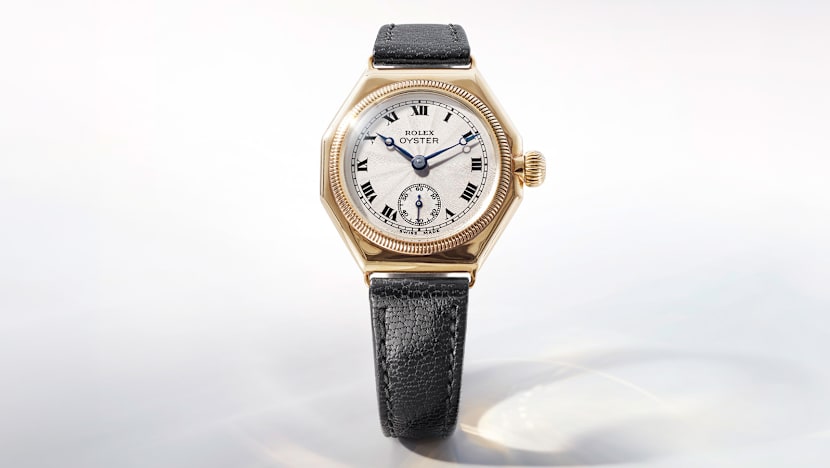
How a century of engineering shaped the modern wristwatch
Key Points
THE OYSTER EVOLUTION When the Rolex Oyster arrived in 1926, it made the wristwatch more reliable, robust and practical. A century on, it still shapes what comes next. I N the mid-1920s, the wristwatch was still finding its place.
THE OYSTER EVOLUTION
When the Rolex Oyster arrived in 1926, it made the wristwatch more
reliable, robust and practical. A century on, it still shapes what comes next.
I
N the mid-1920s, the wristwatch was still finding its place.
Pocket
watches remained
the trusted instruments of precision, while wristwatches were smaller, more exposed
and often dismissed as ornamental. Rolex founder Hans Wilsdorf saw not a limitation, but a
challenge to solve through innovation.
Introduced in 1926, the Rolex Oyster was his answer. By improving
protection, reliability and
autonomy, Wilsdorf helped shape the modern wristwatch: a dependable object made to tell
time and keep pace with its wearer. A century later, the Oyster story continues to evolve,
from its original waterproof case to increasingly demanding standards of certification,
precision and durability.
A wristwatch had to earn
its place
Wilsdorf believed otherwise. Long before the Oyster, Rolex had pursued chronometric precision with unusual determination. In 1910, a Rolex wristwatch received a chronometric certificate from the Official Watch Rating Centre in Bienne, Switzerland, proving it could be as precise as a pocket watch. Four years later, another Rolex wristwatch earned a Class A precision certificate from Britain’s Kew Observatory, an accolade previously reserved for marine chronometers.
But precision alone was not enough. For the wristwatch to become practical for everyday life, it also needed protection. In 1926, Rolex introduced the Oyster, the world’s first waterproof and dustproof wristwatch. Its bezel, case back and winding crown were screwed tightly against the middle case, creating a hermetically sealed environment for the movement.
The name made the premise clear: Like an oyster’s shell, the case could be submerged in water and remain impervious to the elements. There was no need to remove the watch in the rain, in a dusty workshop or while washing one’s hands. Waterproofness moved from a radical claim to a basic expectation.
Waterproofness was about trust
The sealed case was the claim, but it still needed proof.
For Wilsdorf, that proof had to
come from the field, not just the laboratory. Waterproofness was a promise of
reliability, and credibility had to be demonstrated in the real world.
That philosophy found its defining moment in 1927, when British swimmer Mercedes
Gleitze
crossed the English Channel wearing a Rolex Oyster. After more than 10 hours in freezing
waters, the watch emerged still working and keeping perfect time.
Over the decades, the Oyster’s reputation was forged across deserts, oceans, mountains and skies. British racing motorist Sir Malcolm Campbell wore a Rolex Oyster when he broke the 300mph (483kmh) land speed barrier in 1935. US Air Force test pilot Chuck Yeager wore one when he became the first person to break the sound barrier in 1947. These experiences informed Rolex engineering, turning shocks, pressure changes and temperature shifts into lessons for the manufacture.
From sealed case to everyday machine
Although the Oyster solved waterproofness, one
inconvenience remained. Like all watches
of the era, it still required regular manual winding. For an everyday companion, that
dependency was a constraint.
In 1931, Rolex addressed it with the Perpetual rotor – a patented self-winding system
in which
a freely rotating rotor, moved by the wearer’s wrist, continuously wound the mainspring.
The
watch drew energy from being worn, reducing the need for manual winding.
Rolex helped lay the foundations for the modern mechanical wristwatch. As the Oyster evolved into the Oyster Perpetual, the idea of an effortless everyday luxury watch became a reality. The wider industry would later adopt the free-rotor self-winding system as standard practice, but Rolex was among the pioneers that refined it into a practical everyday solution.
TOGETHER, THE SEALED OYSTER CASE AND
PERPETUAL ROTOR TRANSFORMED THE WRISTWATCH
INTO A MORE AUTONOMOUS MACHINE.
An original that continues to evolve
From that first waterproof case came a defining watch
family. The Oyster became the
foundation for models that shaped specific categories: the GMT-Master for travel across
time
zones, the Submariner for underwater exploration, the Cosmograph Daytona for motorsport
and the Yacht-Master for nautical adventures. Each remained rooted in Rolex’s 1926
principles of precision, reliability, robustness and practicality.
This continuity helps explain the Oyster’s relevance. Over
the decades, its case evolved
through Twinlock and Triplock crown systems that strengthened waterproof integrity under
more demanding conditions. Innovations such as Paraflex shock absorbers, Cerachrom
bezels
and corrosion-resistant Oystersteel advanced its resilience for modern life.
For the Oyster’s 100th anniversary this year, Rolex turns to the Oyster
Perpetual, one of the
clearest expressions of its watchmaking identity. The commemorative Oyster Perpetual 41
is presented in yellow Rolesor, pairing a yellow gold bezel and winding crown with an
Oystersteel case and bracelet – a nod to the case elements of early Oyster watches. On
the
slate dial, the “100 years” inscription replaces “Swiss Made” at 6 o’clock, while the
number
“100” appears on the winding crown. Accents in Rolex’s emblematic green complete the
centenary tribute.
A legacy moving forward
For the Oyster’s centenary, Rolex is raising the standards it sets for the
watch itself. This
year, its Superlative Chronometer certification expands from four testing criteria to
seven. Precision, waterproofness, self-winding and power reserve are joined by reliability,
sustainability and resistance to magnetism. These criteria now apply across design and
manufacturing. Symbolised by Rolex’s green seal and overseen by internationally recognised
independent Swiss entities, the certification offers a broader measure of each watch.
Rolex is also extending its pursuit of precision through optical atomic clocks, which use
quantum physics to achieve timekeeping accuracy beyond previous standards available to a
watch manufacture. These instruments will contribute to the international framework that
defines coordinated universal time (UTC).
Wilsdorf once said of the Oyster: “It had the entire future and the whole world open before it.” A century later, the modern wristwatch still bears the influence of that idea.
WATCH THE OYSTER STORY
See how the Rolex Oyster’s past continues to shape the future of mechanical
watchmaking.