
Technology
High Time: Watchmakers turn to rare metals, lab-grown crystals and ultra-light composites
Key Points
Rolex has long approached material innovation through in-house expertise rather than overt experimentation. At its Geneva foundry, the brand develops and casts its own 18k gold alloys, refining colour, purity and consistency from the start of production. One example is Everose gold, its patented 18k pink gold alloy introduced in 2005.
Rolex has long approached material innovation through in-house expertise rather than overt experimentation. At its Geneva foundry, the brand develops and casts its own 18k gold alloys, refining colour, purity and consistency from the start of production. One example is Everose gold, its patented 18k pink gold alloy introduced in 2005. Created to resist the fading associated with traditional rose gold, the alloy combines gold, copper and trace elements, including palladium, to preserve its warm tone over time.
That expertise now appears in Jubilee Gold, debuting on the Oyster Perpetual DayDate 40. The watch pairs the exclusive 18k alloy with a bright green aventurine dial, an hour circle of 10 baguette-cut diamonds, a fluted bezel and the President bracelet, reserved for Day-Date references and precious metal versions of the Datejust. Where Everose gold was engineered for durability and colour stability, Jubilee Gold focuses on tonal variation, shifting between yellow, grey and pink depending on the light.
Beyond alloys, Rolex has also developed deep expertise in special ceramics for specific watch-case components, particularly monobloc bezels and bezel inserts. Introduced in 2005, Cerachrom is the brand’s proprietary ceramic bezel material, valued not only for its scratch resistance, but also for its intense colour, resistance to environmental effects and ability to remain inert and corrosion-resistant.
On the latest Oyster Perpetual Cosmograph Daytona, this expertise takes on a new expression with the model’s first Rolesium configuration, combining Oystersteel and platinum. Paired with a white grand feu enamel dial, the 40mm timepiece features an anthracite Cerachrom bezel. The bezel is made from a specific type of ceramic composed of zirconia enriched with tungsten carbide – a composition for which a patent application was filed. The result is a striking metallic gleam, while the moulded, recessed tachymetric scale markings are coated with platinum via PVD, adding another layer of material precision to the watch.
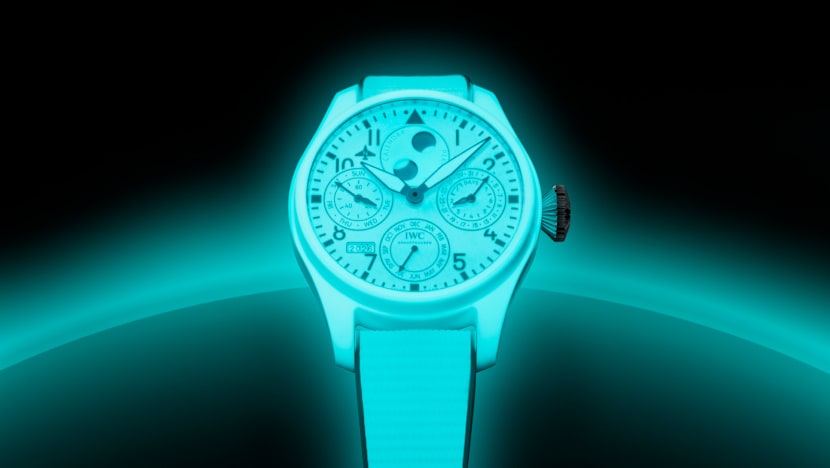
Where Rolex enriches ceramic with tungsten carbide, IWC Schaffhausen makes it glow. Ceralume, a luminous ceramic technology developed over several years by the brand’s XPL experimental division with support from RC Tritec, a Swiss specialist in Super-LumiNova pigments, takes material innovation in another direction. Featured on the Big Pilot’s Watch Perpetual Calendar Ceralume, the material allows the 46.5mm watch to emit an intense bluish glow in darkness for more than 24 hours.
Ceralume is made by adding Super-LumiNova pigments to ceramic raw materials. The compound absorbs energy from sunlight or artificial light, then re-emits it as visible light in a repeatable cycle. The challenge was achieving a uniform blend between pigments and ceramic raw materials, which react differently during production. IWC addressed this with a dedicated ball-milling process, producing a stable material that stores and releases light evenly across the case.
The luminous effect extends throughout the watch. The dial and rubber strap are also enhanced with Super-LumiNova pigments, while indices, numerals and grey hands receive their own luminous treatment. In daylight, the 250-piece limited edition appears understated in white and grey. In darkness, the watch glows from nearly every angle.
Beyond metallurgy and ceramics, some watchmakers are turning to materials more commonly associated with gemstones and crystallography. For Hublot, that material is osmium, a hard, brittle, bluish-white platinum-group metal showcased in the Spirit of Big Bang Impact Sapphire. Considered the scarcest non-radioactive precious metal in the earth’s crust, osmium yields only about 30g from 10,000 tonnes of platinum ore, making it around 1,500 times rarer than gold and 2,500 times rarer than silver.
In its raw state, osmium is toxic and difficult to handle. A crystallisation process developed with scientists in Valais, Switzerland, transforms it into a stable, body-safe crystal with a metallic shimmer. Hublot has used crystallised osmium since 2014 and remains the only watchmaker to do so. Here, shard-like elements across the dial echo the fractured architecture of the Impact line. Set within a 42mm sapphire case, the crystallised osmium catches light with a cool bluish brilliance.
Artya takes a different approach with synthetic crystal. With the Purity Moissanite Curvy Tourbillon, the independent Swiss atelier is the first watchmaker to build an entire case from moissanite, a lab-grown silicon carbide crystal first discovered in a meteorite crater in 1893. Ranking just below diamond in hardness at 9.25 to 9.5 on the Mohs scale, moissanite is difficult to machine. Shaping it into a 41mm by 42mm tonneau case with 65 facets required new processes developed by Artya – which partly explains the nine-piece production run.
Its appeal is not only technical. Moissanite has a dispersion index more than double that of diamond, allowing it to scatter light with unusual intensity. Each facet catches light differently, creating rainbow-like reflections across the champagne-toned case. The case sides also act as a natural magnifying lens for the movement within, giving the watch a sculptural quality.
Material development is also becoming more performance-driven, with lightweight composites engineered for daily wear and extreme use. Tag Heuer brings that idea to the newly launched Formula 1 38mm Solargraph, whose pastel editions feature bezels made from TH-Polylight. Tactile and light, the material lets the collection’s soft colours appear vivid without adding bulk, while staying true to the Formula 1 line’s association with bright composites and sporty practicality. With its 38mm case, solar-powered functionality and TH-Polylight bezel, the model brings advanced materials into a more accessible everyday watch.
Norqain pushes the pursuit of lightness further with the Wild One Skeleton X-Lite Limited Edition, the independent Swiss manufacture’s lightest watch to date at 45g fully assembled. To achieve that weight, the brand developed more than 30 components in ultra-light materials, including titanium, aluminium, yellow rubber, Norteq carbon fibre and X-Lite, a proprietary carbon fibre composite.
Developed with Swiss materials specialist Biwi, X-Lite evolves from Norteq, Norqain’s exclusive carbon fibre material launched in 2022. Anti-magnetic, corrosion-resistant and known for its marble-like appearance, Norteq is three times lighter than titanium and six times lighter than stainless steel. X-Lite goes further, delivering greater lightness and shock absorption. The 200-piece limited edition has shock resistance exceeding 5,000G, despite a case thickness of just 11.95mm.
TH-Polylight and X-Lite point to a future in which advanced materials are valued not only for their visual qualities, but also for comfort, resilience and reduced weight.