
Politics
Singapore launches new initiative to connect mayors from cities amid 'divided and fragmented' world
Key Points
Singapore launches new initiative to connect mayors from cities amid 'divided and fragmented' world Such city-to-city cooperation matters more than ever in a world that feels more divided and fragmented, said Singapore's Prime Minister Lawrence Wong at the World Cities Summit. Singapore will launch a new initiative for mayors around the world to connect and exchange ideas, Prime Minister Lawrence Wong announced on Monday (Jun 15). Such city-to-city cooperation matters more than ever in a...
Singapore launches new initiative to connect mayors from cities amid 'divided and fragmented' world
Such city-to-city cooperation matters more than ever in a world that feels more divided and fragmented, said Singapore's Prime Minister Lawrence Wong at the World Cities Summit.
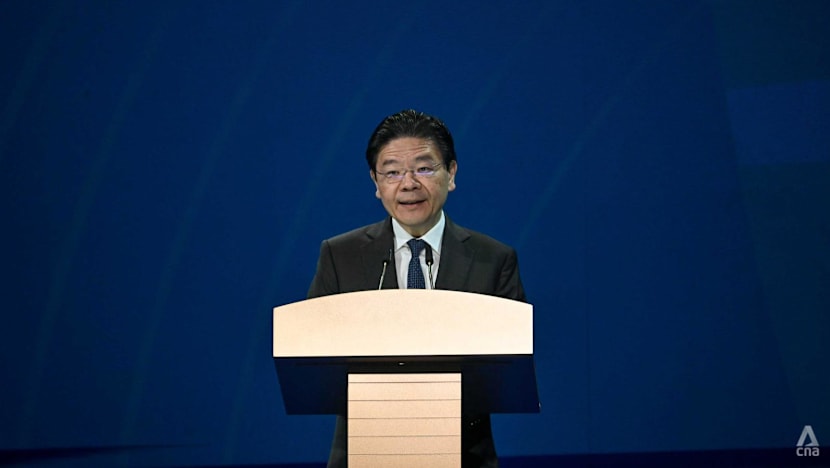
SINGAPORE: Singapore will launch a new initiative for mayors around the world to connect and exchange ideas, Prime Minister Lawrence Wong announced on Monday (Jun 15).
Such city-to-city cooperation matters more than ever in a world that feels "more divided and fragmented", Mr Wong said on the second day of the World Cities Summit (WCS) at Suntec Singapore Convention and Exhibition Centre.
“Between countries, governments may not always see eye to eye on every geopolitical issue. But cities can still find common ground, exchange practical ideas and learn from one another’s experiences,” he said.
The summit, which runs from Jun 14 to Jun 16, brings together government leaders, industry experts and academics to discuss topics on urban liveability and sustainability challenges, among others.
City leaders are grappling with many of the same challenges, Mr Wong said.
These include harnessing technology and growing their economy while ensuring people are not left behind, bringing people from different backgrounds together while maintaining social cohesion, and meeting growing infrastructure needs while keeping cities sustainable and liveable.
"There are no perfect answers or silver bullets to these questions. Difficult trade-offs are unavoidable. Every city must navigate its own constraints and tap on its unique strengths to find its own path forward," he said.
"But no city has to do this alone. Because these are shared challenges, there is much we can learn from one another’s experiences."
The new initiative, called the Mayoral Fellowship, will extend opportunities for learning and exchange to leaders beyond the cities that have won the Lee Kuan Yew World City Prize (LKYWCP), he added.
It is one of the three fellowships offered by the LKYWCP Network, which currently comprises 26 cities. The other two fellowships are the Research Fellowship and the Urban Leaders’ Fellowship.
The inaugural batch of fellows comprises mayors from Agra, Bucharest, Kigali, and Tshwane. Former mayors of Helsinki and Paris will participate as visiting fellows.
"After all, good ideas can come from anywhere, so we want this to be a platform for mayors to engage candidly with one another, share both their successes and setbacks, and build lasting relationships," Mr Wong said.
"I hope all of these exchanges will spark new ideas, forge enduring partnerships, and strengthen cooperation well beyond this week in Singapore," he added.
Mr Wong also announced the launch of the Liu Thai Ker Distinguished Speaker Series, which will be co-organised by the Urban Redevelopment Authority (URA) and the Housing and Development Board (HDB) later this year.
The series honours the contributions and legacy of the late Dr Liu, who is widely regarded as the architect and first master planner of modern Singapore.
It will feature urban leaders sharing insights on community-centric design and sustainable city-building, WCS said in a media release.
City planning is a continuous process of learning, adapting and improving, Mr Wong said, adding that cities succeed when they remain open to new ideas while staying anchored to enduring principles.
“We hope the series will inspire new generations of urban leaders and carry forward his legacy of thoughtful, people-centred city building,” Mr Wong said.
GUIDED BY PRAGMATISM
From the beginning, Singapore has been guided not by ideology, but by pragmatism, Mr Wong said.
"We try different approaches, we keep what works, and we change what does not. And above all, we focus on what delivers the best outcomes for Singapore and Singaporeans," he added.
For example, while the country places great emphasis on economic growth, it also recognises that a good life cannot be measured by gross domestic product (GDP) alone, he said.
That is why Singapore protects its natural and cultural heritage and dedicates prime land to such spaces, even in a small, land-scarce city, he said, pointing to Gardens by the Bay and the Rail Corridor.
Additionally, while Singapore believes in the power of markets to allocate resources efficiently, it recognises that markets alone do not always produce the outcomes it wants.
The state takes a more active role in certain areas, such as housing. Today, about eight in 10 Singapore residents live in public housing flats, and the vast majority own their homes, he noted.
“We ensure a sufficient supply of new flats to meet demand, and heavily subsidise them to keep home ownership within reach for Singaporeans,” he said, adding that the government ensures that public housing estates have an inclusive mix of residents.
And while Singapore may be associated with active state planning, what is less visible is the emphasis placed on partnerships and ground-up community participation, Mr Wong said.
For example, Singapore’s approach to an ageing population is to develop Age Well neighbourhoods rather than building exclusive retirement villages.
This is so older citizens can age in place within their own communities and access a wide range of services and support close to home, he said.
"That depends on much more than physical infrastructure. It requires strong partnerships with healthcare providers, community organisations, caregivers and volunteers,” he said.
Mr Wong said these examples reflect a broader philosophy.
He added: “We do not assume that yesterday’s solutions will always work tomorrow. As circumstances change, we continue to learn, adapt and innovate.”
Singapore (LOCATION)
Lawrence Wong (PERSON)
the World Cities Summit (ORG)
Wong (PERSON)
Suntec Singapore Convention and Exhibition Centre (ORG)
Jun 14 (ORG)
the Mayoral Fellowship (ORG)
the Lee Kuan Yew (PERSON)
World City Prize (EVENT)
the LKYWCP Network (ORG)
the Research Fellowship (ORG)
Agra (LOCATION)
Bucharest (LOCATION)
Kigali (LOCATION)
Tshwane (ORG)