
Business & Finance
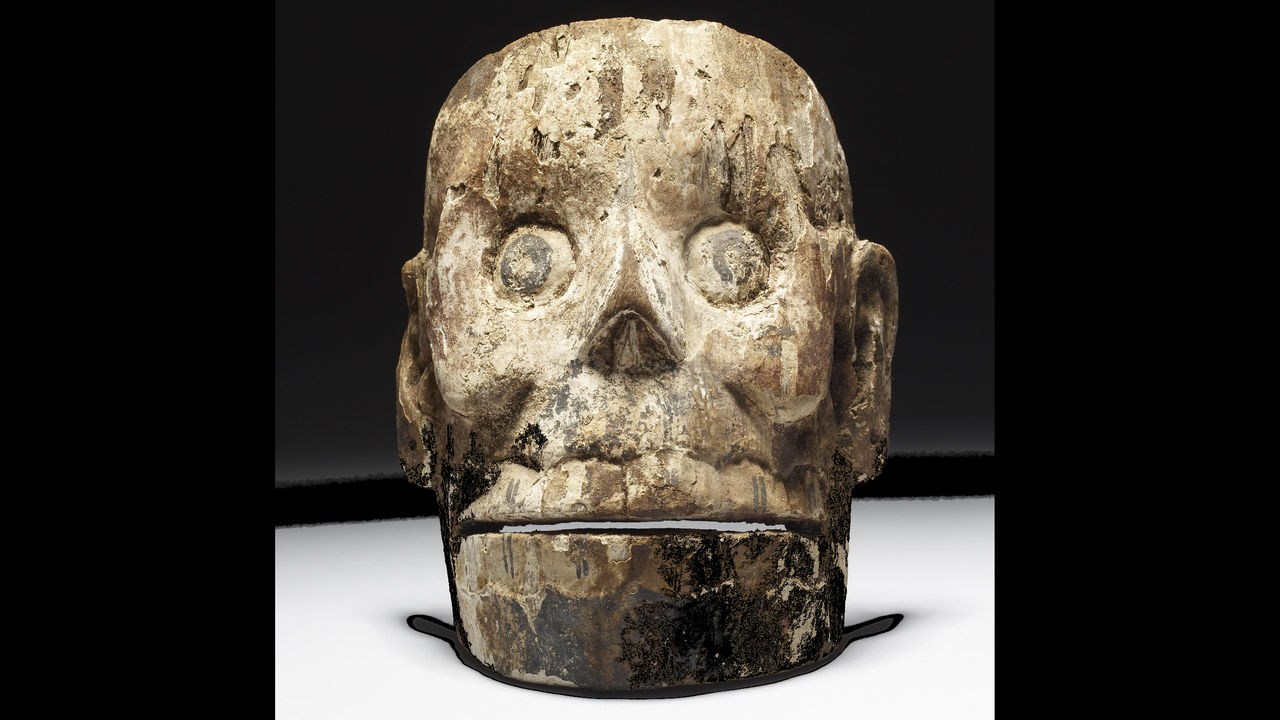
Mask of Mictlantecuhtli: A 500-year-old mask of the Aztec god of the underworld, who tore apart the dead as they entered his realm
Key Points
Mask of Mictlantecuhtli: A 500-year-old mask of the Aztec god of the underworld, who tore apart the dead as they entered his realm This skull-shaped mask was made to be used in a ritual involving the Aztec god of death. Mask of Mictlantecuhtli What it is: A carved and painted wooden mask Where it is from: The Aztec Empire When it was made: Circa 1450 to 1521 This rare example of an Aztec ritual mask was carved from wood over five centuries ago to represent Mictlantecuhtli, the god of death...
Mask of Mictlantecuhtli: A 500-year-old mask of the Aztec god of the underworld, who tore apart the dead as they entered his realm
This skull-shaped mask was made to be used in a ritual involving the Aztec god of death.
QUICK FACTS
Name: Mask of Mictlantecuhtli
What it is: A carved and painted wooden mask
Where it is from: The Aztec Empire
When it was made: Circa 1450 to 1521
This rare example of an Aztec ritual mask was carved from wood over five centuries ago to represent Mictlantecuhtli, the god of death and lord of the underworld, who was always depicted with a skull face. Mictlantecuhtli was responsible for the souls of people who died "heroic deaths" in battle, sacrifice or childbirth, helping them navigate the nine levels of the underworld and find eternal rest.
According to The Walters Art Museum in Baltimore, which has the mask in its collection, the carved wooden artifact measures 6.75 by 5.5 inches (17.2 by 14 centimeters). The sunken eyes with black pupils and the triangular nose give the mask a skull-like quality. On the cheeks, experts discovered traces of small, reddish dots that likely represent splotches of decay associated with Mictlantecuhtli. His teeth have been painted with vertical black lines, and both ears appear to have been pierced, as Mictlantecuhtli was often depicted with ear spools made of human bones.
Masks were an important part of ancient Aztec religion. In some rituals, people would wear masks of key deities, including carved skulls representing death, to transform themselves into supernatural beings. But because this particular mask of Mictlantecuhtli has no eye holes, it was probably affixed to a post or statue rather than worn, according to The Walters Art Museum, making it a rare example of a sculptural Aztec mask.
Mictlantecuhtli was a formidable part of the Aztec pantheon. He was said to be at least 6 feet (1.8 meters) tall and wore a necklace made of human eyeballs. When his full body was depicted, Mictlantecuhtli was shown with his arms raised, ready to tear apart the dead who entered his domain of Mictlan, the Aztec underworld. People who worshipped Mictlantecuhtli even practiced ritual cannibalism at his temple on occasion, according to Michael E. Smith, an emeritus archaeologist at Arizona State University.
One key myth featuring Mictlantecuhtli, according to University of California, Riverside archaeologist emeritus Karl Taube, involves the creation of the generation of people living in the world today. In this origin myth, the feathered serpent deity Quetzalcoatl, the Aztec god of earth, water and wind, among other things, must go to the underworld to retrieve the bones of all the deceased ancestors who had been turned into fish by a massive flood. Mictlantecuhtli agrees to give up the bones if Quetzalcoatl can blow a conch shell trumpet while journeying around the underworld.
MORE ASTONISHING ARTIFACTS
- Roman bath clog: The world's oldest shower shoes were found at a fort along Hadrian's Wall
- Gessel gold hoard: A 3,300-year-old stash of gleaming treasures that's one of the largest Bronze Age hoards from Europe
- Bead net funerary shroud: A 2,500-year-old beaded veil from Egypt depicting the deceased's transformation into Osiris
Mictlantecuhtli secretly gives Quetzalcoatl a shell without holes, but Quetzalcoatl quickly fashions it into a trumpet, completing the task. Mictlantecuhtli is enraged and doesn't want to hand over the bones, but Quetzalcoatl takes them anyway. He brings them to Cihuacoatl, the fertility goddess, who grinds down the bones and places them into a sacred container. All of the Aztec gods gather around the vessel and shed their blood into the bone meal, creating humans.
This myth demonstrates that, although Mictlantecuhtli was associated with the dead in Aztec mythology, he was also connected to the concepts of regeneration and resurrection.
For more stunning archaeological discoveries, check out our Astonishing Artifacts archives.
Kristina Killgrove is a staff writer at Live Science with a focus on archaeology and paleoanthropology news. Her articles have also appeared in venues such as Forbes, Smithsonian, and Mental Floss. Kristina holds a Ph.D. in biological anthropology and an M.A. in classical archaeology from the University of North Carolina, as well as a B.A. in Latin from the University of Virginia, and she was formerly a university professor and researcher. She has received awards from the Society for American Archaeology and the American Anthropological Association for her science writing.
You must confirm your public display name before commenting
Please logout and then login again, you will then be prompted to enter your display name.
Mictlantecuhtli (PERSON)
Aztec (ORG)
The Aztec Empire (ORG)
The Walters Art Museum (ORG)
Baltimore (LOCATION)
Mictlan (ORG)
Michael E. Smith (PERSON)
Arizona State University (ORG)
University of California, Riverside (ORG)
Karl Taube (PERSON)
Quetzalcoatl (PERSON)
fort (LOCATION)
Hadrian (PERSON)
Wall - Ges (PERSON)