
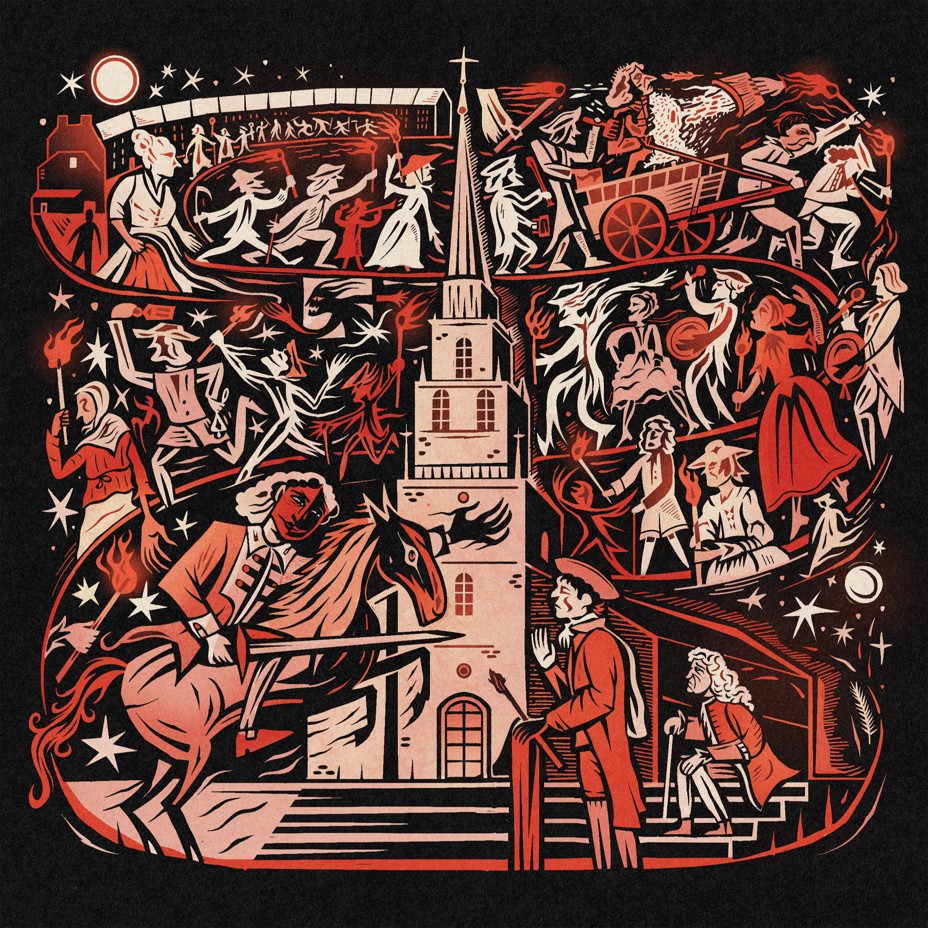
Illustrations by Laurie Avon
In January 1836, Nathaniel Hawthorne moved from Salem to Boston to assume the editorship of The American Magazine of Useful and Entertaining Knowledge. It wasn’t a typical editorial arrangement. Hawthorne would not manage a staff of writers, or make assignments to a network of correspondents. The lean budget required him to rely entirely on a single contributor: himself.
The issues that Hawthorne produced are, in fact, full of useful and entertaining knowledge. He published essays on John C. Calhoun, “Modern Jewish Passover,” and the history of hats. Some of these he composed; others he digested or simply aggregated from books or other magazines. Longer articles were punctuated with shorter curiosities: a new medical explanation for snoring; how to ascertain the height of a mountain using only a thermometer; the spontaneous combustion of a math professor; what the plague smelled like (“mellow apples,” some said; mayflowers, said others).
To read these issues today is to marvel at Hawthorne’s ability to fill so many pages, even if some articles have aged better than others. (Snoring, it turns out, is not caused by poor circulation.) But the work was running him ragged. Desperate for help, Hawthorne pressed his sister Elizabeth into service. “Concoct, concoct, concoct,” he implored her in a letter. “I make nothing of writing a history or biography before dinner. Do you the same.” Elizabeth submitted a profile of Alexander Hamilton and sundry other items. But the job still proved too demanding. In late summer, an exhausted Hawthorne resigned his post and retreated to Salem.
Hawthorne was 32 and beginning to lose hope that he could make a living as a writer. (In a letter to his other sister, he pegged his net worth at “precisely 34 cents.”) The problem was the wages, not the work. In an astonishing burst of creativity, he had already written and published the short fiction that, together with The Scarlet Letter (1850), would eventually establish him as the preeminent writer of the American Renaissance: dark parables such as “Young Goodman Brown,” “The Minister’s Black Veil,” and “Roger Malvin’s Burial.”
He had also published, anonymously, a story called “My Kinsman, Major Molineux.” Even by Hawthorne’s standards, it is an ominous, ambiguous tale. A young man named Robin leaves the countryside to seek his fortune in the city, hoping that a well-connected relative will set him up in business. It is also an allegory of the American founding. Over the course of one phantasmagoric evening, Robin witnesses events that prefigure the Revolutionary War. But far from celebrating or sanctifying the throwing off of English rule, the story’s shocking ending portrays the patriots as a fiendish mob, and casts doubt on the bedrock American faith in prosperity.
Throughout his career, Hawthorne packaged and repackaged his short stories and sketches, hoping to earn some much-needed income. In 1837, he published Twice-Told Tales. In 1846, he published Mosses From an Old Manse, the collection that left Herman Melville in awe of his friend’s “great power of blackness.” For reasons we can only guess at, Hawthorne declined to include “My Kinsman, Major Molineux” in either volume. Perhaps he worried that its portrait of American history was simply too black to have anything like mass-market appeal. Only after the success of The Scarlet Letter did he finally put his name to it, selecting it as the final story in his final collection, 1851’s The Snow-Image.
Unlike Melville’s, Hawthorne’s genius was appreciated in his lifetime. Yet “My Kinsman, Major Molineux” languished for a century before being discovered by scholars. Its great early champion was the British critic Q. D. Leavis. In an influential 1951 essay, she wrote that Hawthorne had never surpassed the story “in dramatic power, in control of tone, pace, and tension, and in something more wonderful, the creation of a suspension between the fullest consciousness of meaning and the emotional incoherence of dreaming.” Another critic, remarking on the tale’s long road to recognition, wrote, “For one hundred years the story lay dormant, the sleeping beauty of the American canon, until kissed by an English queen.”
Literary scholars have been working overtime to interpret the story ever since, yet outside the academy, it remains undeservedly obscure. This semiquincentennial summer is a good time to get to know it. Hawthorne may have been inspired to write it by the 1826 celebration of the American jubilee, which was marked by veneration of the Founding Fathers and rosy mythmaking about the Revolution. Hawthorne was more inclined to be haunted by history. The descendant of a hanging judge in the Salem witch trials, he was suspicious of certitude and wary of hysteria. His allegory of the conflict does not turn away from its violence or its darker implications; it offers no certainties.
The story is set on a midsummer night sometime around 1730. Robin, our hero, is the son of a country clergyman. He has come to the city—though never named, it’s clearly Boston—to find Major Molineux, his father’s cousin. Molineux, a man of wealth and status in the colonial government and without a son of his own, has hinted that he is willing to set Robin up in business.
First, though, this aspiring nepo baby needs to find him: Robin doesn’t have his kinsman’s address. Each denizen Robin stops to ask for help claims no knowledge of the major—and responds with disdain or worse. An old man nursing a “sepulchral” cough threatens to put Robin in the stocks for having accosted him on the street. An obsequious innkeeper, upon hearing the Molineux name, turns inhospitable, darkly noting Robin’s resemblance to a runaway indentured servant. Only a young woman in a scarlet petticoat proves more obliging. But when the night watchman interrupts their conversation, her motive is revealed: She intended to turn young Robin into a john.
With each encounter, the mystery of Molineux’s whereabouts mounts, though the sense of foreboding is cut by the comedy of our hero’s haplessness. Robin is a country mouse unaccustomed to the manners of the city, yet the narrator repeatedly describes him as a “shrewd youth”—typically right before Robin does something entirely lacking in shrewdness. When the fellow with the cough refuses to help him, Robin decides it is the old man, not himself, who is the Yankee bumpkin: “ ‘This is some country representative,’ was his conclusion, ‘who has never seen the inside of my kinsman’s door, and lacks the breeding to answer a stranger civilly.’ ”
As the night wears on, Robin begins to doubt that he will ever find Molineux, and the reader starts to wonder as well. Robin now stops “a bulky stranger muffled in a cloak” and demands to know where he can find his kinsman. The man removes his muffler to reveal a face painted half in red, and half in black. “The effect was as if two individual devils, a fiend of fire and a fiend of darkness, had united themselves to form this infernal visage.” It is this demonic figure who at last offers Robin an answer to his question, though a cryptic one: “Watch here an hour, and Major Molineux will pass by.”
As he waits, Robin slips into disorienting reverie, imagining his family at home on the farm. “Am I here, or there?” he wonders. But he is soon brought back to reality. The same “parti-colored” man has returned at the head of a howling mob parading through the streets a member of the colonial government—Major Molineux. He has been tarred and feathered, an antique torture that may sound cartoonish to contemporary ears, but that Hawthorne describes in all of its horror:
His face was pale as death, and far more ghastly; the broad forehead was contracted in his agony, so that his eyebrows formed one grizzled line; his eyes were red and wild, and the foam hung white upon his quivering lip. His whole frame was agitated by a quick and continual tremor, which his pride strove to quell, even in those circumstances of overwhelming humiliation.
This image of a broken man would have made for a terrifying denouement. But Hawthorne conjures another unnerving transformation. As Molineux passes by, Robin recognizes his kinsman and hears the cruel laughter of the mob. Rather than shrink from it, he joins the frenzy: “The contagion was spreading among the multitude, when all at once, it seized upon Robin, and he sent forth a shout of laughter that echoed through the street,—every man shook his sides, every man emptied his lungs, but Robin’s shout was the loudest there.”
Illustration by Laurie AvonA few years after departing The American Magazine of Useful and Entertaining Knowledge, still struggling to make a career of writing, Hawthorne tried his hand at a different kind of project: a children’s book. In Grandfather’s Chair, an old man recounts stories from American history through the experiences of his trusty oaken chair, which has seen it all. Hawthorne mostly succeeds at keeping the blackness in check in this foray into YA. But after Grandfather describes the Boston Massacre, one of the boys who has been listening to the tale speaks up:
“The Revolution,” observed Laurence, who had said little during the evening, “was not such a calm, majestic movement as I supposed. I do not love to hear of mobs and broils in the street. These things were unworthy of the people when they had such a great object to accomplish.”
The reader of “My Kinsman, Major Molineux” can be forgiven for having a similar response. We are accustomed to viewing the Sons of Liberty as defiant and resourceful and their rebellion against English tyranny as virtuous. Here, the stand-ins for the patriots are presented as ghouls, and the Tory is granted poignant nobility: “On they went, like fiends that throng in mockery around some dead potentate, mighty no more, but majestic still in his agony. On they went, in counterfeited pomp, in senseless uproar, in frenzied merriment, trampling all on an old man’s heart.”
Consider as well that Hawthorne has set his allegory not at the Old North Bridge or on Bunker Hill, but decades before the war for independence. As Michael J. Colacurcio writes in The Province of Piety, the definitive account of Hawthorne’s early tales, “Hawthorne is studying the majestic Revolution in terms of a minor outbreak of provincial unruliness, a mob scene.” Its victim is also a substitute: a man of rank, but a mere representative of the colonial government, seemingly made to suffer for the sins—a new tax on molasses? on sugar?—of the King or the Crown governor.
[From the November 2025 issue: Rick Atkinson on the myth of Mad King George]
Hawthorne wasn’t a monarchist. He was a lifelong Democrat who was rewarded for his loyalty to the party with patronage positions in the customhouses of Boston and Salem, jobs that supported him when his writing could not. Later, he wrote a campaign biography for the feckless Franklin Pierce, a friend from Bowdoin College. When Pierce took office, Hawthorne was given a posting as consul to Liverpool. His notebooks from the years that he and his wife, Sophia, spent in that damp industrial port suggest a man who was at best ambivalent about the English way of life.
But the author of “My Kinsman, Major Molineux” is clearly suspicious of the mythology that has hardened around the Revolution by the year of jubilee. He seems to worry that a political philosophy intended to empower the people might inadvertently unleash the populist energies of the mob. Once unleashed, as a native of Salem would surely understand, that contagion can be hard to contain. Good Robin, exposed to the furor, looks upon his kinsman’s torture and betrays him with a laugh.
Hawthorne’s tale is not just an allegory of the Revolution. It is also one of early American literature’s great coming-of-age stories, and its account of Robin’s initiation into the complexities of adult life carries its own ambiguities, and its own critique of a dearly held myth.
One frigid afternoon this spring, I walked past blocks of storefronts filled with witch kitsch to the stately home of the Salem Athenaeum. Hawthorne was a member, and the library has preserved the records of the books he checked out. On display in a vitrine was a volume of General Zoology or Systematic Natural History, opened to a colorplate depicting a coiled “Fasciated Boa”—the 1802 book makes a cameo in his story “Egotism; or, the Bosom Serpent,” in which a man is possessed by a snake.
A librarian had pulled for me Memoirs of the Life and Writings of Benjamin Franklin, Written by Himself. Hawthorne consulted it in 1828, when he would have been composing “My Kinsman, Major Molineux.” I half-hoped that he had defaced the Athenaeum copy with some margin notes—no such luck. But the text itself was proof enough that Hawthorne had Franklin’s own famous coming-of-age story in mind as he wrote.
The scholar Julian Smith was the first to list the many parallels between Robin’s arrival in Boston and Franklin’s in Philadelphia: “Each leaves his father’s house to go to a strange city in search of advancement; each arrives in this strange city by boat; each is embarrassed about his lack of money.” Robin is all but accused of being a runaway servant; Franklin had indeed broken his indenture to his older brother. He, too, seeks the assistance of a well-placed benefactor: The governor of Pennsylvania has offered letters of introduction and credit, establishing him in the printing business. But the promises prove empty.
Instead, Franklin will rise by virtue of hard work and (actual) shrewdness. In his Memoirs, he stresses his “most awkward ridiculous Appearance” upon landing in Philadelphia—like Robin, he arrives in shabby attire, his meager possessions stuffed into his pockets—in order that the reader might “compare such unlikely Beginnings with the Figure I have since made there.”
Franklin’s account of his rise from poverty to prominence is the foundational text in the American myth of the self-made man, which holds that wealth and status are the products of diligence, not advantages inherited from a rich relative. Ostensibly, Robin learns the Franklin lesson. At the story’s conclusion, he asks a city dweller who has stood by him during the awful procession—the first man to show him kindness all evening—to direct him back to the ferry. Deprived of his meal ticket, Robin sees no reason to remain in the city. But the man won’t permit him to leave:
“No, my good friend Robin,—not to-night, at least,” said the gentleman. “Some few days hence, if you wish it, I will speed you on your journey. Or, if you prefer to remain with us, perhaps, as you are a shrewd youth, you may rise in the world without the help of your kinsman, Major Molineux.”
The Robin of the story’s end is shrewder than the boy who arrived in the city hours before. The mob he met in the moonlit street included, notably, all of the characters Robin had encountered earlier in the evening: the man with the sepulchral cough, the innkeeper, the whore, even the parti-colored man, first glimpsed at a tavern “holding whispered conversation with a group of ill-dressed associates.” Out in the wider world, Robin has learned that adults can conspire and deceive—that they can wear two faces.
Yet Robin’s story has a grimmer aspect than Franklin’s. In place of an optimistic fable, we get a psychologically astute account of a young man’s loss of innocence, complete with a startling act of oedipal violence—Robin’s participation in the ruin of the man who was to be his surrogate father. By the end of the ordeal, Robin looks more defeated than wise: “His cheek was somewhat pale, and his eye not quite as lively as in the earlier part of the evening.”
The good gentleman has told Robin that he can “rise in the world” without the help of his kinsman. But the tale ends there, his future far from assured. Young Hawthorne may have had his doubts that hard work will necessarily be rewarded.
Hawthorne’s contrarian streak didn’t always serve him well. In May 1862, he submitted to James T. Fields, the editor of this magazine, a Civil War dispatch, reported from Washington, Harpers Ferry, and the Tidewater. Hawthorne was an unlikely war correspondent. His reflexive suspicion of causes left him more dismayed than energized by the nascent conflict. Although he was an old friend of Henry Wadsworth Longfellow’s, and well acquainted with other founders of The Atlantic, he did not share their passion for abolition.
Hawthorne’s sardonic essay described the war not as a divinely sanctioned liberation—as it had been deemed in “Battle Hymn of the Republic,” published in The Atlantic that February—but as a grand folly. He writes witheringly of John Brown (“Nobody was ever more justly hanged”) and sympathetically of Confederate prisoners of war, and likens the Monitor, the Union’s mighty ironclad, to a “gigantic rat-trap.” His condescending description of “contrabands”—fugitive slaves seeking emancipation behind Union lines—suggests another reason for his lack of abolitionist zeal: He clearly views Black people as an inferior race.
Fields asked Hawthorne to excise some of the more offending passages, including an irreverent account of his meeting with “Uncle Abe.” (The author acquiesced, though grudgingly: “What a terrible thing it is to try to let off a little bit of truth into this miserable humbug of a world!”) The article, “Chiefly About War-Matters,” nevertheless scandalized Atlantic readers. In this instance, the Hawthorne biographer Edwin Haviland Miller writes, “his familiar ambivalence afforded him a kind of cowardly protection and freedom from commitment, his seesawing and evasiveness pleasing no one.”
Hawthorne’s unsentimental view of the Revolutionary War, as expressed in “My Kinsman, Major Molineux,” has aged better. Lately, historians have come around to the story’s portrait of the conflict as marked by internecine mayhem. “Nothing done since by historian or novelist so concisely conveys the internal essence of the revolution,” Alan Taylor writes in American Revolutions. “Hawthorne recognized that the struggle was our first civil war, rife with divisions, violence and destruction.”
This is not a perspective likely to be on display in any official 250th celebrations. The current administration is engaged in an effort to bowdlerize American history, stripping away complexity in favor of easy myth and hagiography, not to mention the attempt to whitewash more recent events. The president insists that the insurrectionists who stormed the Capitol on January 6, 2021—including one man, the notorious QAnon Shaman, in parti-colored face paint—were “patriots.”
The point of picking up Hawthorne’s confounding story isn’t to recast the American Revolution as little more than a provincial riot. It is to heed Hawthorne’s warning about political passion giving way to hysteria and to recall the hard lesson that shrewd Robin learns: The adult world can be deceptive, disorienting, disturbing.
Melville left only a single notation in the margins of his copy of “My Kinsman, Major Molineux,” a check mark beside a line I’d read past too quickly. It compares moonlight to the human imagination in its power to invest “a beautiful strangeness in familiar objects.” This, perhaps, is the best reason to wander the crooked streets of Hawthorne’s Boston: to see America’s too-familiar origin story in a strange new light.
This article appears in the July 2026 print edition with the headline “Nathaniel Hawthorne’s American Horror Story.” When you buy a book using a link on this page, we receive a commission. Thank you for supporting The Atlantic.