
Bo Nickal, his face shiny with Vaseline, had just finished pounding the nose and eyes and ears of his opponent, Kyle Daukaus, who lay on his back like an overturned, squashed bug. Immediately, Nickal jumped over the edge of the Octagon and landed just in front of Donald Trump, who stood up and grabbed the fighter’s hand. Still panting, Nickal thanked the president: “This wouldn’t be possible without you.” So ended the second bout of last night’s UFC 250, the extravaganza of squirting blood and patriotic kitsch that took place—to the stupefaction of all, including a giddy Joe Rogan—on the South Lawn of the White House.
All of this was pure, distilled Trump. No previous American leader could plausibly have presided over the scene of a tattooed Brazilian fighter in a black cowboy hat and Lycra shorts running out of the White House, saluted by honor guards, with the intent of pulverizing another human being. He had built an Octagon on the lawn in part, surely, to troll his opponents, as he so often does, but what I saw in the fighting itself—in fight after fight after fight, seven in all—was an affirmative expression of Trump’s favorite kind of storyline: dominance and submission. This was not just a political stunt, but the best way he could imagine spending his 80th birthday.
Other presidents have used stagecraft to project their worldviews. Ronald Reagan was an acknowledged genius at this—or, rather, his main image manager, Michael Deaver, was. Reagan would give speeches positioned so that the Statue of Liberty or the Berlin Wall was perfectly framed in the background. The idea was that Reagan would borrow from the symbolic power of these places.
Trump has the same Hollywood instincts, but in the tableau he created last night, he was not using the White House to elevate himself; rather, he was swallowing it whole. The 600-ton star-spangled Claw, which looked like it was about to pick up the White House like a stuffed animal in an arcade game, was meant to convey dominance. So was the scene that preceded the main bout, in which both fighters began their walks to the ring from the Oval Office, looking up at a copy of the Declaration of Independence. Only the president could allow the seat of American power and the founding document to be used this way, and perhaps that was the point.
The French theorist Roland Barthes captured the symbolic meaning of all this perfectly in his 1957 collection, Mythologies, when he described the “spectacle of excess.” In the book, now considered the ur-text of cultural criticism, Barthes picked apart some very taken-for-granted elements of our world, such as soap powders, steak and chips, and Citroëns. But most enduring was his essay on professional wrestling. He saw it, alongside bullfighting and Greek tragedy, as an entertainment that both reduces the human passions to their basic elements—rage, pleasure, and the like—and then blows them up larger than life. These were “great solar spectacles” because they typically took place outside, as if a roof couldn’t contain all that huge feeling. In the plaza de toro, the ancient amphitheater, and—I would add—the UFC White House Octagon, “a light without shadow elaborates an emotion without secrets,” as Barthes writes.
[Read: Trump’s gladiator delusion]
I am aware that bringing a French structuralist to a cage fight borders on self-parody, yet the essay really feels like a key that unlocks this baffling and historic event. Barthes was dissecting professional wrestling, with its heroes and heels, its obvious theater. Trump’s appreciation for and emulation of the histrionics of that sport has been much discussed over the years—recall how the late Hulk Hogan ripped his shirt to shreds at the 2024 Republican National Convention to reveal a TRUMP VANCE T-shirt underneath. Mixed martial arts is something different—more real and more violent. It became legal only in 2016, a few months before Trump won the presidency. But Barthes’ reflections apply here even more than they do to World Wrestling Entertainment.
Wrestling to him is the “draining of interiority in favor of external signs, this exhaustion of content by form.” In other words, all is on the surface, and nuance is banished like a foot slammed into the solar plexus. What struck me about the UFC fights was the anticipation of blood, the waiting for the final moment, when one man would be at the complete mercy of another, and only the referee’s call would stand between the loser and death. “What is thus given to the public is the great spectacle of Suffering, of Defeat, of Justice,” Barthes writes. The emotions are presented with “all the amplification of the tragic masks.” In professional wrestling, the fallen fighter plays his role. In MMA, the shock is real, and so is the fall. But in both cases, the crowd waits for the fighter to produce that face of suffering; “like a primitive Pieta, he allows us to see his face exaggeratedly distorted by an intolerable affliction.”
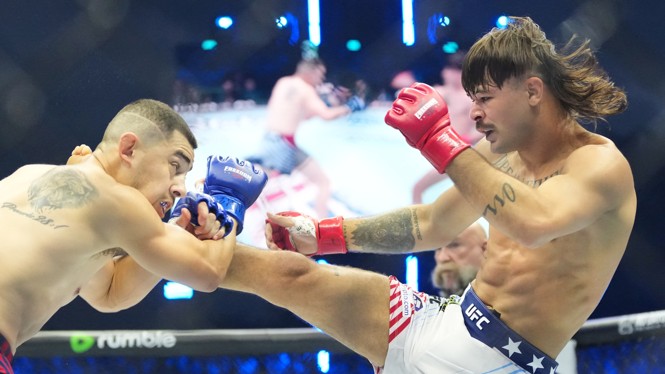
Alex Brandon / APFeatherweight fighter Diego Lopes, right, kicks Steve Garcia during UFC Freedom 250.
The kind of fighting, of entertainment, seen on the South Lawn yesterday still speaks to what Barthes was observing. Even though the action is revoltingly real, the fighters seem almost interchangeable, cookie-cutter, and therefore even more archetypal. Some seem meaner than others, or more obscene—like Josh Hokit, who yelled from the center of the ring (again, feet away from the White House), “Michelle Obama is a man! Am I right, America?” To my admittedly untrained eye, every fight reproduced the same drama no matter the combatants—or even how skilled they were. There is surely technique to what they do, but every knockout moment brought the same climactic scramble of life and death: slipping around in sweat and blood, grappling with each other on the ground like two creatures fighting over the last crust of bread in the world. What matters is the revelation of those emotions. “I’ll do whatever it takes,” Steve Garcia said just before the fight he lost. “I’ll break every bone in his body.”
Trump usually operates at this register. He is either going to annihilate Iran completely—“a whole civilization will die tonight”—or he is announcing that he has just brought everlasting peace to the region, as he did yesterday with a new, though still tenuous, cease-fire agreement. Particularly when it comes to the Iran war, toggling between these extremes has become another kind of exhausting spectacle of excess. He knows no subtlety; for him, as for an MMA fighter, it is either kill or be killed. By staging these fights so close to the seat of executive power, Trump is putting on a show that is also meant to demonstrate what being president means to him. The office might be oval, he is saying, but it is his Octagon.
[Read: And now a few words from our former presidents on UFC 250]
I had hoped that even in a UFC fight, we might see displays of power that would suggest other possibilities beyond face-pounding. I’d heard about a 2024 bantamweight title fight in which a Georgian fighter named Merab Dvalishvili shocked his opponent by kissing his head repeatedly and went on to win his match. In another notorious bout, also in 2024, Mason Lewis was caught in a hold—apparently called a “reverse triangle”—in which his head was squeezed between Tim Fargo’s thighs like a watermelon in a vise. He responded by gently tickling the bottom of Fargo’s foot, forcing his release. “I couldn’t break the lock with one hand,” Mason later said. “And I knew, people are ticklish. People let go. So I figured if I tickled his foot, he might let go.”
But there was no kissing or tickling on Saturday night—no exposition of the artful ways that one can sneakily overtake an opponent through charm or surprise. Not a single one of these seven fights were even won on points. They all resulted in one man’s rage and another man’s pain and humiliation. That was the whole story—the only one that mattered to the 80-year-old man taking it all in from the edge of the ring.