
Science
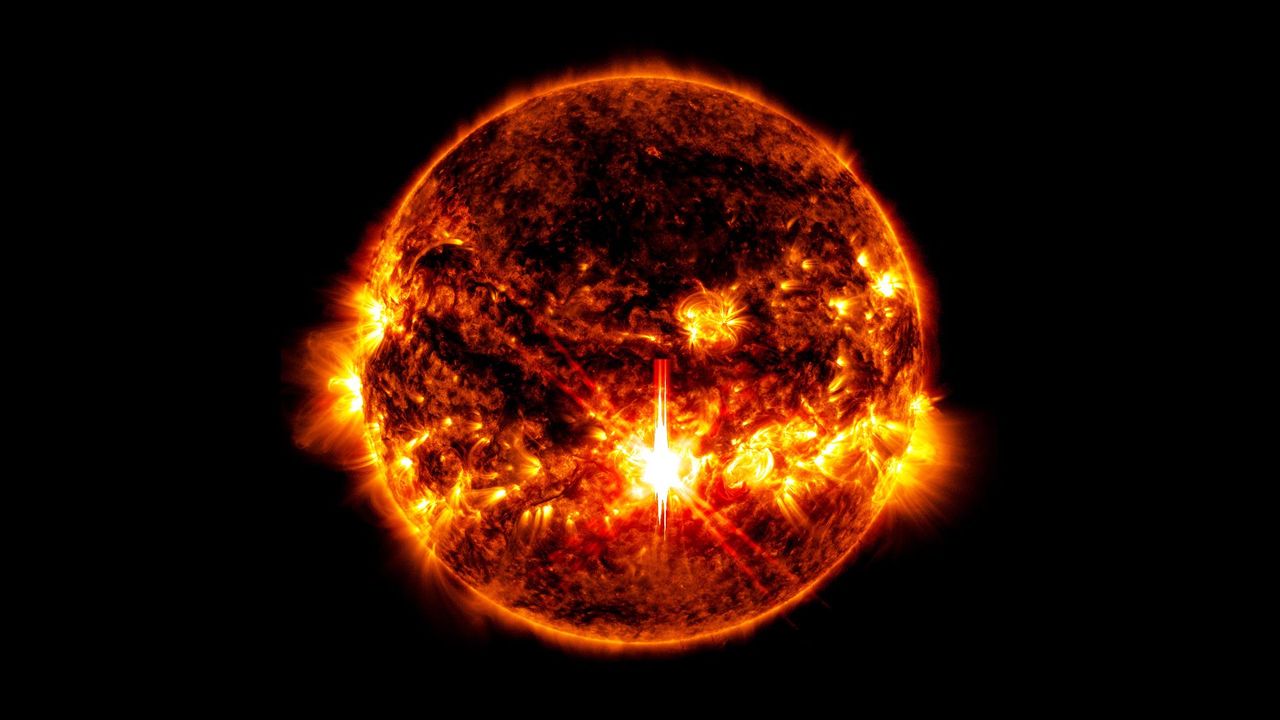
Scientists find strange changes on sun hours before a powerful X9 solar flare: 'I was not expecting what I found'
Key Points
Scientists find strange changes on sun hours before a powerful X9 solar flare: 'I was not expecting what I found' "There's very few that reach that amount of power." Scientists may have finally seen the sun telegraph an eruption hours before it happened — and the one caught was one of our star's most powerful explosions. Drawing on a rare dataset collected in the hours leading up to a massive solar flare, scientists identified a series of changes in the sun's atmosphere that offer new clues...
Scientists find strange changes on sun hours before a powerful X9 solar flare: 'I was not expecting what I found'
"There's very few that reach that amount of power."
Scientists may have finally seen the sun telegraph an eruption hours before it happened — and the one caught was one of our star's most powerful explosions.
Drawing on a rare dataset collected in the hours leading up to a massive solar flare, scientists identified a series of changes in the sun's atmosphere that offer new clues about how major eruptions begin. Eventually, these results could help improve space weather forecasting.
"I was not expecting what I found," Louis Seyfritz, a graduate researcher at the New Jersey Institute of Technology who led the new study, told Space.com.
Solar flares are powerful bursts of radiation from the sun driven by the sudden release of magnetic energy. The more powerful of these eruptions can disrupt radio communications, damage satellites and contribute to geomagnetic storms that affect infrastructure on Earth. Yet, despite decades of study, scientists still do not fully understand what causes these eruptions to occur.
Part of the challenge is practical. While spacecraft continuously monitor the sun, detailed observations of the conditions leading up to a flare are difficult to obtain. High-resolution instruments typically focus on active regions already producing solar activity, and researchers often begin tracking a flare in earnest only after it erupts — when it's possible to trace its path through space and assess its potential impacts on Earth.
In the new study, Seyfritz and his colleagues were able to take advantage of an unusually fortuitous dataset that captured the buildup to an X9-class solar flare that erupted on Oct. 3, 2024.
Their analysis identified several changes in the sun's atmosphere hours before the explosion, offering new clues about how major flares begin and potentially revealing early warning signs of future events.
The active region that produced the eruption had already generated several powerful flares in the preceding days, prompting scientists to keep multiple solar observatories focused on the area. Among them was NASA's Interface Region Imaging Spectrograph, or IRIS, a spacecraft designed to study a narrow slice of the sun's atmosphere in extraordinary detail.
And indeed, because IRIS was already observing the region, researchers obtained nearly five uninterrupted hours of observations before the flare erupted, providing a rare window into the processes unfolding in the sun's atmosphere before the explosion.
"I chose that event because I was expecting the flare to be big enough to see those signs," Seyfritz said. "There's very few that reach that amount of power."
Using data from IRIS, the researchers tracked three properties of plasma in the sun's atmosphere — its brightness, its motion toward or away from observers, and a quantity known as non-thermal velocity, a measure of turbulence and small-scale motions within the plasma. Together, those measurements allowed the team to reconstruct conditions in the hours before the flare, the study notes.
The results showed all three properties began increasing roughly three hours before the eruption, suggesting the sun's magnetic field was gradually becoming more unstable.
Such a long buildup of preflaring signatures is rarely observed, Seyfritz said.
The team also found that the plasma's brightness, motion and turbulence rose and fell in regular cycles before the flare. One repeated every seven to 10 minutes, while another appeared roughly every 18 to 21 minutes. The fluctuations were concentrated near a boundary where oppositely directed magnetic fields meet — a region where scientists suspect magnetic stress builds up before flares.
Scientists do not yet know exactly what causes the oscillations. They may reflect waves moving through the solar atmosphere or a series of small-scale magnetic reconnection events occurring before the larger eruption.
"If we see those oscillations happening before the flare, it can be a strong indicator that a flare is going to happen," Seyfritz told Space.com.
Roughly 15 to 20 minutes before the flare erupted, the sun's atmosphere appeared to shift into a more volatile state, with turbulence surging and plasma streaming outward — changes that may reflect the sudden release of magnetic energy that drives solar flares, the study notes.
No single measurement appeared to provide a definitive warning sign on its own. Instead, Seyfritz said, it was the combination of increasing brightness, rising turbulence and coordinated oscillations that stood out as a possible precursor signature.
To be clear, the findings do not immediately mean scientists can now predict solar flares hours in advance. The study examined a single eruption, and researchers do not yet know whether the same signatures appear consistently before other events. Answering that question will require analyzing many more flares — a challenge made difficult by the scarcity of suitable observations.
The next step, Seyfritz said, is to determine whether the same patterns emerge across a much larger sample of eruptions. If they do, the signatures could eventually become part of future space-weather forecasting systems.
"That's the goal," he said.
The results were published in May in the journal Solar Physics.
You must confirm your public display name before commenting
Please logout and then login again, you will then be prompted to enter your display name.
Sharmila Kuthunur is an independent space journalist based in Bengaluru, India. Her work has also appeared in Scientific American, Science, Astronomy and Live Science, among other publications. She holds a master's degree in journalism from Northeastern University in Boston.