
Politics
Inside the forgotten ‘capital of Brexit’ – where Boris Johnson’s unkept promises have left voters feeling betrayed
Key Points
Inside the forgotten ‘capital of Brexit’ – where Boris Johnson’s unkept promises have left voters feeling betrayed In one of the biggest shocks of election night 2019, Labour lost the Stoke-on-Trent seat as the Red Wall collapsed amid a Boris Johnson pledge to get Brexit done. Seven years on Alex Ross discovers a city feeling even further left behind - Bookmark - CommentsGo to comments It’s a bleak, cold weekday afternoon in Hanley, one of the six towns that make up Stoke-on-Trent in the...
Inside the forgotten ‘capital of Brexit’ – where Boris Johnson’s unkept promises have left voters feeling betrayed
In one of the biggest shocks of election night 2019, Labour lost the Stoke-on-Trent seat as the Red Wall collapsed amid a Boris Johnson pledge to get Brexit done. Seven years on Alex Ross discovers a city feeling even further left behind
- Bookmark
- CommentsGo to comments
It’s a bleak, cold weekday afternoon in Hanley, one of the six towns that make up Stoke-on-Trent in the Midlands.
On the high street, a serene, almost sleepy atmosphere is suddenly broken by two masked young men racing their electric motorbikes past empty shops and a boarded-up 18th century church.
A few shoppers look up. Many trudge on, undisturbed.
This is the gateway to Hanley, the place billed as the centre for a resurgent Stoke-on-Trent but now an area even city leaders admit hasn’t worked out so far.
Seven years ago, a report revealed more than a quarter of shops were empty. Today, the large Poundland, Greggs bakery, and numerous card and phone shops cannot disguise the many shuttered units across the town.
In the former Sports Direct, a closure sign dated August 2018 is on display.
“Why would anyone want to come to Hanley,” Matt Bradbury, manager at Armstrong Health and Herbal, says. Situated between a mini market and a nail salon, the family-run business was established in 1906 and is said to be the oldest in town.
Stood amongst shelves of herbal remedies and health supplements, Mr Bradbury says just 10 years ago the town drew in shoppers from afar, attracted by the now-closed Debenhams and Marks and Spencer, and a vibrant nightlife.
“Now you go down the high street and you can see the lack of support given for small businesses,” he says.
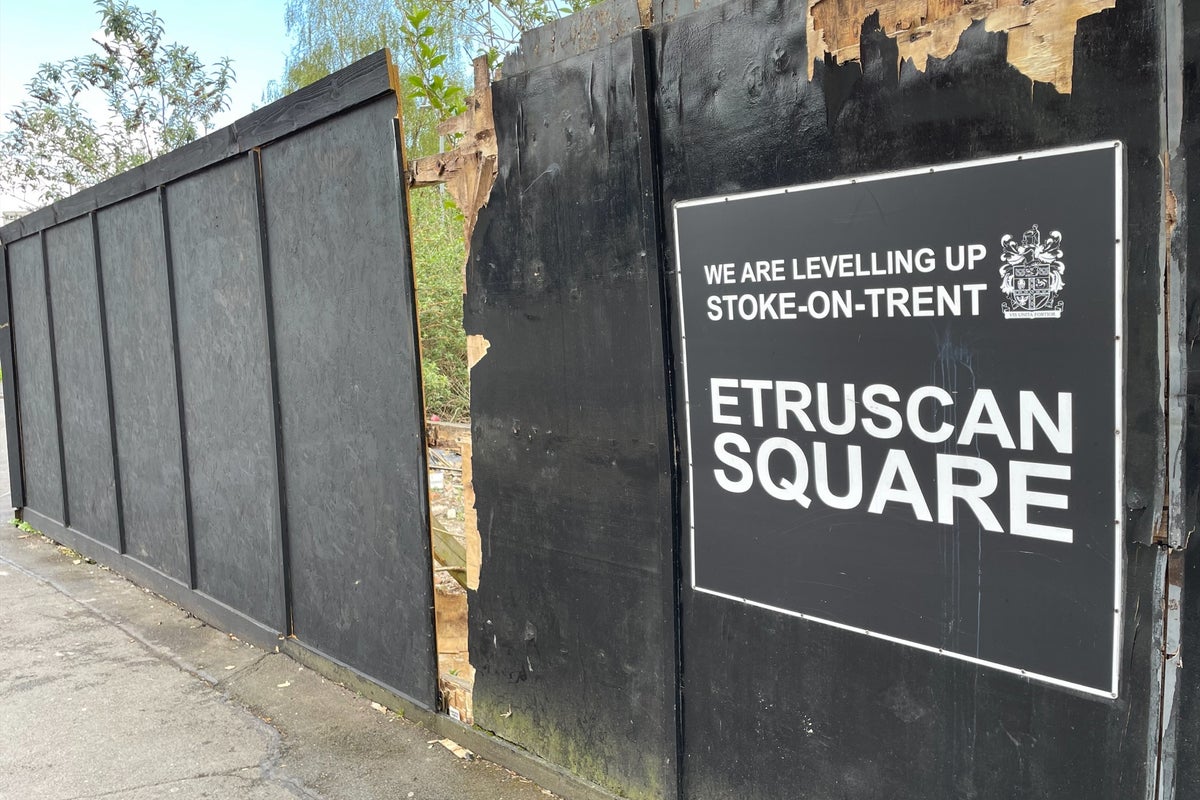
Hope for a revival in fortunes arrived in the form of an ambitious plan, Etruscan Square, to build a 2,600-capacity arena, along with homes and food outlets, at the boarded-up former bus station in Hanley town centre, backed by £20m in the government’s post-Brexit Levelling Up scheme.
It appeared a just reward for the city that overwhelmingly voted for Brexit, and then kicked-out a Labour MP from Stoke-on-Trent Central constituency for the first time at the 2019 general election as the Red Wall came tumbling down in the face of Boris Johnson’s pledge to ‘get Brexit done’ and exit the EU.
But after Labour seized back control of the council in 2023, the plan for an arena was dropped due to affordability. In May, the BBC reported that out of £56m Levelling Up money awarded to Stoke in 2021, more than £31m remained unspent.
The Etruscan Square scheme forms part of a wider masterplan unveiled this year, which also includes tackling empty shops, revitalising disused historic buildings and replacing a nearby leisure centre. The target date for the project, to transform the city centre into a "more vibrant, connected and welcoming space”, is 2050.
It’s no wonder people in the town feel so disillusioned, says Danny Flynn, former chief executive of the YMCA North Staffordshire, who retired in April after more than 40 years working in the voluntary sector in Stoke.
“People don’t believe it anymore - they go ‘yeh rubbish,” he says. “There have so many times been promises made about regeneration in Stoke, and they haven’t happened.
“People feel left behind. Forty, 50 years of decline is so bleeding obvious in Stoke, how else would you feel? If you’ve seen your city degrade so badly then you are going to be feeling pretty pissed off.”
Once at the heart of the industrial revolution, Stoke continues to suffer successive shocks; from the closure of its coal mines and steel works, to the decline in its potteries industry - although, the city’s tourism website still promotes its status as “World Capital of Ceramics”.
Office for National Statistics data shows 21 per cent of working-age adults were neither employed or seeking work in 2023. Across the city’s six towns, 6.1 per cent claim unemployment benefits, almost double the national average.
Set against this background, the EU referendum rolled up a decade ago with the promise of more money for services such as the NHS, and a tightening of border controls. Almost 70 per cent of people backed Leave when the vote came in 2016.
Then-Ukip leader Paul Nuttall, who failed to win a by-election in Stoke-on-Trent Central a year later, called the city the “Brexit capital of the country”.
The city further loaded its support to a break from the EU when it appeared to back Mr Johnson’s mandate to get a withdrawal agreement signed, voting in a relative stranger to the region, Tory candidate Jo Gideon, who moved from her home in Kent, some 200 miles away to take her constituency seat.
Ms Gideon, ironically herself a Remainer, tells The Independent the result was one of the biggest shocks of the 2019 election. She was selected as the Tory candidate just 10 weeks before the election, and tasked with delivering 55,000 leaflets across the constituency.
Initially doing it on her own, and losing two stone in weight in the process, an SOS call-out on a WhatsApp group of members of the House of Lords saw a “quite surreal” arrival of earls and baronesses arrive to help her cause.
“I went from complete obscurity to being on the 6 o’clock news on the BBC the night after the election was held,” she says.
Her victory came as a “Red Wall” of traditional Labour seats were lost to the Tories.
“In 2015 there was a movement away from just voting the same as your grandfather,” she says. “People were becoming more aware of the political situation and Brexit moved people way from that blanket vote for Labour, which came to a head at the referendum.”
Traditional Labour supporters also disliked Jeremy Corbyn, she adds, and were swayed by the appeal of Mr Johnson.
In Stoke, a lack of investment or “industrial renaissance” had left voters feeling behind.
She says: “The way that Brexit dialogue was played out, people felt that it was because the money as going to Europe and we didn’t have control of our own policy and so it was directly to do with economic decline and a feeling of not receiving what they should have done.”
Once in her seat, Ms Gideon says she and three other Tory MPs elected in Stoke secured the highest Levelling Up settlement in the country. Her greatest achievement was clearing a huge industrial waste site containing thousands of tonnes of combustible material that, she says, could have turned Stoke into Beirut.
The city even attracted an unusual “away trip” for Boris Johnson’s cabinet in 2022, where ministers appeared to want to remind voters in “Red Wall” areas that the government was focused on work to “level up” the country.
But in 2024, Ms Gideon’s seat swung back to Labour.
The turnout was notably down almost 10 per cent from 2019.
Back in Hanley, where damaged black boardings line the boundary of the seven-acre Etruscan Square, a faded sign states “we are levelling up Stoke-on-Trent”.
Opposite, in one corner, is a dilapidated pub situated on a road called Parliament Row. Fenced off for safety, people have still managed to scrawl graffiti on the black windows and doors to Franky’s Bar.
One person has written: “Jacob Rees-Mogg. Establishment piss-take.”
Shoppers passing by seem to have little interest in politics, or the Etruscan Square development.
“What’s the point in talking about it,” says one man called Paul, stood underneath a Stanley Matthews statue in the town centre. “We’ve got lives to get on with, no one is here to support us.”
Join the community
Sign up to our free Europe: The Way Back newsletter here or by using the form below:
What you will get by joining:
- A dedicated community: We are fully committed to the long haul, consistently campaigning to secure the absolute best deal for Britain within Europe.
- Free weekly newsletter: Every Wednesday, political editor David Maddox and political correspondent Millie Cooke will be in your inbox with exclusive reporting, analysis and insight on the biggest developments shaping relations between Britain and Europe. Each week, they will explain what’s happened, what it means, and what the key political figures, experts and decision-makers are saying about it.
- Essential continental updates: Stay informed with regular briefings on the biggest developments in European politics and the specific policies that could pave the way for closer EU relations.
There are even more benefits if you subscribe for just £1 for seven months:
- Exclusive content: Get the highest quality analysis, opinion and debate from political experts across the UK and Europe by subscribing to our premium service.
- The Brexit Effect: You'll get exclusive access to extracts from Anthony Seldon’s major new book, The Brexit Effect, offering an unparalleled analysis of the 10 years since the referendum.
- Inform the debate: Receive exclusive invitations to live events, webinars, expert Q&As and podcast recordings.
Join our commenting forum
Join thought-provoking conversations, follow other Independent readers and see their replies
Comments