
Science
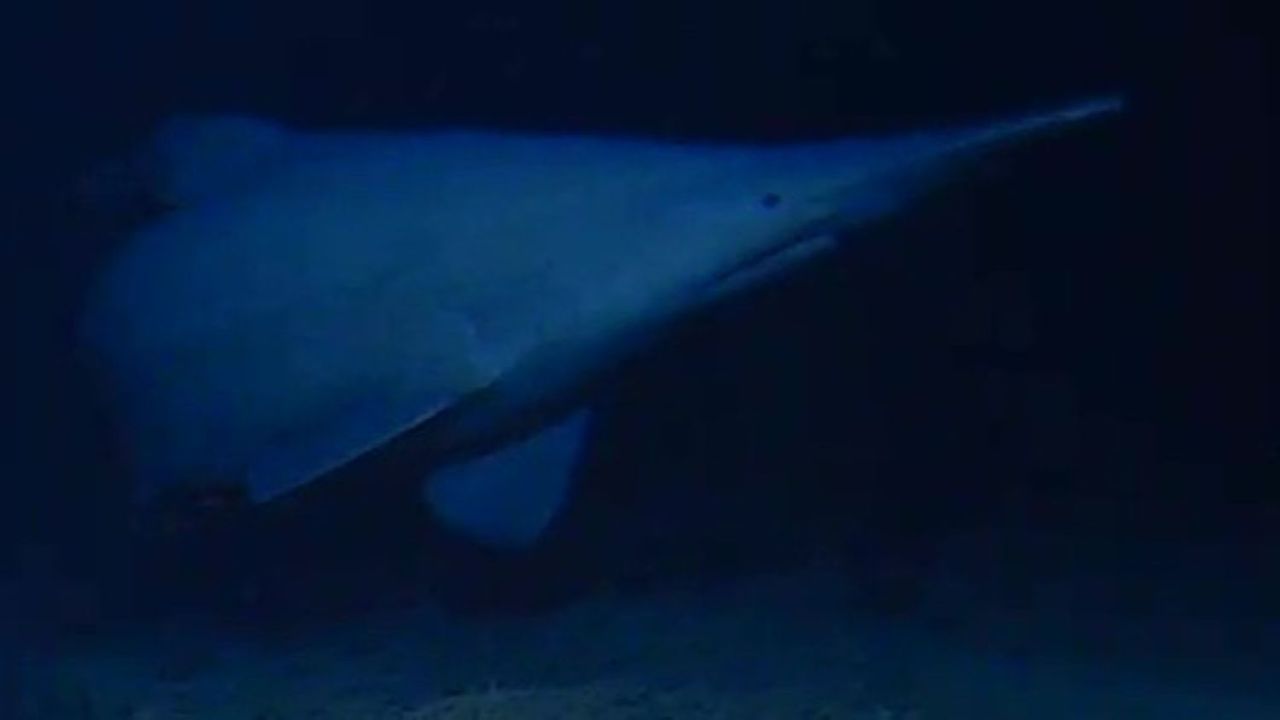
'I never thought we'd see one alive': Elusive goblin shark captured on camera for the first time
Key Points
'I never thought we'd see one alive': Elusive goblin shark captured on camera for the first time Researchers have filmed goblin sharks in the deep sea for the first time. Until now, these sharks had been seen alive only after being hauled up to the surface with fishing lines. For the first time ever, scientists have captured deep-sea footage of the elusive goblin shark, extending its known range far into the Central Pacific and down to nearly 6,560 feet (2,000 meters) below the water's surface.
'I never thought we'd see one alive': Elusive goblin shark captured on camera for the first time
Researchers have filmed goblin sharks in the deep sea for the first time. Until now, these sharks had been seen alive only after being hauled up to the surface with fishing lines.
For the first time ever, scientists have captured deep-sea footage of the elusive goblin shark, extending its known range far into the Central Pacific and down to nearly 6,560 feet (2,000 meters) below the water's surface.
The goblin shark (Mitsukurina owstoni) is a deepwater shark with an elongated snout and protrusible jaws that shoot out to snatch prey. The species, which has been around for about 125 million years, is described as a "living fossil." Until now, it had been seen alive only briefly, when it got hooked on fishing lines and hauled to the surface, according to a new study.
In the new footage, researchers documented two goblin shark sightings — one near Jarvis Island in the South Central Pacific Ocean and another at the Tonga Trench in the Southwest Pacific. Researchers suspect that goblin sharks live throughout the planet's oceans, as they have been caught in many different regions, but the specimen record is very sparse. So far, goblin sharks have been found only in narrow regions in the Atlantic and Indian oceans, as well as in small patches off the western U.S., Australia, Japan and Taiwan.
"The goblin shark is a deep-sea charismatic animal, and I never thought we'd see one alive," study co-author Alan Jamieson, the director of the Minderoo-University of Western Australia Deep-Sea Research Centre, said in a statement.
Not only was it fascinating to capture footage of goblin sharks in their natural habitat for the first time, but the specimen in the Tonga Trench was found swimming 2,300 feet (700 m) deeper than any other goblin shark, at around 6,550 feet (1,997 m), Jamieson said.
"On that expedition we filmed over 50 days of continuous footage between depths of 800 and 10,800 metres [2,600 to 35,400 feet] and this observation was a little over 20 seconds long which is [a] testament to how elusive this species is, and how special it is to have two observations in the same study," he said.
The researchers made the Tonga Trench observation in August 2024, while the Jarvis Island record dates to July 2019. The Tonga Trench shark was likely female and swam along the trench's northern slope, the team wrote in the study.
Get the world’s most fascinating discoveries delivered straight to your inbox.
RELATED STORIES
The Jarvis Island shark, on the other hand, was a male that was more than 11 feet (3.4 m) long and probably over 51 years old. It swam above an unnamed seamount at a depth of 4,058 feet (1,237 m), according to the study, which was published May 19 in the Journal of Fish Biology.
"New discoveries like this demonstrate that there is still so much to explore in our deep ocean home," study first author Aaron Judah, a doctoral student in biological oceanography at the University of Hawaii at Manoa, said in the statement. "Given the newly expanded geographic range of the goblin shark, this species can be included in regional management and a nation's biodiversity list."
Judah, A. B., Jamieson, A. J., Bingo, S. R. D., Cundy, M. E., Ebert, D. A., Auscavitch, S., Carlson, H. K., Cunanan, T. N. G., Sims, H. B., & Putts, M. (2026). First in situ observations of the goblin shark Mitsukurina owstoni. Journal of Fish Biology. https://doi.org/10.1111/jfb.70505
Shark quiz: How much do you know about these iconic ocean superstars?
Sascha is a U.K.-based staff writer at Live Science. She holds a bachelor’s degree in biology from the University of Southampton in England and a master’s degree in science communication from Imperial College London. Her work has appeared in The Guardian and the health website Zoe. Besides writing, she enjoys playing tennis, bread-making and browsing second-hand shops for hidden gems.
You must confirm your public display name before commenting
Please logout and then login again, you will then be prompted to enter your display name.
the Central Pacific (LOCATION)
Mitsukurina (PERSON)
Jarvis Island (LOCATION)
the South Central Pacific Ocean (LOCATION)
the Tonga Trench (LOCATION)
the Southwest Pacific (LOCATION)
Atlantic (LOCATION)
Indian (ORG)
U.S. (LOCATION)
Australia (LOCATION)
Japan (LOCATION)
Taiwan (LOCATION)
Alan Jamieson (PERSON)
the Minderoo-University of Western Australia (ORG)
Deep-Sea Research Centre (ORG)