
Technology
China's cheaper AI tokens a double-edged sword for Asian businesses
Key Points
China's cheaper AI tokens a double-edged sword for Asian businesses In the second of a two-part series on AI tokens, CNA explores how lower-cost Chinese models are emerging as an attractive option across businesses in Asia, even as experts warn that price is only one part of the equation. SINGAPORE: Artificial intelligence (AI) is often described as a race to work smarter. But for businesses in Asia, the more urgent question may be simpler: who can afford to use it at scale?
China's cheaper AI tokens a double-edged sword for Asian businesses
In the second of a two-part series on AI tokens, CNA explores how lower-cost Chinese models are emerging as an attractive option across businesses in Asia, even as experts warn that price is only one part of the equation.
SINGAPORE: Artificial intelligence (AI) is often described as a race to work smarter. But for businesses in Asia, the more urgent question may be simpler: who can afford to use it at scale?
At the heart of that question is the cost of AI tokens - a little-known building block that determines how much companies pay when AI systems read, process and generate information.
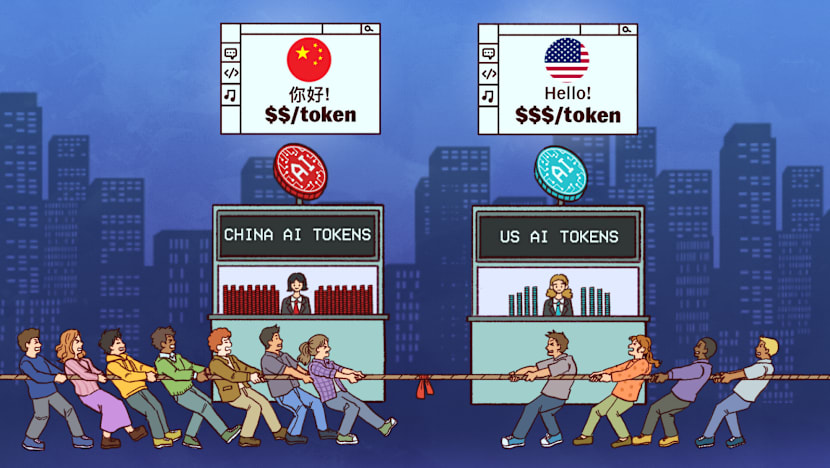
This is where Chinese AI models could excel and gain more traction over American AI models among businesses in Asia - especially India and Southeast Asia - experts told CNA, citing their ability to offer cheaper AI tokens.
For instance, models from Chinese companies such as MiniMax and Moonshot charge about US$2 to US$3 per million output tokens.
In comparison, Google’s Gemini 3.5 Flash model charges about US$9, Anthropic’s Claude Sonnet 4.5 costs about US$15 and OpenAI’s GPT 5.5 model is priced at US$30, according to a Financial Times report and Google and OpenAI’s pricing documents.
Charges are based on the number of input and output tokens consumed.
Input tokens come from the prompt or material sent to the AI, while output tokens come from the response it generates. Output tokens usually cost more.
A small sales team of 50 employees could use about 450 million tokens monthly, including both input and output tokens, according to estimates from Amit Verma, founding head of technology at US-based AI services firm Neuron7.ai.
This can amount to a cost of about US$3,150 monthly and US$38,000 annually using GPT 5.5 model, which is around two to three times more than the costs of Chinese AI models.
Chinese AI token costs are cheaper because of a mix of efficient model designs, lower energy and data infrastructure costs, government subsidies, and aggressive pricing strategies, said experts.
As companies move from simple AI chatbots to AI agents that can plan, search, verify information, connect to other software systems and repeat tasks in the background, token usage can surge - and so can costs.
“Token costs multiply across every step, making the unit price of each token far more consequential,” Wong Qi Han, an independent AI researcher and builder, told CNA.
Signs are emerging: companies and organisations such as Airbnb, Thinking Machines Lab - founded by former OpenAI chief technology officer Mira Murati - and AI Singapore have incorporated Alibaba’s Qwen models.
Experts said AI token prices from Chinese AI firms such as Alibaba’s Qwen, DeepSeek, Kimi, Zhipu’s GLM and MiniMax are giving startups and enterprises a cheaper way to run high-volume AI tasks, especially in price-sensitive markets such as India and Southeast Asia.
They added that cheaper AI tokens could make its adoption far more affordable across call centres, software development, e-commerce, education, legal research, manufacturing and back-office operations.
But observers also added that the cheaper route comes with trade-offs, including quality, latency, trust, regulation, data security and geopolitical risk.
WHY CHEAPER TOKENS MATTER TO ASIAN BUSINESSES
AI token-based pricing mainly affects companies and developers that build AI into products, apps and internal workflows.
While ordinary users may access AI through free or fixed-fee subscriptions, businesses running AI at scale typically pay by usage, based on the number of input and output tokens their systems consume.
Tokens also act like a billing meter: the more a system reads and generates, the more it costs.
Experts said this pricing model is now common because corporate businesses and enterprises use AI at a much larger scale than ordinary users - across millions of customer chats, coding requests, research tasks, document summaries and background AI agent actions.
Every chatbot reply, code suggestion, translation, document summary or AI agent action consumes tokens.
According to a joint report by McKinsey, Singapore Economic Development Board and Tech in Asia in February, 46 per cent of companies in Southeast Asia had gone beyond AI experimentation to include them in their workflows and products.
In India that number is 47 per cent, according to an Ernst & Young-Confederation of Indian Industry report.
For Asian companies, the cost of AI is becoming a business problem, especially with the rise of AI agents, experts told CNA.
AI agents go beyond answering prompts. They can plan steps, check information, use apps or company systems, and repeat actions in the background to complete a task.
Verma told CNA that AI use is shifting from “single-turn prompts” - simple one-step AI requests - to agentic workflows that may require 50 to 100 internal operations for a single output.
These background steps, including prompting, verification, reflection, code execution and the use of other external software tools, all consume more tokens, he said.
Based on Anthropic’s estimates, the average AI token cost of a software developer in an enterprise using Claude Code was US$13 per day, with monthly costs of roughly US$150 to US$250 per developer, said a Business Insider report in April.
For large tech businesses employing 500 developers, the AI token costs would be roughly US$75,000 to US$125,000 a month, or US$900,000 to US$1.5 million a year, before any discounts or enterprise deals.
Most AI providers do offer discounts for enterprise customers.
However, these are typically negotiated privately and based on usage volume commitment, contract length, models being used, customer support required and if whether cloud services are included.
According to media reports, OpenAI has offered some enterprise customers 10 per cent to 20 per cent discounts on multi-year or bundled deals.
Verma added that Asia “may become the first region where AI becomes a truly mass market at industrial scales”, as countries such as India, Indonesia, Malaysia and the Philippines have “huge services economies, large developer pools and are extremely price sensitive”.
If Chinese AI token cost makes AI execution cheaper, Asian companies could build AI into “call centres, field services, education, logistics and finance operations faster than if they had to pay premium Western prices”, he said.
But Wong said businesses in India and Southeast Asia should not judge AI costs by only the sticker price per million tokens.
An AI model trained to handle Chinese or English efficiently may use more tokens - and therefore cost more - when processing languages such as Tamil, Bahasa Indonesia or Vietnamese.
A model that appears 50 per cent cheaper can become more expensive in production if it performs poorly in a company’s local operating language, requires repeated attempts or needs more human review, Wong said.
The more useful metric, he added, is the “cost per successful outcome” - the total cost of getting a correct and usable result.
WHO IS WINNING THE AI RACE FOR BUSINESS ADOPTION?
China is emerging as a stronger challenger to the US in the AI race because of its lower token costs, experts told CNA.
Chinese AI firms’ cost advantage comes from cheaper energy and more efficient models, including mixture-of-experts architectures, according to a Financial Times report.
Mixture of experts, or MoE, is an AI architecture popularised by DeepSeek’s R1 model last year. It uses multiple specialised sub-models within one AI model, but activates only the most relevant sub-model for each prompt. This reduces computing costs.
Think of an MoE model as a team of specialists - a doctor, lawyer and engineer - where only the most relevant expert responds while the others remain idle.
Verma said Chinese AI firms’ cost advantage also comes from subsidised AI data centre infrastructure provided by their government and more efficient model architectures such as key-value, or KV, caching.
KV caching allows AI systems to store and reuse information they have already processed, instead of spending new tokens and computing power to read or reproduce the same material again.
Still, experts said this does not mean the US has lost the AI race.
The US continues to dominate the premium frontier layer through OpenAI, Anthropic and Google, especially in complex reasoning, advanced coding, enterprise reliability, security and support, they added.
Verma said the AI market could be split into “premium intelligence” and “commodity intelligence”.
Premium models from US firms would still be used for frontier reasoning, complex coding, scientific work and high-trust enterprise agents, while cheaper Chinese models could handle summarisation, extraction, classification, translation, document parsing, customer support tickets, basic coding and routine agentic tasks.
THE TRADE-OFFS: CHEAP AI IS NOT ALWAYS CHEAPER
Cheaper Chinese AI tokens could be attractive for high-volume tasks where some margin of error is acceptable, or where a human remains in the loop, experts said.
Verma said he would accept a small drop in model performance for a large cost saving.
“I will sacrifice 2 to 3 per cent (lower performance) for cost optimisation,” he said.
As of March, the top US models had a 2.7 per cent performance advantage over Chinese AI models, according to a Stanford University report.
Calvin Tan, co-founding chief technology officer and an AI and software engineer at Singapore AI firm Pints.ai, told CNA that cheaper and smaller Chinese models may work well in areas such as news summarisation and sentiment analysis because volumes are large and the tasks are not too difficult.
For example, financial firms can use cheaper AI tokens to scan large volumes of news and classify whether an item could affect oil prices, he said.
“The fire hose of news is going to be a lot. Doing that with ChatGPT or Claude is too expensive,” he added.
But cheaper AI models can be harder to deploy reliably for complex use cases, experts said.
Tan said Anthropic’s Claude and OpenAI’s GPT models remain “hot favourites” because they are more reliable options for building AI applications that work well.
He cited chatbots as an example.
“Chatbots are one of the most challenging to make work with cheaper models,” he said.
He added that in China, the Chinese chatbots work “reasonably well” as a lot of engineering hours have been put into overcoming the weaker models.
“Outside of China, where labour is expensive or AI talent is scarce, such ability to overcome weaker models won’t be there,” he said.
Companies may therefore struggle to engineer around weaker models, he added.
Regulated industries face another constraint.
Wong said that for enterprise customers in sectors such as finance, healthcare and government, AI cost is rarely the only deciding factor.
Compliance with local data protection rules and data storage requirements can matter more than unit pricing.
Last year, when DeepSeek’s R1 model became widely popular, countries such as the US and the United Kingdom cautioned users about data security and hacking risks linked to the Chinese AI model, according to reports from Politico and The Guardian.
Experts told CNA that such concerns have eased among businesses in Southeast Asia, especially because many Chinese models are open source.
Verma said that if a company downloads a model and runs it locally, “security ends up becoming less of a concern”.
Open-source models allow developers and companies to download and customise by adding their own guardrails before running AI systems on their own cloud infrastructure or locally contained servers, experts said.
Running an AI system locally can help ease data protection and storage concerns by giving organisations greater control over where sensitive information is processed and stored, while reducing the need to send confidential data to external AI providers or third-party platforms, they added.
GEOPOLITICS
Another consideration for companies is geopolitical sensitivities.
On Apr 30, US lawmakers launched an investigation into US companies using Chinese AI models, starting with Airbnb and Anysphere, the parent company of coding agent tool Cursor, The Hill reported.
James Pang, an analytics and operations professor at the National University of Singapore (NUS) and director of the NUS Business Analytics Centre, said some companies in Asia using Chinese AI tokens may not mention it publicly “because of geopolitics”.
In India, companies are also cautious about Chinese AI models because they fear future regulatory changes could stop them from using the technology, Chinmay Bhosale, co-founder of Indian legal AI startup Nyai, told CNA.
Such concerns are understandable.
In June 2020, the Indian government banned 59 Chinese apps, including TikTok and WeChat, due to security concerns following a border dispute between the two countries, according to local media reports.
Latency is another trade-off.
Tan said Chinese AI tokens’ appeal outside China depends partly on whether they can deliver the same cost benefits when AI infrastructure is hosted elsewhere.
Once hosted outside China, some of the infrastructure cost advantages may disappear because energy and AI data centre costs can be higher.
The likely outcome is not that Asia chooses one AI stack.
Verma said the region may become a multi-model market: OpenAI, Anthropic and Gemini for premium reasoning; Qwen, DeepSeek, Kimi and MiniMax-style models for high-volume workflows; and local models for language, regulation and national-security needs.
In the end, Verma said, companies will judge AI not by the model it uses, but by the business outcome it delivers.
“Is the AI helping them meet that objective? … Am I making money or saving money?” he said, of the questions that companies will be looking at in deciding how to deploy AI models.
[Image text:] Hello!
$$/token
$$$/token
CHINA AI
TOKENS
US AI TOKENS