
World News
Commentary: Why West Bengal matters beyond India’s borders
Key Points
Commentary: Why West Bengal matters beyond India’s borders Prime Minister Narendra Modi’s ruling party and its allies now control states covering most of India’s shared border with Bangladesh, says Rahul Verma from the Centre for Policy Research. The 2026 West Bengal legislative assembly election may come to be remembered as one of the most consequential state polls in contemporary India. It marked the moment when Prime Minister Narendra Modi finally breached one of the last major regional...
Commentary: Why West Bengal matters beyond India’s borders
Prime Minister Narendra Modi’s ruling party and its allies now control states covering most of India’s shared border with Bangladesh, says Rahul Verma from the Centre for Policy Research.
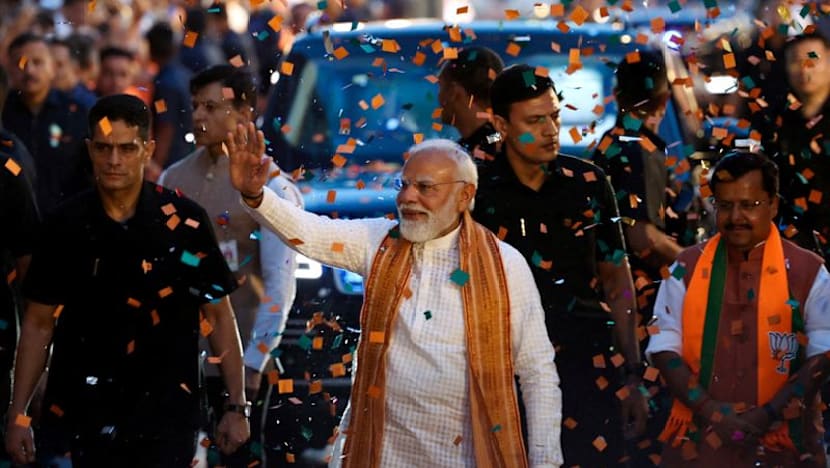
NEW DELHI: The 2026 West Bengal legislative assembly election may come to be remembered as one of the most consequential state polls in contemporary India. It marked the moment when Prime Minister Narendra Modi finally breached one of the last major regional fortresses resisting his expansion of political power.
But the larger significance of West Bengal lies in what it signals beyond the immediate – about the nationalisation of Indian politics and what that might mean beyond India’s borders.
The Bharatiya Janata Party (BJP) and its allies now govern 22 out of 31 states across India. When Mr Modi came to power in 2014, they held just seven states.
HOW WEST BENGAL WAS WON
West Bengal was supposed to be difficult terrain for the BJP and victory looked an uphill task.
The state’s political culture tends to produce dominant parties. West Bengal was governed by the communist-led Left Front for 34 uninterrupted years before the incumbent Trinamool Congress (TMC) came to power in 2011. TMC leader Mamata Banerjee remained extremely popular despite governing continuously for 15 years.
And while the BJP has gained considerable ground in previous polls of the last decade, there were structural barriers that historically created a ceiling on its expansion: Muslims constitute nearly 30 per cent of the state’s population, and they had historically backed anti-BJP parties. The BJP was also long viewed by Bengalis as culturally associated with India’s Hindi-speaking political establishment.
So what changed this time? The single biggest factor behind the TMC’s defeat was serious anti-incumbency sentiment.
Allegations of extortion and bribery, popularly called “cut money” politics in West Bengal, became politically corrosive. Voters were frustrated that petty corruption had become normalised in everyday interactions between citizens and the party-state machinery.
The deterioration of law and order compounded these frustrations. A widely publicised 2024 rape and murder case of a trainee doctor in a hospital in West Bengal capital city Kolkata sparked outrage about women’s safety.
This evolved into a symbol of broader anxieties about governance and impunity after allegations of an institutional cover-up. This mattered because women had formed one of the TMC’s most reliable electoral blocs.
BJP’S INCREASING DOMINANCE
This historic win will deepen concerns that India is moving toward becoming a one-party state. Some continue to question the authenticity of the West Bengal results and it will also add further fuel to concerns regarding increasing democratic deficit.
There had been controversy surrounding the Special Intensive Revision (SIR) of electoral rolls, where an update of West Bengal’s list of 76 million eligible voters removed 9 million names. While there are allegations that this disenfranchised a large number of eligible voters and disproportionately excluded Muslim voters in several constituencies, the BJP’s victory margin was too substantial to be explained purely through the SIR process alone.
The political effect of the controversy was more indirect: It deepened communal polarisation and reinforced the BJP’s broader narrative around illegal immigration, citizenship and demographic anxieties.
But hasty conclusions are a grave injustice to the fact that elections in India remain fiercely competitive, and opposition parties are in power in major states. Tamil Nadu and Kerala went to the polls at the same time as West Bengal and elected very different parties, keeping BJP as a marginal player.
Still, there is no doubt that BJP's political dominance is increasing. But this cannot be solely explained by BJP's resource and institutional advantage as the ruling party.
The BJP is increasingly setting the agenda of electoral contests. The opposition parties are merely reacting and opposing, rather than adapting and offering viable alternatives. Regional parties that once served as powerful counterweights to BJP's national dominance appear trapped between dynastic succession, ideological exhaustion, and weak organisational machines.
The turmoil within the TMC following its electoral defeat in West Bengal – in which a large faction of party legislators and parliamentarians have parted ways with the parent party – is a reminder that the challenge facing India's opposition parties is no longer merely winning elections, but also preserving party unity after losing them.
WHY ASIA SHOULD PAY ATTENTION
The significance of West Bengal extends beyond India’s domestic politics. It could also reshape dynamics in South Asia.
The BJP now exercises significant influence across much of India’s eastern frontier – from Assam and the Northeast to West Bengal – giving New Delhi greater political coherence in managing one of South Asia’s most sensitive border regions with Bangladesh and Myanmar.
The BJP has consistently framed illegal immigration from Bangladesh as both a demographic and security challenge. The party now has greater administrative capacity to pursue tighter enforcement of the 4,000km land border India shares with Bangladesh (more than half of which is in West Bengal), as well as citizenship verification measures and anti-infiltration operations.
In West Bengal, the BJP victory has accelerated long-pending efforts to expand border infrastructure. The state’s chief minister said on May 27 that about 57 hectares of land had been transferred to the Border Security Force for fencing projects. Additional land has been allocated around the strategically important Siliguri Corridor, the narrow stretch connecting mainland India to its northeastern states.
It remains to be seen how New Delhi navigates its ties with the new regime in Dhaka when there are heightened sensitivities on both sides of the border, but there is no doubt that the BJP's consolidation along India's eastern border will shape South Asia's strategic landscape in the years ahead.
Across the world, democracies are witnessing the fusion of charismatic leadership, welfare populism and majoritarian politics into durable electoral coalitions. The West Bengal electoral results suggest India may now be moving more firmly in that direction.
As economic anxieties deepen and global instability grows, the consequences of this political order in the world’s largest democracy will extend far beyond India itself.
Rahul Verma is a Fellow at the Centre for Policy Research (CPR), New Delhi. The views expressed are personal.
West Bengal (LOCATION)
India (LOCATION)
Narendra Modi (PERSON)
Bangladesh (LOCATION)
Rahul Verma (PERSON)
the Centre for Policy Research (ORG)
Indian (ORG)
The Bharatiya Janata Party (ORG)
BJP (ORG)
Mr Modi (PERSON)
Left Front (ORG)
Trinamool Congress (ORG)
TMC (ORG)
Mamata Banerjee (PERSON)
Muslims (ORG)