
Weather
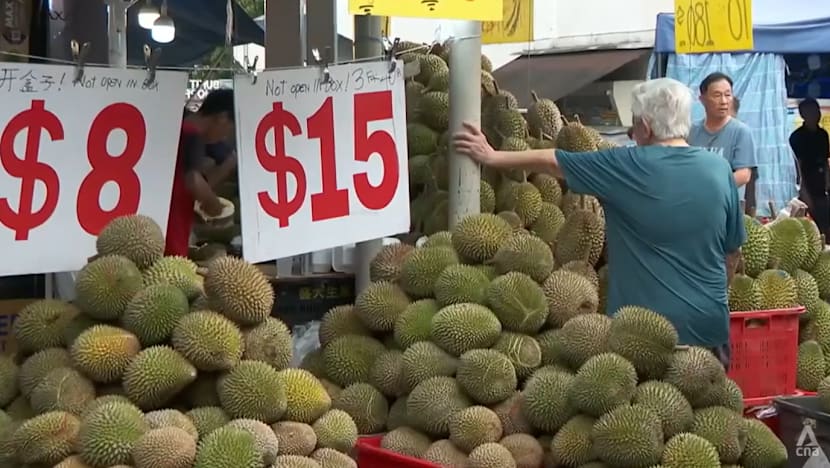
Durian sellers brace for less supply, poorer quality durians amid rainy peak harvest season
Key Points
Durian sellers brace for less supply, poorer quality durians amid rainy peak harvest season Harvests from some regions in Malaysia are expected to arrive in Singapore later this month, but supply is likely to be lower than last year's bumper crop. SINGAPORE: Weather conditions in the coming weeks could affect the size and quality of this year's durian supply, amid the ongoing peak harvest season between June and September. Sellers and suppliers of the thorny fruit said they are navigating an...
Durian sellers brace for less supply, poorer quality durians amid rainy peak harvest season
Harvests from some regions in Malaysia are expected to arrive in Singapore later this month, but supply is likely to be lower than last year's bumper crop.
SINGAPORE: Weather conditions in the coming weeks could affect the size and quality of this year's durian supply, amid the ongoing peak harvest season between June and September.
Sellers and suppliers of the thorny fruit said they are navigating an increasingly unpredictable season.
Harvests from some regions in Malaysia are expected to arrive in Singapore later this month, but supply is likely to be lower than last year's bumper crop.
Heavy rainfall can affect the taste and ripeness of the “King of Fruits”, according to sellers. They noted that while consumers often associate harvest quantities with prices, quality can have an even greater impact.
"If durian (quality) is bad, the price is going to be very cheap. It doesn't matter whether the season (yields) a lot of durians,” said Mr Jeremy Chew, founder of Royal Durian, a Musang King – or Mao Shan Wang – specialty store.
The popular cultivar is prized for its bittersweet taste and creamy flesh.
“Ultimately, we need to factor in the weather as well … If let's say every day (there is) heavy rain, durian quality will be very bland or unripe,” said Mr Austin Quak, who co-founded the Rolling Durian shop in Toa Payoh.
Mr Quak is currently sourcing durians from Malaysia’s Perak and Penang states, saying the quality of the fruits there is more stable than in Johor and Pahang.
LIVESTREAMING SALES
As sellers contend with uncertain harvest conditions, many are also changing how they reach customers.
Livestreaming has become an increasingly important sales channel, allowing consumers to watch durians being opened in real time before deciding whether to place an order.
"Us doing online (gives us) the chance to serve multiple customers at once, compared to the traditional offline store, where you have to chat one by one,” said Mr Quak.
“If we do live streaming, there's an opportunity for us to cater towards more people as compared to walk-ins.”
According to Mr Quak, online sales for his business have increased by around 50 per cent compared with the same period last year.
However, as more sellers embrace livestreaming, competition has intensified, with businesses increasingly offering discounts and promotional bundles to attract customers.
FROZEN INVENTORY
Beyond adapting sales strategies, some firms are turning to technology to reduce their dependence on seasonal harvests and weather conditions.
Spike Durian, a Singapore start-up, is using electromagnetic fields during the freezing process to preserve durians long after the harvest season ends.
The company processes and freezes durians within five hours of harvest in Pahang, allowing them to store the fruits for at least six months.
The technology from Europe could eventually be applied to other products, including seafood and ready-to-eat meals.
"We only just started in December, and we have now sold close to about 5,000 boxes so it's been really, really encouraging,” Spike Durian founder Christopher Quek told CNA.
“Over the last two months we have received multiple inquiries across the world, in particular North Asia, China, Taiwan, and Japan. (These are) requests by suppliers who supply to premium supermarkets.”
The company is also fielding queries from further-flung places like the United States and United Kingdom, which Mr Quek called an “exciting” development.
“The biggest challenge that we're having now is trying to maintain the quality of durians from the durian supplier,” he added.
Another seller, 99 Old Trees Durian, also relies on frozen inventory to bridge the gap between harvest seasons.
While fresh durian accounts for about 80 per cent of its sales during harvest season, the company stockpiles up to 9 tonnes of seasonal harvest each year.
The fruit is frozen using liquid nitrogen and later used to make desserts sold at its cafe, including local favourites like chendol as well as other items such as durian mousse and cream puffs.
"During the off-season, the desserts are what keeps the lights on,” said 99 Old Trees Durian co-founder Kelvin Tan.
“We serve them up in desserts of different forms. For example, we serve them in cakes, or we turn them into durian ice cream, etc. … so customers can try durian at any time throughout the year.”
The company also produces its own durian paste, supplying it to about five bakeries and ice cream shops in Singapore.