
Politics
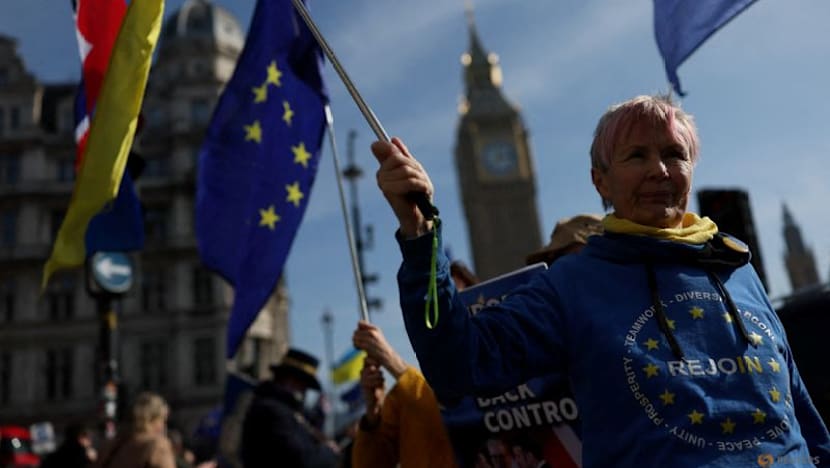
Commentary: Reversing Brexit would be an exercise in futility
Key Points
Commentary: Reversing Brexit would be an exercise in futility Rejoining the European Union is again a live topic in the United Kingdom, but the hurdles are daunting, says Matthew Brooker for Bloomberg Opinion. Rejoining the European Union is again a live topic of UK debate, a decade after Britain voted to leave. Reversing Brexit would be a mistake.
Commentary: Reversing Brexit would be an exercise in futility
Rejoining the European Union is again a live topic in the United Kingdom, but the hurdles are daunting, says Matthew Brooker for Bloomberg Opinion.
LONDON: Rejoining the European Union is again a live topic of UK debate, a decade after Britain voted to leave.
Reversing Brexit would be a mistake. That’s not because the decision to leave was correct; at this point, it’s indisputable that withdrawal damaged the economy, as well as doing obvious harm to the UK’s diplomatic relationships and global influence. Neither is it because of the practical objections to going back in, though these are substantial. The real reason is because Brexit was, at its heart, an identity crisis that remains unresolved.
Cards on the table. I wouldn’t have voted for Brexit, had I been in the UK at the time. Watching from afar in Hong Kong, where I lived during the referendum and through the UK’s formal departure, it seemed like a delusional project driven by magical thinking and a curious animus toward the EU’s rulemaking and (apparently lavishly remunerated) bureaucrats.
Regulations governing the shape of cucumbers and the definition of jam may be irritating and intrusive but they are also trivial. This seemed a little like leaving the biggest and best-equipped club in the neighborhood because you don’t like the way management repainted the lobby.
But Brexit was evidently about much more than economics. It was about sovereignty, culture and - above all, perhaps - immigration. At root, it was a crisis over what kind of country Britain is, what it wants to be and where it sees its place in the world. Leave and Remain became markers of tribal identity rather than a policy choice to be determined by a rational weighing of likely positives and negatives.
The 2016 campaign exposed deep fissures, and the decision and its aftermath haven’t healed any of them. This can be seen in the way these issues continue to play out, in the fracturing of the political landscape and the rise of the far right, the 2024 anti-asylum seeker protests and now the reactions to the murder of teenager Henry Nowak in Southampton and a knife attack by a Sudanese immigrant in Belfast.
AN HONEST CONVERSATION NEEDED
Polls for years have shown that most Britons think the decision to leave the EU was a mistake - and by a far wider margin than the 52-to-48 majority who voted for Brexit in 2016. If another referendum were held today, voters would probably choose to rejoin.
But to attempt to jump back in without working through the tensions and divisions that caused the initial rupture would simply invite another loop in a recurring psychodrama. There’s a sequence that needs to be followed.
Progress requires an honest conversation, a refrain I heard repeatedly in discussions about Brexit. The hardening consensus that leaving the EU has done large and enduring damage to the UK economy has opened space for a more sober debate on the costs and benefits of sovereignty versus integration - and how much we are prepared to give up of one to achieve the advantages of the other.
This wasn’t possible as long as people were able to hold on to the illusion that the country could become both freer and richer by breaking away from the EU.
A LOOK AT BRITAIN'S POLITICAL SYSTEM
Britain’s political system has retarded this truth-and-reconciliation process. One of the unfortunate side-effects of Brexit is the noxious effect it had on the political establishment’s capacity for honesty and candor. A polemical campaign marked by false claims and exaggerations gave way to a post-referendum code of omerta. The majority of parliamentarians understood that the decision to withdraw was economically harmful, but it became impolitic to confront this openly for fear of alienating Leave-voting constituencies. This taboo is now breaking down, thanks partly to the leadership ambitions of Labour’s Wes Streeting. But there is a long way to go.
A country that has yet to resolve the traumas that caused it to break away last time can hardly be regarded as a reliable partner. Hence the speculation that, if Britain did attempt to rejoin, the EU would require a “Farage clause” to protect the bloc from a future Reform UK government led by Brexit’s chief architect, Nigel Farage, reneging on any deal.
In any case, the hurdles to rejoining would be daunting. Time has moved on and the UK, the EU and the world have all changed since 2016.
The British public’s recognition that Brexit was an economic mistake doesn’t necessarily imply a willingness to go through the whole ordeal again. And even if an application were welcomed, there’s no guarantee the country could obtain the same generous terms enjoyed previously, such as budget rebates and opt-outs from the euro and the Schengen passport-free area.
There are more fundamental questions to address first.
Returning to the UK in 2022 after more than three decades away, I recognise now that I came back to a much more divided and discontented country than the one I left. It still feels in flux. Britain can’t make credible decisions about its long-term destiny until it has moved beyond this unstable equilibrium. The powers of sovereignty and autonomy reclaimed by Brexit are real; they’re just not free. A shared understanding on that point needs to be the start rather than the end of a journey.