
Science
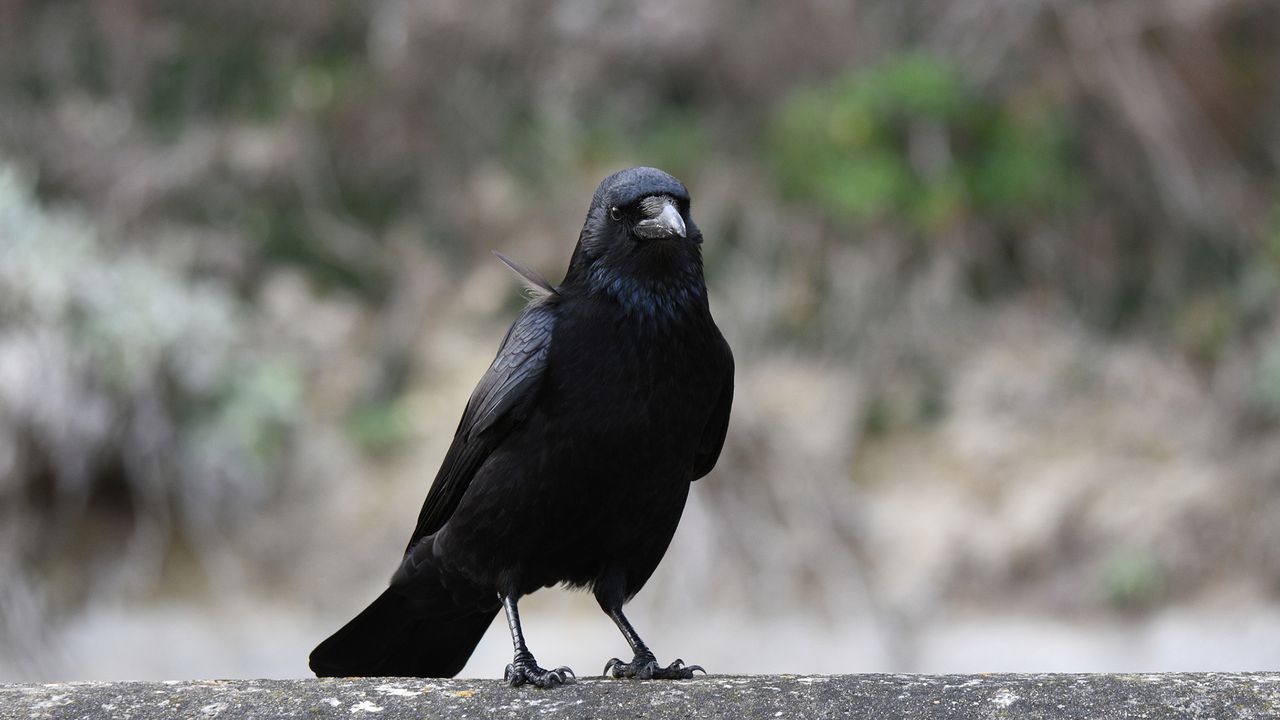
'They reliably chose the statistically more favorable option': A crow researcher explains how these winged geniuses process numbers, and what it could reveal about human math smarts
Key Points
'They reliably chose the statistically more favorable option': A crow researcher explains how these winged geniuses process numbers, and what it could reveal about human math smarts Live Science spoke with animal researcher Andreas Nieder about how animals process mathematical concepts like statistical reasoning and the idea of zero. Corvids, including ravens and crows, have earned a reputation for being some of the smartest birds on Earth. They can recognize human faces, use tools, solve...
'They reliably chose the statistically more favorable option': A crow researcher explains how these winged geniuses process numbers, and what it could reveal about human math smarts
Live Science spoke with animal researcher Andreas Nieder about how animals process mathematical concepts like statistical reasoning and the idea of zero.
Corvids, including ravens and crows, have earned a reputation for being some of the smartest birds on Earth. They can recognize human faces, use tools, solve multistep puzzles and even hold funerals.
In recent years, scientists have added another surprising skill to the list: a grasp of numbers. Research suggests that corvids can distinguish between different quantities and, in some cases, even perform statistical analysis.
These discoveries have raised a provocative question: How deep do the roots of mathematical thinking go? While modern humans are the only known species to develop formal mathematics, studies of crows, monkeys and other animals suggest that the cognitive building blocks of math may have evolved hundreds of millions of years before people began doing calculations.
Few researchers have done more to uncover these abilities than Andreas Nieder, a professor of animal physiology and the director of the Institute of Neurobiology at the University of Tübingen in Germany. By examining the neural activity of both monkeys and crows, Nieder has found evidence that very different animal brains can process numerical information in surprisingly similar ways. Live Science spoke with Nieder about how these findings may reveal that the origins of mathematics are far older than our species.
Kenna Hughes-Castleberry: How did you get into researching crows and primates?
Andreas Nieder: After studying the auditory and visual systems for several years as a student, I realized that I wanted to focus on the neuronal foundations of intelligence and cognitive control functions. How does the brain give rise to abstract concepts, working memory, or the ability to follow complex rules deliberately? Of course, to study intelligence, you need intelligence specialists. I therefore began working with primates — more specifically, rhesus monkeys, arguably among the most intelligent mammals. They are closely related to humans, possess relatively similar brains, and share many cognitive abilities with us.
However, as a trained biologist, I was always interested in a broader evolutionary question: Are sophisticated cognitive abilities unique to mammals, or can they emerge in very different brains? Crows provided an ideal comparative species. Birds diverged from mammals more than 360 million years ago — roughly six times longer ago than the extinction of the dinosaurs. Yet despite this immense evolutionary distance, corvids display remarkably flexible behavior; in many ways, they are the feathered primates of the air.
Get the world’s most fascinating discoveries delivered straight to your inbox.
KHC: Are crows difficult to study? Are they fun? Do they have personalities?
AN: Both primates and crows are demanding to study. Because they are highly intelligent, they require special housing and care. Since we investigate cognitive abilities under tightly controlled experimental conditions, they also require extensive behavioral training by skilled personnel. And, of course, the regulations governing research with these species are particularly strict.
At the same time, they are fascinating research subjects. Individual monkeys and crows differ noticeably in temperament and behavior. Some are curious and adventurous, others are cautious and reserved, and some learn new tasks much faster than others.
Their qualities can be quite striking. Some are reliable, highly motivated workers that perform consistently day after day. Others are sensitive divas who seem to require special treatment before they are willing to cooperate. Researchers generally avoid anthropomorphizing, but there is little doubt that individual animals exhibit stable behavioral traits that we would reasonably describe as distinct characters.
KHC: You've found that crows understand the concept of zero. How do we know this?
AN: We trained crows to recognize different numbers — sets containing one, two, three, four objects, and so forth. We then included trials in which no items appeared at all. The remarkable finding was that the birds treated an empty set as a quantity and as part of the numerical continuum. They behaved as though the empty set belonged before "one." Their error patterns were particularly revealing: They confused zero more often with one than with larger numbers, exactly as one would expect if zero were mentally represented as a numerical quantity next to one. In addition, recordings from neurons in the crow brain showed cells that responded selectively to empty sets. This suggests that zero is not merely a behavioral trick but is represented neurally as a meaningful numerical category.
KHC: To play devil's advocate, is the ability to recognize the difference between something and the lack of something really that surprising? Is it akin to the human concept of zero?
AN: That's an important question. Simply recognizing that nothing is present or absent is not surprising. Many animals can distinguish between the presence and absence of objects. The key issue is whether they treat "nothing" as a quantity that can be compared to other quantities.
Our experiments suggest that crows do more than detect absence. They position empty sets within an ordered numerical sequence, at the low end of the number line, and show distance effects similar to those observed with other numbers. For example, they find it easier to distinguish zero from two than zero from one.
That said, we should not claim that crows possess the full human mathematical concept of zero. Humans use symbolic zero in arithmetic, algebra, calculus and formal mathematics. What we have demonstrated is a foundational precursor: a nonsymbolic numerical representation of zero. This may represent an evolutionary building block from which more sophisticated human concepts eventually developed.
KHC: You've also found that crows can perform statistical analysis. Tell me more about these findings and what you showed.
AN: We trained carrion crows [Corvus corone] to associate a series of arbitrary visual signs, colored geometric images displayed on a touch screen, with different reward probabilities. One sign might yield a food reward 90% of the time, another 70%, another 50%, and so on down to 10%. Importantly, the signs themselves carried no inherent meaning; the birds had to learn these probabilities through experience.
Once the birds had learned these sign-probability associations, we presented them with pairs of signs and asked them to choose one. To maximize their rewards, they should select the sign associated with the higher reward probability. The crows did exactly that. Even when confronted with many novel pairings, they reliably chose the statistically more favorable option.
This does not mean that crows perform formal statistics in the human sense. They are not calculating percentages or solving probability equations. However, the results show that they can extract probabilistic regularities from experience, store this information in memory, and use it flexibly to make reward-maximizing decisions under uncertainty. These are fundamental ingredients of statistical reasoning and are highly valuable in natural environments, where animals constantly have to make decisions based on incomplete information.
KHC: Have researchers tried similar tests on babies or young humans, and if so, how do we stack up?
AN: Yes. Developmental psychologists have conducted many related studies with infants and young children. Even before learning language, infants show sensitivity to quantities, numerical differences and simple probabilistic information. By around 4 years of age, children also display an intuitive understanding of empty sets.
What is striking is that the behavioral signatures observed in crows resemble those seen in preverbal human infants and nonhuman primates. Of course, human children eventually develop symbolic mathematics through language, education and culture, which takes them far beyond the abilities observed in animals.
KHC: Can these findings tell us anything about how the human understanding of math evolved?
AN: They suggest that some foundations of mathematics may predate humans by a very long evolutionary timescale. Humans did not invent numerical intuition from scratch. Rather, we appear to have inherited ancient cognitive systems that allow brains to estimate quantities, compare numbers, and represent concepts such as zero approximately.
The fact that crows and primates — two distantly related groups — show similar numerical abilities suggests that these capacities may emerge whenever evolution favors flexible intelligence. Human mathematics likely built upon these ancient cognitive foundations and then expanded dramatically through language, symbols and culture.
KHC: What's something a general audience might be surprised to learn about crows?
Many people are surprised to learn that crows are songbirds. Most people associate songbirds with melodic singers such as nightingales or blackbirds, not with the harsh cawing of a crow. Yet crows do learn a significant part of their vocal repertoire and are even known as apt imitators, even of human speech sounds — the internet is full of funny videos in which crows imitate human speech.
What makes this particularly interesting is that their vocalizations are not merely reflexive calls. In our experiments, we found that crows can exert volitional control over their vocal behavior. They can learn to produce vocalizations in response to arbitrary cues and withhold them when required, demonstrating a level of cognitive control over vocal output that is considered an important prerequisite for complex communication and, ultimately, language.
Related stories
More recently, we showed that crows can even use their vocalizations to count. In a recent study published in [the journal] Science, we trained crows to produce a specific number of calls — between one and four — in response to visual or auditory cues. Remarkably, they not only generated the correct number of vocalizations but also appeared to prepare the intended number before they started calling. This suggests that they can represent numerical information and use it to guide a self-generated sequence of vocal actions.
Taken together, these findings show that crow vocalizations are far more sophisticated than most people assume. Their characteristic "caw" is not just a simple call — it can be brought under deliberate cognitive control and even used to express numerical information. For a bird, that is a remarkably advanced ability.
This interview has been edited for length and clarity.
Are you a bird nerd? Find out with our bird quiz!
Kenna Hughes-Castleberry is the Content Manager at Live Science. Formerly, she was the Content Manager at Space.com and before that the Science Communicator at JILA, a physics research institute. Kenna is also a book author, with her upcoming book 'Octopus X' scheduled for release in spring of 2027. Her beats include physics, health, environmental science, technology, AI, animal intelligence, corvids, and cephalopods.
You must confirm your public display name before commenting
Please logout and then login again, you will then be prompted to enter your display name.