
Science
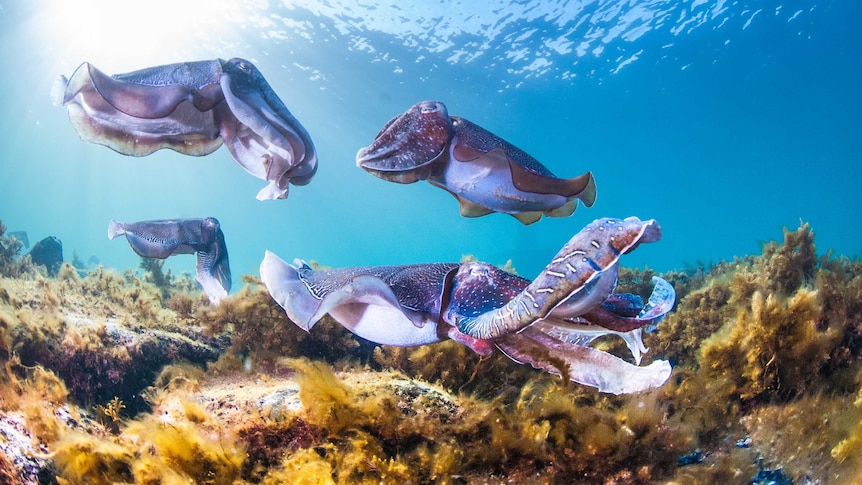
Experts fear algal bloom to blame for disappearance of Whyalla's cuttlefish
Key Points
Whyalla's giant Australian cuttlefish missing amid fears algal bloom to blame Thu 18 Jun 2026 at 7:32am In short: The giant Australian cuttlefish annually return to the waters of the Upper Spencer Gulf, near Whyalla, in their tens of thousands for its breeding season. But this year, barely any have arrived. Tourism operators, environmentalists and marine experts are worried the species has been devastated by the algal bloom.
Whyalla's giant Australian cuttlefish missing amid fears algal bloom to blame
Thu 18 Jun 2026 at 7:32am
In short:
The giant Australian cuttlefish annually return to the waters of the Upper Spencer Gulf, near Whyalla, in their tens of thousands for its breeding season. But this year, barely any have arrived.
Tourism operators, environmentalists and marine experts are worried the species has been devastated by the algal bloom.
What's next:
The cause is as-yet undetermined, with PIRSA and South Australian Research and Development Institute investigating. A full population survey to be undertaken next week.
At this time of year, the waters of Whyalla are normally home to tens of thousands of giant Australian cuttlefish, but so far this winter, they haven't arrived in even close to those numbers.
Marine experts fear the harmful algal bloom has had a devastating impact on the species, which annually breeds in the Upper Spencer Gulf.
Owner of the Whyalla Dive Shop and Eyre Lab director Manny Katz said those thousands of cuttlefish "should" have arrived, with waters now within the temperature range for the species' breeding conditions, yet they're almost nowhere in sight.
"We've seen maybe a couple dozen spread out across all of the different sites that we go to, across the 8 kilometres of coast," Mr Katz said.
"There's been maybe 25 to 30 that we've been able to spot. It's not great at the moment."
Fears for the Upper Spencer Gulf's cuttlefish population were raised last year during the height of South Australia's harmful algal bloom, with discussions on whether to relocate the species' hatchlings.
Those discussions culminated in a government investment of $700,000 to install a "bubble curtain", which was hoped would protect the species and its eggs.
With the bloom never arriving in the Upper Spencer Gulf, the curtain — which was hoped to form a shield around a specific part of the Upper Spencer Gulf — was never needed to be turned on. However, the population's migratory patterns take the species out of that protected area during warmer seasons.
Mr Katz said they will not fully know how the tourism season will fare until temperatures drop further, but his business had thus far been postponing tours.
"It would be absolutely devastating to not have them here — not just for the tourism operators, but also for the rest of the town,"he said.
"If the cuttlefish don't rock up, there's not going to be a season."
Different than before
Tony Bramley has been a scuba diver, environmentalist and tourism operator in the Upper Spencer Gulf for almost four decades, and previously owned the Whyalla Dive Shop.
He said there have been a number of times the species has had a sharp decline in its numbers since he arrived in the town in the 1980s.
He pointed to when commercial fishing decimated the species in 1997 and 1998. He said those numbers recovered in the years after a fishing ban, with the population finally arriving at a figure Mr Bramley said was representative of a "biomass" of up to 225,000 cuttlefish around Whyalla.
That was until 2013, when the population crashed from 200,000 down to 8,000, with the official cause never determined. The population did eventually recover.
But Mr Bramley said this time, it's even worse.
"In 40 years, I've never seen anything like that, even in 2013 or '97, '98," Mr Bramley said.
"We've never seen numbers this low, even 2013 where we had only a very small number of animals; that was good compared to today. I'm sort of very pessimistic about the results for this year. I think what we're looking at is what they'll be for this year."
'Jury is out' at this stage
While the lack of cuttlefish is obvious to see, the cause is still uncertain.
Mr Katz said it was "hard to say" what impact the algal bloom has had on the cuttlefish population, though it was "most certainly having an impact".
"It might potentially be the largest impact on the cuttlefish aggregation, but because we don't have these systems in place for long-term monitoring, we just don't know," Mr Katz said.
Whyalla is currently celebrating Cuttlefest, its annual winter festival held in June and July dedicated to the species' return.
Whyalla mayor Phill Stone said it has been a great start to the event, even though the "special guest", the species itself, was so far absent.
He was quick to counter any fear of the bloom, and said "all the information we've been getting is that the algal bloom is not responsible".
"The jury is out, there," Mr Stone said.
"But believe it or not, the advice we have had is that the seawater temperature is too high for the cuttlefish to be moving in the numbers that they normally do. Yes, we would have expected them by now. You're always concerned when you know the normal movements."
The South Australian Research and Development Institute (SARDI) will undertake a full population survey next week.
Professor Mike Steer, executive director of SARDI, said it is "probably folly" to make an assessment on the aggregation so early in the season.
"It's not as simple as looking at numbers here and there," Mr Steer said.
"We do understand South Australia had been heavily impacted from the harmful algal bloom; there is that concern from that perspective, but we also understand cephalopod populations can fluctuate from year to year.
"There's a number of potential environmental factors that could be contributing to the fluctuations — food availability, temperature — that we see on an annual basis, but until we get the survey numbers, I think we'll hold until we make any premature assumptions."