
World News
China unveils white paper on global governance, calls for stronger Global South representation
Key Points
China unveils white paper on global governance, calls for stronger Global South representation This comes as Beijing seeks to position itself as a champion of multilateralism amid growing geopolitical tensions. BEIJING: China on Wednesday (Jun 17) released a new white paper on global governance, warning that the international system is at a critical crossroads. It also called for a greater voice for countries in the Global South while reaffirming the central role of international...
China unveils white paper on global governance, calls for stronger Global South representation
This comes as Beijing seeks to position itself as a champion of multilateralism amid growing geopolitical tensions.
BEIJING: China on Wednesday (Jun 17) released a new white paper on global governance, warning that the international system is at a critical crossroads.
It also called for a greater voice for countries in the Global South while reaffirming the central role of international institutions such as the United Nations.
The nearly 50-page document, which sets out Beijing’s vision for reforming global governance, comes as China seeks to position itself as a champion of multilateralism amid growing geopolitical tensions.
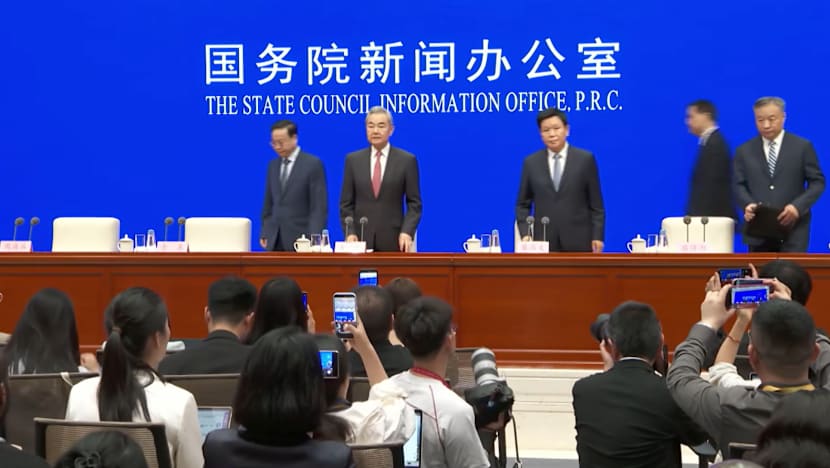
The white paper was unveiled at a rare news conference led by Chinese Foreign Minister Wang Yi, alongside senior officials from the country’s state planner and the ruling Communist Party, in a display of cross-agency coordination.
At the press conference, Wang Yi said the world was facing mounting challenges that required renewed commitment to multilateralism.
"Global governance is like a boat sailing against strong currents and it risks going backward if not moved,” he added.
"As the world has entered a new period of turbulence, more than ever, we need to reinvigorate multilateralism to uphold rules and the rule of law and increase the efficiency and efficacy of governance."
EXPANSION OF GLOBAL GOVERNANCE INITIATIVE
The white paper – called “More Just and Equitable Global Governance: China’s Principles, Proposals and Actions” – expands on ideas first outlined in China’s Global Governance Initiative (GGI) that was unveiled last year.
The GGI, put forth by Chinese President Xi Jinping, built on a string of sweeping international proposals rolled out by Xi in recent years. Observers told CNA it reflected China’s effort to consolidate them under a cohesive banner.
Beijing’s white paper presents what China describes as its solution for building a more just and equitable international system.
While it references major global flashpoints such as the war in Ukraine and hostilities in the Middle East, many of its criticisms are framed broadly rather than directed at specific countries.
It also contains several veiled criticisms of the United States, referring to some countries that have instigated trade and technology wars, as well as a “certain major power” that has withdrawn from international organisations.
Instead, Beijing advocates a UN-centred and multipolar system of global governance.
Wang Yi said on Wednesday: “The law of the jungle is resurfacing, not because the UN Charter is outdated, but exactly because the charter has not been effectively observed and safeguarded.
“Facing emerging global challenges, the pressing priority now is to fulfil the UN Charter's obligations, uphold sovereign equality, observe the international rule of law, oppose power politics and bullying acts.”
The white paper also calls for countries to de-escalate ongoing conflicts, with Wang Yi making a brief reference to the war on Iran.
“What is needed now is for all parties to work toward the same direction, commit firmly to a ceasefire, in order to lay the foundation for a sustainable security architecture in the Middle East,” he noted.
On Wednesday, US President Donald Trump and Iran’s president signed a deal meant to end the war, with Tehran agreeing to dilute its enriched uranium in return for large-scale economic relief.
GLOBAL SOUTH’S GROWING ROLE
Another key theme of Beijing’s white paper is the growing role of the Global South, which refers to various countries around the world that are sometimes described as “developing”, “less developed” or “underdeveloped”.
Many of these nations are in the Southern Hemisphere, largely in Africa, Asia and Latin America.
Wang Yi called for reforms to international financial institutions such as the International Monetary Fund and the World Bank to increase the representation of developing countries in global affairs.
While the white paper does not explicitly state China’s ambitions, observers said the push reflects Beijing’s desire to play a greater leadership role among developing nations.
Chinese Vice Foreign Minister Miao Deyu said: “China believes the collective rise of the Global South is unstoppable. The days when a handful of countries could dominate international affairs are over and long-standing historical injustices should be addressed.”
The white paper also outlines China’s approach to emerging challenges in areas such as artificial intelligence and outer space.
Beijing said it would continue to promote international cooperation to ensure that technological development remains safe, inclusive and beneficial to all.
"REALLY TIMELY"
Wang Huiyao, founder of Beijing-based non-government think-tank Center for China and Globalization, said even though the white paper did not explicitly mention the US, the implication of the US’ unilateral behaviour “is so obvious”.
“I think the message is clear – that we need to avoid the vacuum of global governance, and also all the countries, including the Global South which is rising economically and politically, should take more part in this global governance system,” he noted.
He added that the release of the white paper was “really timely”, given the multitude of global governance issues on the table over the next few months.
China is set to host the Asia-Pacific Economic Cooperation (APEC) Economic Leaders’ Meeting in Shenzhen in November, while the G20 summit will be held in the US the following month.
The UN is due to elect a new secretary-general by the end of this year as well, noted Wang, who is also a former Counselor to China's State Council.
The white paper demonstrates China's position and its call for a more inclusive, constructive and forward-looking reform of global governance, he told CNA’s East Asia Tonight.
“(Wang Yi) was saying China now is the second largest contributor to the UN peacekeeping budget, and the largest peace troop-sending country among the P5,” he added, referring to the five permanent members of the UN Security Council.
“I think China wants to make sure that they are active players – but not only that, China (is) calling for a greater reflection of the Global South.”