
Environment
Zero-waste plan review should focus on changing recycling habits, with penalties as last resort: Experts
Key Points
Zero-waste plan review should focus on changing recycling habits, with penalties as last resort: Experts Experts said future measures should not only aim to raise awareness about recycling, but to convert it into action. SINGAPORE: With Singapore looking to refresh its Zero Waste Masterplan amid dipping recycling rates, there needs to be a renewed focus on improving waste infrastructure and guiding consumer habits, said environmental academics and an advocacy group. While Singaporeans'...
Zero-waste plan review should focus on changing recycling habits, with penalties as last resort: Experts
Experts said future measures should not only aim to raise awareness about recycling, but to convert it into action.
SINGAPORE: With Singapore looking to refresh its Zero Waste Masterplan amid dipping recycling rates, there needs to be a renewed focus on improving waste infrastructure and guiding consumer habits, said environmental academics and an advocacy group.
While Singaporeans' awareness of recycling has improved over the years, it has not translated into better recycling outcomes, they said. This is why more must be done to convert awareness into action, but without having to turn to fines and penalties to guide behaviour.
For example, encouraging people to sort recyclables at the household level by providing segregated waste bins can improve recycling outcomes. But imposing penalties for not doing so, as is the case in some countries, should only be considered after everything else is in place.
Speaking to CNA, experts gave various suggestions that could move the needle on recycling after the government on Wednesday (Jun 17) announced a review of its 2019 Zero Waste Masterplan.
At the time, the master plan set a target of raising the overall recycling rate to 70 per cent, the domestic recycling rate to 30 per cent, and the non-domestic recycling rate to 80 per cent by 2030.
However, the overall recycling rate has since slipped from 59 per cent in 2019 to 52 per cent in 2025. The domestic and non-domestic recycling rates have also fallen from 17 per cent to 11 per cent and 73 per cent to 67 per cent respectively over the same period.
Senior Minister of State for Sustainability and the Environment Janil Puthucheary on Wednesday pointed to "significant" shifts in the global economics of recycling as a factor behind the decline in overall recycling rates. The review will begin in the coming months and complete in 2027.
While experts pointed to global shifts in recycling markets as part of the problem, domestic factors remain a significant challenge to Singapore's recycling goals.
MOVING FROM AWARENESS TO ACTION
The data suggest that awareness alone is no longer the main obstacle.
According to the National Environment Agency's 2025 household recycling survey, 78 per cent of households recycle, up from 72 per cent in 2023, and awareness of what can and cannot be recycled has also increased.
However, domestic recycling rates, which reflect recycling at households and trade premises such as shophouses, hawker centres and places of worship, have remained low.
"The disconnect lies between 'recycling participation' and 'effective recycling'," said Professor of Strategy and Sustainability at James Cook University Adrian Kuah.
More households may be attempting to recycle, but contamination of recyclables resulting in the limited recovery of good quality materials continues to undermine outcomes.
"This suggests that the problem is not just awareness or willingness, but the quality of recycling behaviour," Prof Kuah said.
He added that the domestic recycling rate was measured by tonnage recycled rather than the number of households participating.
"A household may recycle a few bottles or cans, but dispose much larger amounts of food waste and general waste down the rubbish chute.
"If the volume of successfully recycled material remains small, the recycling rate will stay low despite higher participation," he said.
Households also need clearer feedback and stronger behavioural signals of what they ought to do or avoid.
"More estate-level feedback, clearer labelling and visible reporting from grassroots (organisations) could help residents understand whether their recycling is actually effective," Prof Kuah said.
Singapore Management University's Associate Professor of Sustainability Communication Sonny Rosenthal noted that people who recycle do not always do so consistently or correctly.
He said that many people continue to throw recyclable items into general waste bins because they do not want the inconvenience of rinsing containers before disposal.
Singapore University of Social Sciences lecturer Eugene Or also pointed out that if households generate less waste overall, there will naturally be fewer recyclable materials entering the waste stream. Daily domestic waste generated per person fell from 1.06kg in 2015 to 0.83kg in 2025.
"As a result, a lower recycling volume does not necessarily indicate weaker participation in recycling. Rather, it may reflect broader changes in consumption patterns and waste generation behaviour," he said.
While stronger enforcement and disincentives are sometimes raised during discussions of how to improve recycling rates, experts said penalties should not be considered for now.
Prof Kuah said the priority should still be to build an "accountable" recycling system before imposing penalties on households.
"Penalties may still have a role later, especially for repeated or deliberate misuse. But they should come only after better separation, feedback, incentives, producer responsibility and measurement are in place."
In South Korea, fines are imposed on those who put food waste in general waste or recycling bags.
Dr Or said one of the main challenges with penalties is the cost and difficulty of enforcement.
"Contamination of recycling bins is difficult to police because the blue recycling bins in HDB (Housing and Development Board) estates are typically shared by many households. When an inappropriate item is found in a bin, it is often impossible to identify the responsible party, making fines costly and impractical to administer," he said.
He also argued against increasing the cost of waste disposal, such as "pay-as-you-throw" schemes seen in South Korea and Taiwan. Such systems would require a substantial redesign of Singapore's existing waste management infrastructure and could increase the risk of illegal dumping, he said.
Such pay-as-you-throw schemes charge people for the amount of trash they throw out, and involve requiring residents to buy special trash bags or stickers.
SEPARATING RECYCLABLES AT THE SOURCE
The experts that CNA spoke to generally agreed that infrastructure improvements will be necessary if Singapore wants to improve recycling outcomes.
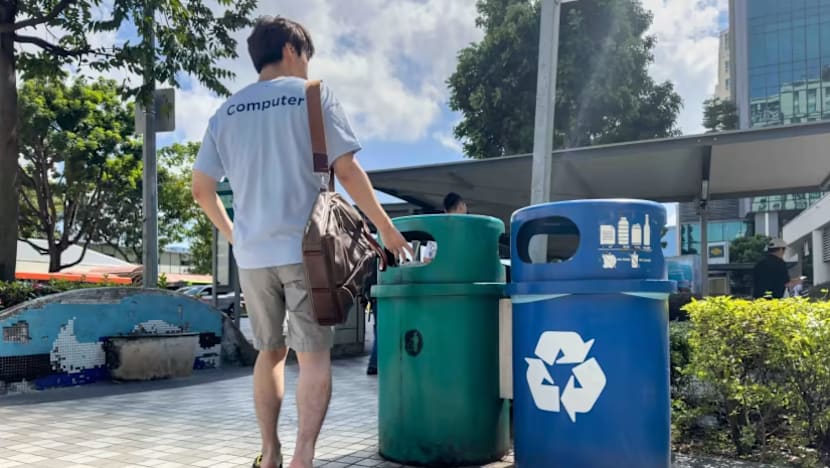
Underpinning the present day household recycling collection system is the co-mingled bin, more commonly known as the Bloobin or blue bin.
Over the years, the blue bins have been criticised because the co-mingled approach - in which recyclables are not sorted - leads to people disposing food and liquid waste in the bins, causing contamination. Contamination rates in blue bins have remained at about 40 per cent for years.
The blue bin "lowers the barrier to participation", but the convenience comes at the expense of quality, said Prof Kuah.
Contamination reduces the quality and market value of recyclables, he added.
Hence, Singapore should consider moving from a purely co-mingled model to a more differentiated system, where blue bins are retained for selected dry recyclables, such as clothes and textiles.
This should be complemented by separate collection streams for other materials, with one example being the Beverage Container Return Scheme, Prof Kuah said.
"The challenge now is to strengthen incentives that encourage households to recycle more consistently and comprehensively, while also reducing the effort required to sort and dispose recyclables correctly," said SUSS' Dr Or.
"Improving both the rewards for participation and the convenience of proper recycling (reducing the cost of recycling) will be critical to translating awareness into higher recycling outcomes.
"These will help alleviate the misalignment between private incentives and social objectives, a key reason why Singapore has struggled to meet recycling targets."
Source-segregated collection would therefore be an appropriate approach to reduce contamination and make proper recycling more convenient, he said.
Experts also called for more upstream efforts to reduce waste generation.
"Given the inherent challenge of recycling some waste streams, upstream waste reduction deserves more attention," said Singapore Environment Council (SEC) executive director Cheang Kok Chung, citing measures such as product redesign and reduced packaging.
Consumers should be encouraged to be "waste-light" in their consumption, he added.
Assoc Prof Rosenthal pointed to the disposable carrier bag charge as one example of an effective upstream intervention.
"So people are more likely to think twice and take only what they need," he said, noting that the charge adds "extra steps and a little extra cost" to using plastic bags.
"Singapore should adopt an ecosystem-wide circular economy design approach," said Prof Kuah.
"This means treating domestic recycling not just as a household behaviour issue, but as a system involving producers, importers, retailers, consumers, waste collectors, recyclers, regulators and end-markets."
Assistant Professor of Public Policy Sreeja Nair said past reliance on highly convenient waste collection systems may also have shaped household recycling behaviours and expectations.
"While participation has increased over time, developing consistent recycling habits and improving sorting quality remains an ongoing challenge," said Asst Prof Sreeja Nair, who is from the Lee Kuan Yew School of Public Policy.
"These outcomes reflect not just individual behaviour, but also how waste systems, infrastructure, and social norms have evolved together over time."
ADDRESSING THE ECONOMICS OF RECYCLING
Likewise, there is also a need to address the economic viability of recycling, which presents an equally significant challenge as behavioural and infrastructural issues.
Singapore remains heavily dependent on overseas markets to process recyclables. Fluctuations in freight costs, commodity prices and overseas import requirements can affect whether recycling remains commercially viable.
SEC's Mr Cheang said that while source-segregated collection can improve the quality of recyclables, it might not be "needle-moving if the underlying economics of recycling remains unattractive".
He pointed to the paper recycling sector as one example.
International recycled cardboard prices fell significantly after China tightened import regulations in 2018 and have generally remained weak since, he said.
This is partly reflected in the decline of Singapore's paper recycling rate from about 50 per cent to around 30 per cent over the past decade, he said.
"The weak commercial case for recycled materials may explain why improved recycling practices have not translated to higher recycling rates," he said.
As part of the review, experts said Singapore should look more closely at the economics of individual waste streams instead of treating recycling as a single category.
Prof Kuah said the review should consider expanding producer responsibility frameworks beyond e-waste and beverage containers, as packaging waste is broader.
Even with Singapore's land constraints, it should build stronger local or regional recycling capacity for priority waste streams.
"It may not be realistic to process everything domestically given our land constraints, but Singapore should identify strategic resources such as metals, e-waste and incineration ash residues where greater recovery capability is needed. This would reduce dependence on overseas recycling markets," he said.
Beyond policy changes, Prof Kuah also called for better metrics to assess Singapore's recycling performance.
Rather than focusing primarily on headline recycling rates, Singapore should track material recovery, packaging reduction and the proportion of recyclables that are successfully turned into new products, he said.
"Without these metrics, Singapore may overestimate progress while the domestic recycling rate remains structurally weak."
Ultimately, the review presents an opportunity to recalibrate Singapore's approach to waste.
"For long-term environmental planning, a tension between ambitious intent and implementation realities is common," Asst Prof Sreeja Nair said.
"Adaptive planning often proceeds with several assumptions about the future policy environment and citizen behaviour and must be open to feedback loops and recalibration mechanisms for previous policy goals and measures."
She added that while the Zero Waste Masterplan was designed with ambitious targets, the reality of global recycling markets, contamination rates, and shifting demand for recyclables has disrupted the assumptions underlying it.
"The government’s decision to review and revise the plan including updating measurement frameworks, tackling contamination, and exploring AI sorting shows an attempt towards adapting policy instruments and even goals in response to changing conditions."