
Business & Finance
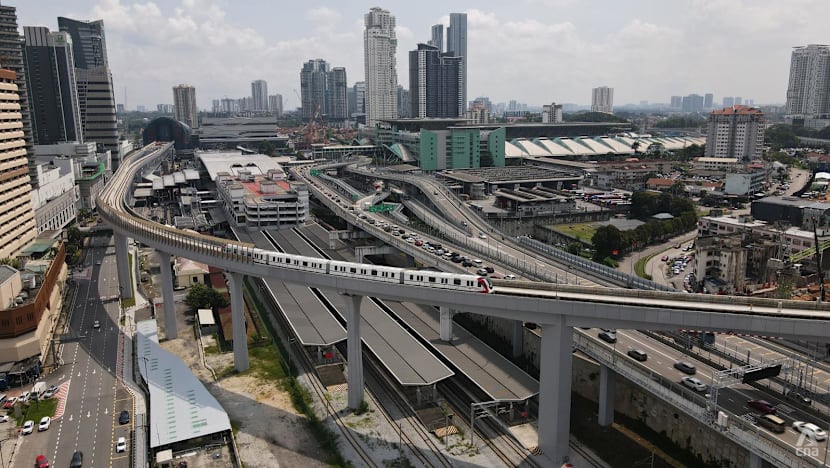
Johor’s economy thriving - so why is cost of living a likely hot-button issue for state election?
Key Points
Johor’s economy thriving - so why is cost of living a likely hot-button issue for state election? A North-South divide in wealth distribution means some Johoreans struggle to keep up with rising costs – a potential key issue in the Jul 11 state polls.
Johor’s economy thriving - so why is cost of living a likely hot-button issue for state election?
A North-South divide in wealth distribution means some Johoreans struggle to keep up with rising costs – a potential key issue in the Jul 11 state polls.
JOHOR BAHRU: When purchasing officer Ahmad Azri Azizi was ready to get married and start a family, he had wanted to buy a two-storey townhouse near Johor Bahru city centre.
The homes he had in mind were part of Johor's affordable housing scheme, Rumah Mampu Milik Johor (RMMJ), where some townhouse units are priced at around RM180,000 (US$44,440).
But after years of unsuccessful applications, the 32-year-old gave up.
"People say anything below RM300,000 is rare now," said Ahmad Azri. "It's really challenging to get the kind of house you want at a price you can afford."
Instead, he and his wife, a civil servant, bought a compact double-storey house in Kota Masai, Pasir Gudang, for RM290,000 on the resale market this year.
Their home, which has a built-up area of 600 square feet, is about an hour's drive from Johor Bahru during peak periods. The larger home he once envisioned, closer to where he works, remains out of reach.
"Financially, we just can't afford it,” he said.
Ahmad Azri's experience reflects a growing concern among many Johoreans: While the state is one of Malaysia's biggest economic success stories, life is not necessarily more affordable.
Johor recorded the highest gross domestic product (GDP) growth among all Malaysian states in 2024 – at 6.4 per cent, it was higher than the national average of 5.1 per cent. In 2025, it attracted a record RM110 billion in approved investments, surpassing even Selangor and Kuala Lumpur.
Yet for many residents, wages have struggled to keep pace with rising home prices, rents and living costs.
The result is a paradox at the heart of Johor's rapid transformation: The state has never been wealthier, but many of its residents feel increasingly priced out.
Affordability and the distribution of economic gains are set to be one of voters' concerns in the run-up to Johor’s state election on Jul 11.
Analysts expect a fiercely fought contest, with a likely three-way fight for all 56 seats in the state assembly among the governing Barisan Nasional, Perikatan Nasional and Pakatan Harapan pacts - and that’s not counting some smaller parties planning to throw their hat into the ring.
“These issues affect a broad coalition of voters … when residents are pushed to the fringes of towns, they carry that grievance to the ballot box,” Johor urban planning expert and property consultant Samuel Tan told CNA.
THE "SINGAPORE FACTOR"
Johor's proximity to Singapore has long made it a magnet for investment. But the dynamic is intensifying.
The Johor-Singapore Special Economic Zone (JS-SEZ) is expected to attract more businesses from across the Causeway, while the upcoming Johor Bahru-Singapore Rapid Transit System (RTS) Link will significantly improve cross-border connectivity, bringing more workers, tourists, investors and retirees into the state.
Analyst Nasser Ismail, a former senior official with the Iskandar Regional Development Authority, said these developments are creating what he called a "dual-market dynamic", where prices in parts of Johor increasingly reflect Singapore's purchasing power rather than local earning capacity.
"What happens is that the local economy starts pricing itself against a different benchmark," added Nasser, who is also founder of the JS-SEZ Monitor Substack.
Based on 2024/2025 Department of Statistics Malaysia (DOSM) data, Johor’s median household income was around RM7,712 (US$1,896) per month, a 12.1 per cent increase from about RM6,879 per month in 2022, State Investment, Trade, Consumer Affairs and Human Resources Committee chairman Lee Ting Han said in May.
Singapore’s median monthly household income was S$12,446 (US$9,250) last year, according to Singapore Department of Statistics data released in February.
Nasser likened the phenomenon to other prosperous border regions including Hong Kong and Shenzhen, as well as Basel in Switzerland and neighbouring German towns, where income differentials spill over into housing and consumer markets.
Nowhere is this more evident than housing.
While Malaysia does not publish official state-level housing affordability rankings, property portal New Projek estimates Johor's median housing price to median annual income ratio, known as the median multiple, at 7.4.
This places it among the highest in the country and firmly in the "severely unaffordable" category, based on a method recommended by the World Bank and United Nations to gauge housing affordability.
Property consultant Tan believes the situation may be worse than the headline figures suggest.
This is because state-level income data includes Johoreans who reside in Malaysia but earn salaries in Singapore dollars, masking the affordability challenges faced by workers paid entirely in ringgit, he argued.
Using the median annual income figures for local workers and median condominium prices in Johor Bahru, Tan estimated that affordability ratio in some cases could be between 17 and 19 — levels he described as "crisis territory by any global benchmark".
He added that condominium prices in Johor Bahru have risen by as much as 20 per cent since 2024, outpacing wage growth.
"The Singapore factor is structural, not cyclical," Tan said.
"Johoreans earning in Singapore dollars effectively operate in a different price ecosystem. Someone earning S$4,000 a month has roughly three times the purchasing power of a local earning RM4,000."
The affordability challenge is not confined to Johor Bahru.
Democratic Action Party (DAP) assemblywoman Gan Peck Cheng said housing prices in Batu Pahat - about 120km northwest of Johor Bahru - have climbed sharply in recent years, narrowing the gap with the state capital.
"Life is hard. In Batu Pahat, even if you're a university graduate, your salary is only slightly above RM2,000," said Gan, who represents the Penggaram constituency.
"That's a big problem. The cost-of-living issue is a hot topic and something we need to address."
DAP is part of PH, which forms Prime Minister Anwar Ibrahim’s federal unity government together with BN and other parties. But at the state level in Johor, PH and BN are rivals and PH was on the opposition bench in the recently dissolved Johor state assembly.
Batu Pahat resident Benjamin Lim said the rent for his two-storey terrace house has increased by 50 per cent since 2021. This has forced him to look for a job in Singapore in order to afford housing and other expenses.
“I would prefer to work in Batu Pahat, but (I have) no choice,” said Lim.
“Rent is one thing, but everything has become more expensive - food, groceries, even cutting hair is expensive,” added the 40-year-old father of two.
Prices of basic goods and services in Johor have also risen faster than the national average, with Johor frequently recording among the highest inflation rates in the country in 2025.
LIFTING INCOMES TO TACKLE “MISMATCH”
Analysts say the long-term solution lies in lifting local incomes instead of attempting to suppress investment.
Despite leading Malaysia in economic growth and investment approvals, Johor's GDP per capita of around RM37,000 remains significantly below the national average of RM56,734, according to latest figures from 2024.
"That is the mismatch between the macroeconomic numbers and on-the-ground reality," said Nasser.
The Johor government has sought to address the issue through programmes such as the Johor Talent Development Council (JTDC), which aims to connect residents with higher-paying jobs.
According to state government figures, 8,537 young Johoreans had secured jobs paying more than RM4,000 a month through the programme as of May.
Whether those efforts can keep pace with rising living costs remains to be seen.
State executive committee member Lee told CNA that the incumbent state government is cognisant of the housing affordability problem, and is looking to expedite the construction of RMMJ units to around 100,000 by 2030.
Currently, around 20,000 units have been sold under the programme.
“The state government will do what we can afford ... within our capability,” said Lee.
If re-elected, the BN state government intends to uplift the salaries of Johoreans, Lee added.
Incumbent chief minister Onn Hafiz Ghazi has identified RM4,000 as a suitable salary floor for Johor graduates working in selected sectors in the JS-SEZ, such as in data centres, and petrochemicals, Lee said.
The government has taken a “soft touch” so far, encouraging companies through tax incentives and other perks such as fast-track facilitation, Lee added. The hope is that when companies reduce costs, they pass the savings on to their workers, he said.
In the longer term, the government is considering implementing “productivity-linked wages” for certain sectors in JS-SEZ so that it’s “worthwhile for the state” to pursue high-growth industries, he said.
JOHOR’S NORTH-SOUTH DIVIDE
The uneven distribution of wealth and development could be another hot-button issue in the state election.
Southern Johor, which encompasses districts like JB, Kulai and Kota Tinggi, have seen higher levels of household income and lower levels of poverty due to their proximity to Singapore.
For instance, the median monthly household income in Johor Bahru is almost double that of Mersing. JB’s poverty rate is 3.7 per cent, starkly lower than Mersing’s 12.7 per cent.
The poverty rate is the proportion of households with monthly income below the poverty line income which, in 2022, was RM2,589, according to the Department of Statistics Malaysia.
Tan said this could be exacerbated with the JS-SEZ, which has identified specific areas in the southern corridor for industrial development.
“Districts like Kluang, Batu Pahat, Segamat, Muar and Mersing are outside this zone and have seen comparatively modest investment inflows,” said Tan.
“There are fewer data centres, no major logistics anchor tenants of the scale seen in Kulai-Senai, and manufacturing remains legacy-oriented rather than high-value,” he noted.
Nasser said this disparity in development – what he dubbed a “fractured two-Johors economy” – will be on the minds of voters.
“Because the disparity is geographic, grassroots grievances will take centrestage in the campaign, and the critical danger is populist policymaking,” said Nasser.
“With coalitions head-to-head, the pressure to offer quick fixes across divided districts will be immense. It is vital that promises made during this campaign do not structurally damage the state's fundamentals or the ease of doing business that produced the boom in the first place,” he added.
Of the 56 state constituencies in Johor, around 20 are concentrated in southern Johor while the rest are in less developed and rural areas.
Kluang resident Koh Chen Choon said he is hoping for spillover benefits from JS-SEZ.
“I hope that other residents like us, who live outside of the JB area, are not forgotten,” said the minimart owner.
BN’s Lee, who is the incumbent state assemblyman for the rural seat of Paloh in central Johor, told CNA that if re-elected, the BN state government will press on with policies like the Johor Economic Transformation Plan (JETP) to ensure prosperity extends throughout the state.
The JETP has district-specific mandates.
For example, it envisions Batu Pahat as a processing and manufacturing hub, Pontian as a blue-green energy and aquaculture hub, Kota Tinggi as an energy and green chemicals hub, Mersing as a blue economy and eco-tourism hub, and Kluang as a high-value agri-processing and logistics hub.
Lee added that the state has identified 83 projects to be launched across the 10 districts under the JETP.
“This is our response to the constructive opinion and criticism that too much is being focused (on) JB, so we are trying to balance it out a bit so that other districts will feel the benefits of development,” he said.
CNA has contacted PH Johor chief Aminolhuda Hassan and PN Johor assemblyman Sahruddin Jamal about their coalitions' plans for Johor and proposals to address issues like cost of living.
Locals like Ahmad Azri, who will be voting in the rural district of Endau in Mersing, said he will pick the candidate or party he feels is able to “uplift the lives” of Johoreans and “share the wealth equally”.
While he faces “financial constraints” currently, “if God wills it and blesses me with the means, maybe one day I'll be able to live in the house I've always dreamt of”, he said.
Johor (LOCATION)
North-South (LOCATION)
Johoreans (ORG)
Ahmad Azri Azizi (PERSON)
Johor Bahru (LOCATION)
Rumah Mampu Milik Johor (ORG)
RMMJ (ORG)
Ahmad Azri (PERSON)
Kota Masai (LOCATION)
Pasir Gudang (PERSON)
Ahmad Azri's (PERSON)
Malaysia (LOCATION)
Malaysian (ORG)
Selangor (LOCATION)
Kuala Lumpur (LOCATION)