
World News
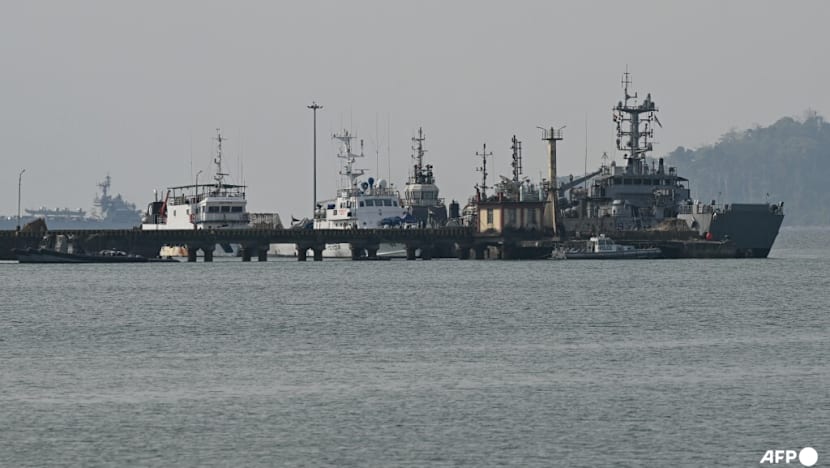
Commentary: The Great Nicobar project - a signal of India finally ‘Acting East’?
Key Points
Commentary: The Great Nicobar project - a signal of India finally ‘Acting East’? India’s increasing military footprint is largely welcomed in Southeast Asia, which sees India as relatively benign rather than aggressive or imperialist, says former foreign correspondent Nirmal Ghosh. Located around 80 nautical miles from Aceh and 430 nautical miles from the coast of Thailand, the Great Nicobar Island is closer to these Southeast Asian countries than it is to India.
Commentary: The Great Nicobar project - a signal of India finally ‘Acting East’?
India’s increasing military footprint is largely welcomed in Southeast Asia, which sees India as relatively benign rather than aggressive or imperialist, says former foreign correspondent Nirmal Ghosh.
SINGAPORE: Located around 80 nautical miles from Aceh and 430 nautical miles from the coast of Thailand, the Great Nicobar Island is closer to these Southeast Asian countries than it is to India.
But the sleepy island - the site of a roughly US$10 billion infrastructure project championed by the Indian government as one that would “enhance India's national security, strategic and defence presence” - has drawn little commentary from Southeast Asia so far.
Instead, it is at the center of a domestic debate in India over whether its strategic value compensates for its environmental destruction.
India’s main opposition Congress party had turned the project into a totemic issue ever since its leader Rahul Gandhi visited in April, free diving into the azure waters around the pristine island and emerging to denounce the project as “one of the biggest scams and gravest crimes” against the country’s natural and tribal heritage.
The pushback from Congress has emboldened closer scrutiny of the mega development project whose proponents maintain is a strategic move that will put Indian forces in a position to “choke” the Strait of Malacca, checkmating China in the Indian Ocean.
Critics say that is an exaggeration and the 30-year project, which includes a township and high-end tourism plans, a power plant and a deepwater transshipment port, instead creates a vulnerability. It will also involve irreversible environmental destruction and severely impact the island’s indigenous communities such as the forest-dwelling Shompen tribe and the Nicobarese people.
SOUTHEAST ASIA’S DOORSTEP
For Southeast Asia, the beefing up of the Great Nicobar island will bring Indian military force projection to its doorstep. The national security justification - which until Mr Gandhi visited had effectively muted criticism - leads to the broader question of India’s strategy in the region.
This also comes as India sells its supersonic Brahmos missile to more Southeast Asian countries, starting with the Philippines under a US$375 million agreement signed in 2022.
That was followed by a deal with Vietnam, and very likely Indonesia, with Prime Minister Narendra Modi’s visit to Jakarta next month expected to seal the purchase agreement which Indonesia sees as modernising its coastal defense systems.
India earlier this month also became the first foreign country to receive Myanmar’s President General Min Aug Hlaing.
New Delhi’s reception of the general, who seized power from an elected civilian government in February 2021 and in April 2026 was elected President in a poll that excluded major opposition parties, raised eyebrows.
It did not sit well with the Association of Southeast Asian Nations’ (ASEAN) collective position. After the 2021 coup, the 11-nation bloc has barred Myanmar’s generals from attending high-level meetings for failing to honour its peace commitments.
But New Delhi is on the same page as Thailand in terms of pragmatic realism in dealing with Myanmar. India is concerned about China’s influence among the array of militant and drug trafficking groups – in many cases overlapping - in northern Myanmar, which is uncomfortably close to its northeast border.
ACTING EAST, FINALLY?
All these seem to point to India, which has traditionally looked more west and southward, finally taking some real action on the “Act East” policy unveiled in 2014 by Mr Modi as a new, upgraded model of the country’s 1991 “Look East” policy.
“Generally, the region welcomes the involvement of India as a more multipolar Southeast Asia creates more space - strategic and economic - for countries of the region,” veteran former Singapore diplomat Bilahari Kausikan told me.
India’s greater engagement has been a long time coming though - and drawbacks remain.
As long ago as March 2005, Singapore’s then Senior Minister Goh Chok Tong had famously likened Southeast Asia to the fuselage of a new jumbo jet of which one wing would be northeast Asia, and the second wing would be India.
Yet, that expectation has largely been unmet.
Despite ancient trade-based ties and cultural affinities, there have been fundamental differences between Southeast Asia and India on trade in modern times. In essence, Southeast Asia largely embraces free trade while India is a trade sceptic.
One of the biggest and most longstanding complaints of countries doing business with India is that New Delhi is too slow. The ASEAN-China Free Trade Area, for example, is regularly upgraded, while the ASEAN-India Free Trade Area has not been updated in over 10 years. As of 2024, the value of ASEAN’s trade with China was approaching US$1 trillion, while trade with India was around US$107 billion.
“There’s always a sense that Southeast Asia at best comes into the third tier of India’s strategic mental map,” said Dr Sinderpal Singh, a Senior Fellow at the S Rajaratnam School of International Studies in Singapore.
“Southeast Asian countries feel a bit let down by the kind of pace of economic reform within India,” Dr Singh told me.
A similar critique applies to defence. Ironically, pacifist Japan has built a more nimble and modern defence decision-making system than India, where the civilian bureaucracy remains the principal gatekeeper of major defence decisions and strategic planning, Indian strategist Brahma Chellaney wrote in a Jun 11 opinion piece published on US publication The Hill.
In the security realm, while India’s participation in joint naval exercises has been regular and port calls across maritime Southeast Asia may have increased, India maintains a defensive military doctrine at its core. According to a former Indian Ambassador I spoke with, “Southeast Asia is hoping against hope that India can be a balancer to China, but we have not shown that we can.”
At a time of some concern in Southeast Asia over the level of American commitment and Washington’s transactional approach, and even as more great power involvement is seen with some wariness, India’s increasing military footprint is largely welcomed in Southeast Asia, which sees India as relatively benign rather than aggressive or imperialist.
That interpretation is not a bad thing and not inaccurate - but it also means there may be limits to how far India will go in terms of exercising hard power as a security provider in the event of a crisis in Southeast Asia that may or may not affect New Delhi’s interests.
Analysts will be looking for signals from Mr Modi’s visit to Indonesia next month, but until India delivers, scepticism will remain.
Nirmal Ghosh, a former foreign correspondent, is an author and independent writer based in Singapore. He writes a monthly column for CNA, published every third Friday.
Great Nicobar (LOCATION)
India (LOCATION)
Southeast Asia (LOCATION)
Nirmal Ghosh (PERSON)
SINGAPORE (LOCATION)
Aceh (LOCATION)
Thailand (LOCATION)
the Great Nicobar Island (LOCATION)
Southeast Asian (ORG)
Indian (ORG)
Congress (ORG)
Rahul Gandhi (PERSON)
the Strait of Malacca (LOCATION)
China (LOCATION)
the Indian Ocean (LOCATION)