
Business & Finance
Protected sharks, rays allegedly sold as seafood without permits in Singapore’s markets
Key Points
Protected sharks, rays allegedly sold as seafood without permits in Singapore’s markets Shark meat remains widely available at seafood restaurants and supermarkets. SINGAPORE: When it comes to illegal wildlife trade, many think of elephant ivory, rhino horns or pangolins. But another group receives far less attention: Marine species that are not fully banned but whose trade is tightly regulated amid growing concerns over population declines.
Protected sharks, rays allegedly sold as seafood without permits in Singapore’s markets
Shark meat remains widely available at seafood restaurants and supermarkets.
SINGAPORE: When it comes to illegal wildlife trade, many think of elephant ivory, rhino horns or pangolins.
But another group receives far less attention: Marine species that are not fully banned but whose trade is tightly regulated amid growing concerns over population declines.
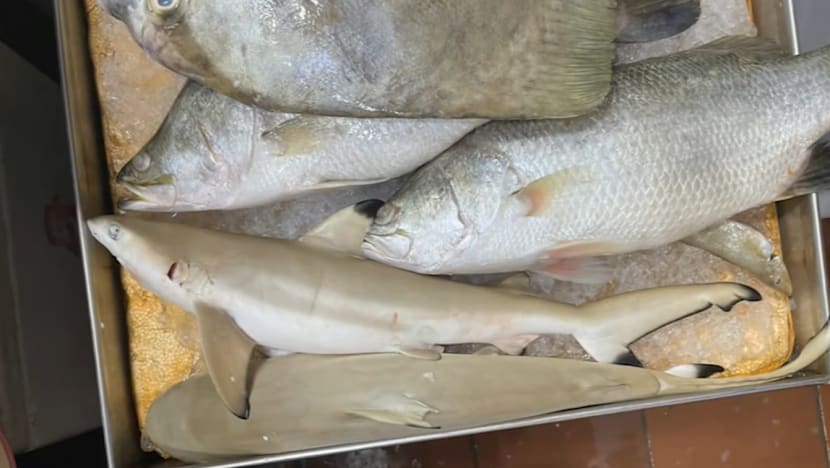
CNA found that in some of Singapore’s wet markets, some species of sharks and rays that are globally protected are allegedly still being sold without permits despite enforcement efforts.
This has led to concerns that such illegal sales could undermine global attempts to prevent overfishing and extinction of these species.
TEKKA MARKET A HOTSPOT
Blacktip reef sharks – a protected species that cannot be sold without a permit – have turned up at some wet markets in Singapore, according to photos provided by CNA’s sources.
The species is well known to those who dive or snorkel in coral reefs across Southeast Asia.
"During the weekends particularly, that's when they bring out the most amount of fish to sell. I think I've seen requiem sharks being sold maybe about 50 to 70 per cent of the time I visited Tekka Market,” he noted.
He recounted one visit where he saw some requiem sharks being hawked around 9am. Most of them were sold by 10am.
“The people I've seen buy them are usually the elderly,” Mr Keh added.
NParks said it has dealt with seven cases of illegal shark and ray imports without permits between 2020 and 2025. Depending on each case, warning letters and offers of composition – fines paid to settle offences without court proceedings – were issued.
MIXED INTO LEGAL SUPPLY CHAINS
Marine life researchers, who have been conducting weekly surveys at Jurong Fishery Port for the past few years, said illegal seafood does not have a separate supply chain.
“It actually comes in mixed in with the regular and legal seafood. That's one of the main problems – that legal seafood supply chains, not just in Singapore but all over the world, have very little regulation and oversight,” said shark and ray researcher Naomi Clark-Shen.
Not all of the thousands of boxes of seafood that come into the port are inspected, she added.
Jurong Fishery Port, which is Singapore’s only fishery port, handles about 15 per cent of the country’s seafood imports. CNA understands that the rest enter via bulk land or air shipments, where checks may be carried out on a tip-off basis.
Researchers and buyers also said fish – especially certain types of rays, like wedgefishes – usually arrive already pre-cut into smaller pieces.
“This makes identifying the species very challenging for authorities, and it's very difficult for them to tell, is this a protected species? Is it an unprotected species?” said Dr Clark-Chen.
MORE SPECIES NOW PROTECTED
Shark meat remains widely available in Singapore at seafood restaurants and supermarkets.
Shark meat – from sharks that can be sold without a permit – can also be found at mixed rice stalls for about S$2.50 per serving. These are often bamboo sharks which have a catfish-like appearance.
With more species under protection, experts warn that consumers may unknowingly buy illegal products, especially when fish are sold in chopped form and mixed with legal species.
Many shark and ray species are protected under the Convention on International Trade in Endangered Species of Wild Fauna and Flora (CITES). These species are overfished or on the brink of extinction and require permits for trade.
CITES regulates the international trade of wild animals and plants to ensure that it does not threaten their survival. Singapore became a signatory to the convention in 1986.
In 2023, 54 shark and ray species were given increased global protection under CITES Appendix II, meaning permits are required for trade.
Since 2025, some species – including the oceanic whitetip shark, whale shark and all manta rays – have been moved to Appendix I as they are now endangered or critically endangered. This means they have been completely banned from international commercial trade.
Countries can also fully ban exports of wedgefish and giant guitarfish, some of which have reportedly been seen in Singapore’s markets.
A 2022 study found that 27 per cent of shark meat sold locally in supermarkets and grocers were protected species listed under CITES Appendix II, which require permits for trade. With updated listings since 2023, that figure has risen to 89 per cent.
"Even though the study was done in 2022, we expect the results to be similar (today),” said researcher Golam Rabbani from the National University of Singapore’s Wainwright Molecular Ecology Lab.
“Even if we were to look at the different dried shark meat products now, most of these products don't have a specific indication as to what species they are. They're just labelled generically as shark meat."
“So, even if certain species are protected, you can't really control the trade unless you know exactly what species each product contains,” he added.
ENFORCEMENT EFFORTS
Enforcement efforts are complicated as marine species span vast ranges over international waters, making it more difficult to pinpoint their source, said Ms Serene Chng, programme manager at wildlife trade monitoring network TRAFFIC International Southeast Asia.
“Another big challenge is how traceability tools have to be very robust. They have to cover all points of the supply chain and yet be feasible to implement by enforcement or regulatory authorities or by the industries themselves,” she noted.
In a response to CNA’s queries, NParks said it follows up on intelligence from government agencies like the Singapore Food Agency and international partners like INTERPOL. It said it also conducts import checks and market surveillance.
Frontline officers use a homegrown, artificial intelligence-powered mobile app called Fin Finder to identify shark and ray fins. Suspicious shipments may undergo further checks, including DNA testing.
Under the Endangered Species (Import and Export) Act, illegal trading in CITES Appendix II and III species without a permit carries penalties of up to S$500,000 in fines (S$1 million for companies) and/or imprisonment of up to four years (six years for companies), along with forfeiture of specimens.
This also comes as the illegal wildlife trade is increasingly moving online, particularly through messaging and e-commerce platforms.
In Singapore, animal rights charity ACRES received a total of 14 cases of prohibited wildlife sold on Telegram groups.
The listings offering prohibited wildlife included a bearded dragon, snapping turtle, axolotl and serval – an African wild cat. These have been verified to be authentic listings.
ACRES said these numbers may only represent a fraction of the actual illegal wildlife trade problem on the ground.
Regionally, the World Wildlife Fund for Nature (WWF) tracked 4,925 listings of globally protected species in 2025, under its Cyber Spotter Programme. Listings involving live animals doubled from 2024.
Jayasri Srikantan, assistant director of conservation and science at WWF, said a majority of such live animal listings involve reptiles and amphibians that are popular in the exotic pet trade, such as leopard geckos and star tortoises.
ENFORCEMENT NOT ENOUGH
Conservation groups say enforcement alone is not enough.
PasarFish, a local conservation initiative, conducts wet market tours and online campaigns encouraging consumers to diversify their seafood choices.
Singaporeans are among the biggest consumers of stingrays, which are a key component of the popular sambal stingray dish, said PasarFish co-founder Elliott James Ong.
“It's completely legal … but we do need to stop eating so much of these stingrays. We can't blame the sellers for selling it when our consumers are demanding it,” he added.
The group encourages alternatives such as the Talang Queenfish, which is commonly used in the Malay community and similarly grilled in sambal.
"What we have realised is that a lot of people are just scared to try alternatives. We're very stuck in our ways – not just in Singapore, but across Asia. We like traditional recipes, and then we want to use the same ingredients in them,” said Mr Ong.
“In terms of the flavours, the aromatics … those can stay the same. But we feel that it's time for us to experiment. If we don't experiment, then we're going to lose (more species).”
Editor’s note: This article has been republished after the removal of some material following a legal review.