
World News
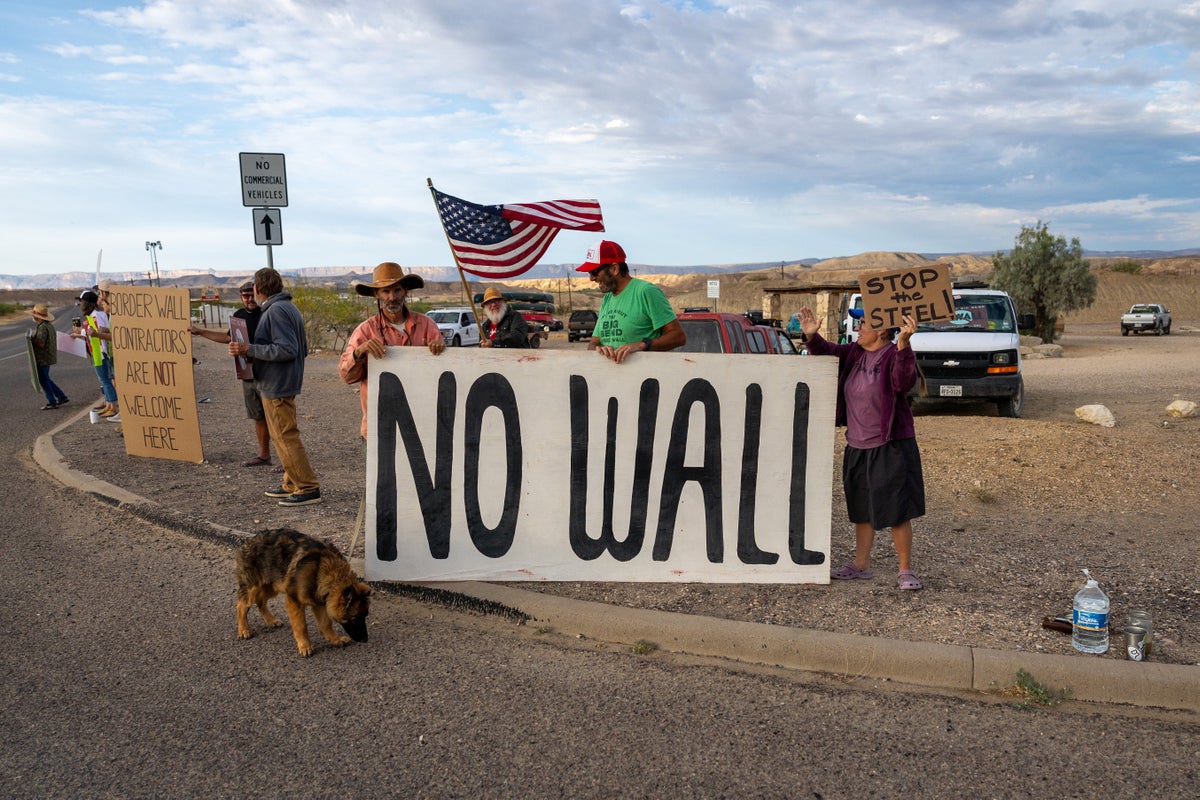
Planned Trump border wall near Texas national park could create flooding risk, suit says
Key Points
Planned Trump border wall near Texas national park could create flooding risk, suit says Building the wall on an existing levee could lead to ‘deadly’ flash flooding, a federal lawsuit argues - Bookmark - CommentsGo to comments Trump administration plans to build parts of the border wall near Big Bend National Park could expose a small town to “potentially devastating” flooding, a federal lawsuit argues. The suit, filed Wednesday by the municipal development district of Presidio, Texas,...
Planned Trump border wall near Texas national park could create flooding risk, suit says
Building the wall on an existing levee could lead to ‘deadly’ flash flooding, a federal lawsuit argues
- Bookmark
- CommentsGo to comments
Trump administration plans to build parts of the border wall near Big Bend National Park could expose a small town to “potentially devastating” flooding, a federal lawsuit argues.
The suit, filed Wednesday by the municipal development district of Presidio, Texas, against the Department of Homeland Security and U.S. Customs and Border Protection, claims that the administration plans to replace an existing earthen levee protecting the area with segments of the 30-foot-tall concrete border wall.
“If not properly planned and carried out, construction on the federal flood-control works in Presidio could compromise their integrity and leave the region vulnerable to deadly flash floods capable of destroying infrastructure, homes, farmland, and agriculture,” the suit claims.
The district argues the Trump administration has begun handing out millions of dollars in contracts for wall construction in the area, moving forward without getting proper permission from the U.S. Army Corps of Engineers to alter a federal water control project under the Rivers and Harbors Act.
In 2008, the binational International Boundary and Water Commission invested millions of dollars into a flood control system around Presidio, after Tropical Depression Lowell caused mass flooding in the area and homes were filled with up to 10 feet of water, prompting the governor to make a disaster declaration.
The Independent has contacted DHS and CBP for comment.
“Here in Presidio, the river has never divided us. It’s the reason our whole community is here, on both sides,” John Kennedy, executive director of the Presidio development district, said in a statement to Marfa Public Radio. “The levee is what lets us live safely alongside it, and we’re asking that it get the flood-safety review the law requires before anyone builds on it.”
The Trump administration has waived a variety of contracting and environmental laws to build the wall in the region, but not the Rivers and Harbors Act, the suit, filed alongside the nonprofit Democracy Forward Foundation, argues.
Border wall construction across the region has remained controversial.
In May, facing bipartisan pushback, the administration said it would not build a physical wall through Big Bend National Park, a popular national destination with stunning border terrain and a variety of sensitive ecological habitats.
Further west, the Indigenous Tohono O’odham Nation, located within central Arizona, sued the administration this week over the wall, alleging DHS plans to build it through tribal land.
“We do not believe, and we know that Customs and Border Protection has no legal authority to take any of our reservation land nor use it without permission,” Tohono O’odham Chairman Verlon M. Jose said in a speech on Wednesday.
The Trump administration’s continued efforts to build wall segments across the border have alarmed ecological advocates, who point to the years of evidence that border walls interfere with natural watersheds and animal migration patterns, and often require blowing up border terrain and destroying fields of native plants as part of construction.
The White House has waived at least 29 legal protections from Big Bend National Park, including provisions of the Endangered Species and Clean Water Acts, to advance Trump’s signature project to close off the border.
“There is no border security emergency here that warrants giving Customs and Border Patrol (CBP) unfettered authority to unnecessarily destroy some of the wildest parts of Big Bend or to disregard the overwhelmingly bipartisan will of the people, the actual data showing minimal numbers of border crossings inside the park, and the values that Texans and all Americans hold dear as represented by the National Parks,” members of Congress wrote in the administration in a June 16 letter.
Border wall construction has been accused of tampering with flood control systems across the region.
The first Trump administration "blew large holes" into systems in Texas's Rio Grande Valley, the Homeland Security Department said under President Joe Biden.
Because the Trump administration often waives environmental review laws to build the wall, construction has often been shoddy and out of step with the local terrain, advocates say.
“Without the thorough analysis of environmental impacts normally required by law, new border infrastructure has been constructed in ill-advised locations with poor engineering — resulting in massive flooding, erosion, and millions of dollars of damage to both private property and public lands,” the Center for Biological Diversity argues.
Join our commenting forum
Join thought-provoking conversations, follow other Independent readers and see their replies
Comments
[Image text:] EHICLE
STOP
URDERWAL
STFEI
CONIRACTIORS
ARE NOT
NO WALL
WELCOME
HERE
Texas (LOCATION)
Trump (ORG)
Big Bend National Park (LOCATION)
Presidio (LOCATION)
the Department of Homeland Security (ORG)
U.S. Customs and Border Protection (ORG)
the U.S. Army Corps of Engineers (ORG)
the Rivers and Harbors Act (ORG)
International Boundary and Water Commission (LOCATION)
Tropical (LOCATION)
Lowell (LOCATION)
Independent (ORG)
DHS (ORG)
CBP (ORG)
John Kennedy (PERSON)