
Politics
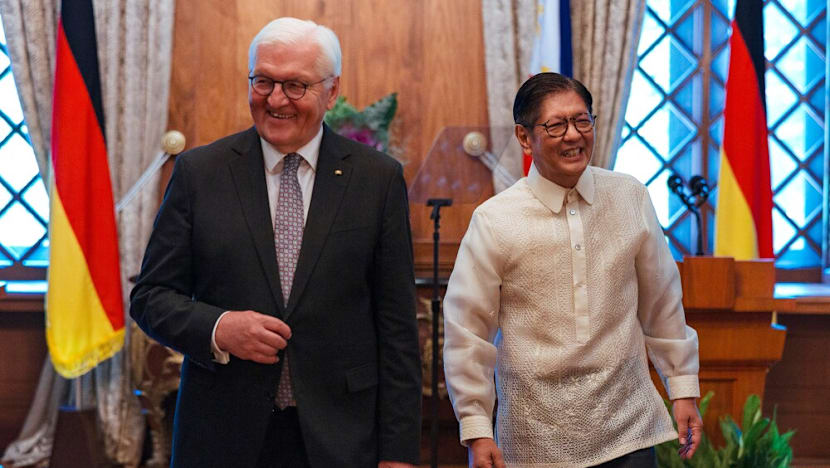
Germany blurs defence lines with bet on Philippines’ old US base
Key Points
Germany blurs defence lines with bet on Philippines’ old US base A multimillion-dollar aviation deal at Clark highlights European economic investment as a tool of strategic power. “Germany’s growing interest in the Philippines is driven by a clear-eyed recognition that the Indo-Pacific is where defining economic opportunities and security risks will unfold,” said Dindo Manhit, president of the Manila-based Stratbase Institute think tank. “With the Philippines sitting at the heart of this...
Germany blurs defence lines with bet on Philippines’ old US base
A multimillion-dollar aviation deal at Clark highlights European economic investment as a tool of strategic power.
“Germany’s growing interest in the Philippines is driven by a clear-eyed recognition that the Indo-Pacific is where defining economic opportunities and security risks will unfold,” said Dindo Manhit, president of the Manila-based Stratbase Institute think tank.
“With the Philippines sitting at the heart of this region and serving as a frontline state in upholding the rules-based international order, Berlin has every reason to invest in a deeper, long-term partnership with Manila.”
HIGH-VALUE HUB
Clark’s transformation from Cold War relic to Indo-Pacific pivot point did not happen overnight.
The results, long uneven, are now finally starting to coalesce – and observers say the Lufthansa deal may be the most visible symbol yet of what Clark is becoming.
LTP’s development contract with the Philippine government agency tasked with transforming old, unused military bases – the Bases Conversion and Development Authority – is its second at Clark since May and follows an extension of its existing arrangement at Manila International Airport, where it already operates a 226,000-square-metre (56-acre) facility.
The layering of these commitments signals a company, and behind it a country, making long-range bets on the Philippines as a serious aviation and logistics hub, according to Manhit.
He said Clark was “no longer merely an alternative airport, but a critical logistics, aviation and industrial gateway capable of attracting high-value foreign investments”.
Chester Cabalza, president of the International Development and Security Cooperation think tank in Manila, agreed, saying the “new high-value operations hub” was emerging as “the de facto backup capital and the future centre of gravity for Philippine progress”.
Cabalza described the corridor as “a geopolitical proof of concept” designed to show that “a Western-backed alliance can outperform China’s Belt and Road Initiative”.
Security analyst Julio Amador, a distinguished visiting fellow at US policy think tank Perry World House, called the corridor “the core or the spine of Philippine economic security initiatives”, adding that the LTP deal at Clark “puts more substance into the investments” of the Philippines’ partners.
BLURRED DEFENCE LINES
Analysts told This Week in Asia that Germany’s involvement at Clark blurred the lines between security and economic engagement.
Where once such interactions could be neatly divided into security cooperation on one track and economic engagement on another, those tracks are now merging.
“This agreement shows that Clark is increasingly being recognised by major partners as a critical entry point for long-term economic engagement in the Philippines,” Manhit said.
Berlin has no mutual defence treaty with Manila and Germany is not officially listed as a partner in the Luzon Economic Corridor project.
The country’s navy, though increasingly active in Indo-Pacific waters, cannot rival the maritime presence of the US or Japan.
And yet here was its head of state, in Manila, signing off on an industrial investment at a former American military base in one of the region’s most strategically sensitive areas.
“When it comes to certain investments in critical infrastructure or strategic sectors, the demarcation line between civilian and military is increasingly blurred, both in terms of purpose and vulnerabilities,” said Matteo Piasentini, an international relations lecturer at the University of the Philippines Diliman.
That observation carries particular weight at Clark, where the ghosts of American air power still haunt the perimeter and where, within a decade, Lufthansa engineers look set to be overhauling the engines of Asia’s commercial aviation fleet.
Gary Ador Dionisio, also a political scientist and dean of the School of Diplomacy and Governance at De La Salle-College of Saint Benilde in Manila, argues that what is unfolding in Clark is not simply economic development with strategic overtones but “the emergence of an integrated strategy” – one in which “infrastructure, logistics, renewable energy and supply-chain resilience become pillars of national security”.
The deal would not only “provide economic security for the Philippines and train Filipinos in specialised industries, but also allow the country to leverage its skilled manpower”, he said, adding that it “reflects the growing convergence of economic development and strategic security in the Indo-Pacific”.
“Defence cooperation is increasingly being complemented by deeper economic engagement, with both no longer seen as separate tracks, but as mutually reinforcing pillars in strengthening long-term resilience and reinforcing the country’s strategic position” in a complex geostrategic landscape, Dionisio added.
SECURING TRADE ROUTES
For Germany, a country that for decades based its foreign policy on European solidarity and the transatlantic security alliance NATO, analysts say the Clark deal must be read against a backdrop of increasingly conditional US commitments and rising Chinese economic power.
“Like many European countries, Germany is seeking to diversify … in light of what it sees is happening with the United States and NATO,” Amador said.
Having closer ties to the Philippines allowed nations to monitor regional developments “from Taiwan to the South China Sea” and to leverage Manila’s position as Washington’s premier partner in Southeast Asia – serving both as a listening post and convergence point for Western responses to regional threats, he added.
But the optics of a German president in Manila for the first time in 62 years, at a moment of high regional tensions, at a former American base that is fast becoming the logistics heart of a US-backed economic corridor, was a signal that registered clearly.
“Germany has a vested interest in preserving a rules-based international order, freedom of navigation and regional stability,” Dionisio said, adding that the Philippines occupied “a critical geopolitical position along key maritime routes” on which Germany’s export-oriented economy depended.
FUNDING NATIONAL SECURITY
Whether Clark and the wider Luzon Economic Corridor can deliver on their economic promises remains an open question.
Analysts point to systemic bottlenecks, from bureaucratic friction to infrastructure gaps and the formidable challenge of upskilling the country’s workforce as obstacles to the project’s ambitions.
Cabalza’s description of the economic corridor as a direct competitor to China’s belt and road projects acknowledges the difficulties ahead.
“For years, countries in the region faced a dual track: military security for the US and economic dependency for China,” he said.
The corridor’s implicit promise, at least according to Cabalza, lies in breaking with this binary, providing a “de-risking model for ASEAN and an economic deterrence to high security tensions”.
It is a strategy that treats supply-chain resilience and foreign capital not as secondary benefits to regional stability, analysts say, but as its primary line of defence.
This article was first published on SCMP.
Germany (LOCATION)
Philippines (LOCATION)
US (LOCATION)
Clark (ORG)
European (ORG)
the Indo-Pacific (ORG)
Dindo Manhit (PERSON)
Manila (LOCATION)
Stratbase Institute (ORG)
Berlin (LOCATION)
Cold War (EVENT)
Lufthansa (ORG)
LTP (ORG)
Philippine (ORG)
the Bases Conversion and Development Authority (ORG)