
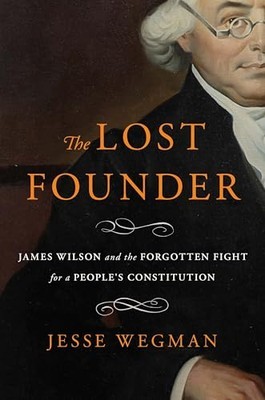
Early one evening in August 1798, a sitting justice of the Supreme Court named James Wilson died in a sparsely furnished boarding room on the second floor of a North Carolina tavern. He had been holed up there for nearly a year to avoid creditors, to whom he owed unspeakable debts from land speculation. Delirious and destitute, he died from malarial fever, which burned through the Carolinas every summer.
There was no public announcement of Wilson’s death. It was an ignominious end to a man who was not only a Supreme Court justice but also arguably the most influential, prescient, and democratic drafter of the Constitution, one of only six men to sign both that document and the Declaration of Independence.
The other Founders had acolytes who promoted their legacy and preserved their records, but Wilson died a pariah, which kept him out of history books as the conventional narrative of the founding took shape. Even today, his headstone in Philadelphia lists the wrong date for his death. Recovering his role in creating America is essential if the nation is to recommit itself to the ideals of democracy and popular sovereignty, which he championed with greater force than any of his contemporaries did.
[Danielle Allen: What the 18th century can teach the 21st]
Wilson’s peers had no doubt about his importance. “No man is more clear, copious, and comprehensive than Mr. Wilson,” said William Pierce, a delegate to the Constitutional Convention from Georgia. According to Benjamin Rush, who signed the Declaration of Independence alongside Wilson, “his mind, while he spoke, was one blaze of light.” He was “as able, candid, and honest a member as any in convention,” George Washington wrote.
This article has been adapted from Wegman’s new book.Wilson first arrived in Philadelphia as a poor 23-year-old immigrant from Scotland. Two decades later, after becoming one of the most celebrated lawyers in America, he attended the 1787 Constitutional Convention in the same city. Wilson spoke more than all but one of his fellow delegates. From the start, his guiding principle was the power of regular people, whom he saw as “the legitimate source of all authority.”
“The general government is not an assemblage of states, but of individuals,” Wilson declared in his Scottish brogue. “It is not meant for the states, but for the individuals composing them: The individuals, therefore, not the States, ought to be represented in it.”
To many delegates, this was unconscionable. “The people should have as little to do as may be about the government,” Roger Sherman of Connecticut said in the convention’s opening days, as the delegates debated how to select members of Congress. Sherman wanted them to be chosen by state legislators rather than the public, who “are constantly liable to be misled.” Elbridge Gerry of Massachusetts seconded the point. “The evils we experience flow from the excess of democracy,” Gerry said. “The people do not want virtue; but are the dupes of pretended patriots.”
Wilson rejected these characterizations outright. No other delegate was more persistent in defending the wisdom of the people or their right to exercise political authority in accordance with their numbers; he was the convention’s strongest advocate of proportional representation. Wilson also called repeatedly for direct popular elections to Congress, as well as for the allocation of representatives in both houses to be based on population. Delegates from the smaller states in particular were aghast at this latter proposal. William Paterson of New Jersey said that he would “rather submit to a monarch, to a despot, than to such a fate,” arguing instead that each state needed equal representation in Congress. Wilson countered that giving states equal power would endanger the entire American project. It would be “a fundamental and a perpetual error,” he said, one that “must be followed by disease, convulsions, and finally death itself.”
The central problem with state equality, Wilson argued, is that it undermined majority rule and thus republican government as a whole. A Senate in which each state had an equal vote would “enable the minority to control in all cases whatsoever, the sentiments and interests of the majority,” he said. Of the 13 states at the time, the seven smallest accounted for less than one-third of the population, Wilson pointed out, which meant “it would be in the power then of less than one-third to overrule two-thirds.”
Wilson lost the fight over state equality in the Senate, but more than a century later, he would be vindicated on the issue of direct congressional elections with the passage of the Seventeenth Amendment.
Congress wasn’t the only branch that Wilson tried to democratize. Early in the convention, he argued for a popularly elected president. When the proposal failed to generate enthusiasm, Wilson was urged to come up with an alternative. The following day, he offered one: Divide the states into districts and allow the eligible voters in each district to nominate “electors” who would pick the president.
Wilson made clear that this was not his first choice; a direct vote “would produce more confidence among the people,” he said. But his elector proposal was far more democratic than the other option under consideration: letting Congress choose the president. More than three months later, the convention adopted a system very similar to Wilson’s original idea—illustrating again his knack for getting there before everyone else.
Wilson was devastated by losing debates about the design of Congress and the presidency, and in particular by the convention’s refusal to acknowledge the centrality of regular people to the government. But he would get another chance to enshrine his view of popular sovereignty.
In late July, when most delegates were out of town for a 10-day break, Wilson stayed in Philadelphia to serve on a five-man committee tasked with drafting the Constitution. William Ewald, a professor of law and philosophy at the University of Pennsylvania, has identified the moment when Wilson hit upon the document’s famous opening words.
Sitting in his home office, Wilson started to make notes on a large folio sheet bearing an early version of the preamble, which began: “The People of the States of New Hampshire etc.” After leaving some annotations, he stopped, went back to the beginning, and added: “We.” In that instant, Wilson had composed the three most resonant words in the history of democracy: “We the People.” He had ensured that the people would come first, before the states, and he watched over his phrase jealously. When it was altered in a later draft to “We the People and the States …” he changed it back to “We the People of the States …” (The individual states would ultimately be removed from the preamble altogether and replaced with “We the People of the United States”—the most Wilsonian gloss of all.)
During Pennsylvania’s ratifying convention later that year, Wilson aptly explained the preamble’s significance. It “contains the essence of all the bills of rights that have been or can be devised,” he said, “for, it establishes, at once, that in the great article of government, the people have a right to do what they please.” This was also the central message of the Declaration of Independence, which Wilson, more than any other Founder, insisted was the basis of the American experiment, supreme over even the Constitution.
During that ratifying convention, Wilson also argued that the franchise should extend broadly, beyond just property owners. Giving people the right to vote, he said, would turn their attention “to the contemplation of public men and public measures,” and foster civic virtue. Voting, he said in a later speech, “has a powerful tendency to open, to enlighten, to enlarge, and to exalt the mind.”
But Wilson’s prescience failed him in one significant instance: the Constitution’s handling of slavery. Although he was personally opposed to slavery, he was less outspoken about its injustice than were many of his peers, including slaveholders such as Thomas Jefferson and George Mason. (For many years, Wilson kept a domestic slave, a man named Thomas Pursel, whom he freed in 1794.) At the 1787 convention, Wilson was the one who proposed counting enslaved people as three-fifths of a person for the purposes of representation and taxation. The general idea predated Wilson, but his willingness to use it in service of that abhorrent compromise—subordinating the dignity and equality of individual people to the importance of the American union—showed that his commitment to popular sovereignty had its limits.
Wilson was also hindered by personal failings. To finance his compulsive land speculation, he took on enormous debt, and toward the end of his life, he was forced to spend more time scrounging for investors than tending to the young nation he had helped create. His reputation was ruined. As a result, more than two centuries later, Wilson remains almost entirely absent from the prevailing narrative about the founding. This usually centers on the likes of Jefferson and his local, agrarian ideal; James Madison and his counterbalancing factions; Alexander Hamilton and his distrust of the common people. Those Founders were of course essential to the nation’s birth, and yet, in time, many of them came to agree with Wilson.
[Yuval Levin: The missing branch]
In a letter to a friend in 1816, Jefferson referred to what he called “the mother-principle, that ‘governments are republican only in proportion as they embody the will of their people, and execute it.’” He proposed a set of amendments to the Virginia Constitution, including “general suffrage,” “equal representation in the legislature,” and “an executive chosen by the people,” echoing what Wilson had sought to establish in the United States Constitution nearly three decades earlier.
In 1821, Madison wrote that his comments on voting rights during the convention—where he, contra Wilson, defended property qualifications to vote—did not convey his “more full and matured view of the subject.” Madison continued, “The right of suffrage is a fundamental article in republican constitutions.” More than a decade later, he wrote that “the will of the majority” is “the vital principle of republican Government,” sounding no less convinced than Wilson had been.
None of these other Founders foresaw more accurately than Wilson what America would become. Consider all of the ways in which his vision has come to fruition: in the dramatic expansion of suffrage and political equality, in the right of the people to elect their senators directly, and in the Supreme Court’s ultimate adoption of the principle of “one person, one vote.”
This was the world Wilson saw 250 years ago. He was, in a sense, a 21st-century man trapped in the 18th century. Today, Wilson’s ideals are under threat. Restoring him to his rightful place in the American story can help us save them.
This article has been adapted from Jesse Wegman’s new book, The Lost Founder.