
Science
A 'new' star could finally appear in the night sky this week, thanks to a once-in-a-lifetime explosion
Key Points
A 'new' star could finally appear in the night sky this week, thanks to a once-in-a-lifetime explosion T. Coronae Borealis undergoes a dramatic nova explosion once every 80 years on average, causing it to shine as bright as Polaris, the North Star. A once-in-a-lifetime stellar eruption could occur at any time, potentially causing a 'new star' to appear in the night sky. If it does, the star system T Coronae Borealis could suddenly brighten to rival Polaris, the North Star.
A 'new' star could finally appear in the night sky this week, thanks to a once-in-a-lifetime explosion
T. Coronae Borealis undergoes a dramatic nova explosion once every 80 years on average, causing it to shine as bright as Polaris, the North Star.
A once-in-a-lifetime stellar eruption could occur at any time, potentially causing a 'new star' to appear in the night sky. If it does, the star system T Coronae Borealis could suddenly brighten to rival Polaris, the North Star. Here's what you need to know about the "Blaze Star" T. Coronae Borealis (T CrB).
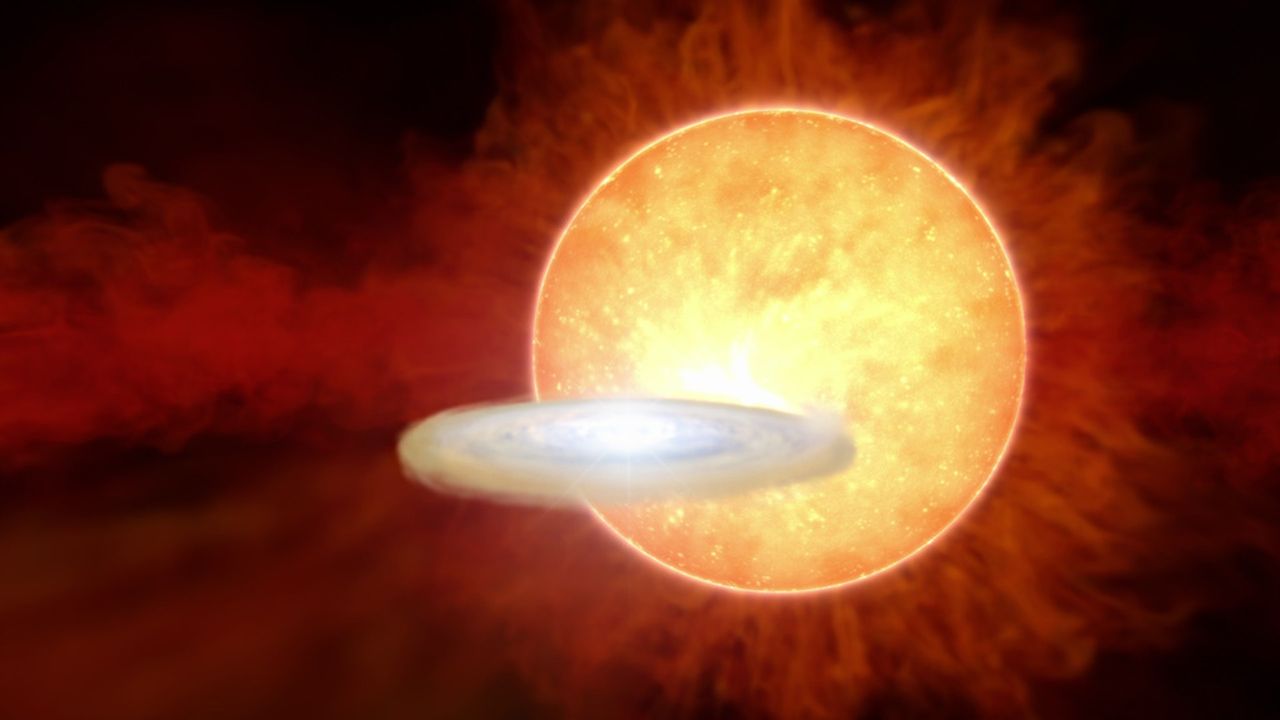
T CrB is a prime example of a recurring nova. This thermonuclear explosion erupts from the atmosphere of a white dwarf star roughly once every 80 years, when it reaches a point of critical mass, having stripped vast quantities of material from a co-orbiting red giant.
After each eruption, the white dwarf returns to vampirically feeding on its companion star, until ready to start the process anew. Recurring novas like T CrB are extremely rare, with only five known to exist within the entirety of the Milky Way, according to NASA.
When will T. Coronae Borealis erupt?
T CrB brightens roughly once every 80 years — an average based on eight centuries of historical observations. The most recent deluge of nova light reached Earth in 1946, prompting some astronomers to predict that the next brightening could occur as early as February 2024, based on an earlier dip in the system's light that echoed historical data.
It seems that T CrB had other ideas, however, and instead has remained stubbornly dim through numerous unsuccessful prediction attempts. Astronomers repeatedly attempted to fit subtle shifts in the brightness of T CrB to the few points of reliable historical data on offer, while accounting for fluctuations in the white dwarf's feeding rate.
The Celestron NexStar 4SE is ideal for beginners wanting quality, reliable and quick views of the night sky. It's sturdily built, quick to set up and automatically locates night sky targets and provides crisp, clear views of them. For a more in-depth look at our Celestron NexStar 4SE review
"We know it has to happen," astrophysicist Elizabeth Hays, project scientist on NASA's Fermi gamma-ray space telescope, told Space.com in 2024. "We just can't pin it down to the month."
One paper authored by Jean Schneider of the Paris Observatory put forward a set of four potential dates for the brightening — the last of which falls on June 25, 2026 — based on the presence of a theoretical third body in the T CrB system. However, other astronomers were sceptical of the predictions, as no evidence of this phantom third body has been spotted in modern data.
What should I expect?
Each nova explosion triggers a dramatic surge in T CrB's apparent brightness, as radiation cast out in the cataclysmic event finally reaches us, having spent approximately 3,000 years racing through the near-perfect vacuum of space.
T CrB is usually far too dim to see with the naked eye, shining as it does with an average brightness, or magnitude, or just +10. Magnitude is the scale used by astronomers to track the apparent brightness of objects in the night sky. The lower the number, the brighter the object, with the human eye capable of spotting targets down to a magnitude of +6 from a dark sky location.
During a nova surge, T CrB can jump from +10 to a magnitude of +2, making it easily visible to the naked eye as it shines with a brilliance comparable to that of the North Star, Polaris.
Where can I find T. Coronae Borealis in the night sky?
T CrB shines close to the semicircle of stars of the lesser-known constellation Corona Borealis, also known as the Northern Crown, which can be found glowing brightly overhead between the constellations of Bootes and Hercules after sunset in early summer.
You'll need a pair of 10x50 binoculars or a small telescope to find the Blaze Star before it brightens to naked eye visibility. First, locate the magnitude 4.28 star Epsilon Coronae Borealis, which is the second star in from the left of the semicircular formation, as viewed from the Northern Hemisphere.
Next, sweep your scope over the patch of sky one degree to the lower right of Epsilon Coronae Borealis — roughly the width of your little finger held at arm's length — to find the patch of sky containing T CrB.
How long will T CrB be visible for?
Once the Blaze Star erupts, its nova light should remain visible to the naked eye for a little under a week, according to NASA, though you'll be able to follow its progress for longer using a pair of binoculars! You can also keep an eye on T CrB's brightness via the American Association of Variable Star Observers (AAVSO) website, which allows you to plot a light curve for the distant star system based on recent member observations.
Be sure to check out our roundups of the best telescopes and binoculars for observing the night sky, to ensure that you're ready to make the most of T. Coronae Borealis' fleeting appearance before it disappears for another 80 years. Photographers may also want to peruse our picks of the top cameras and lenses for astrophotography, along with our guide to capturing the night sky.
Editor's Note: If you capture an image of T. Coronae Borealis and with Space.com's readers, then please send your photo(s), comments, and your name and location to [email protected].
You must confirm your public display name before commenting
Please logout and then login again, you will then be prompted to enter your display name.
Anthony Wood joined Space.com in April 2025 after contributing articles to outlets including IGN, New Atlas and Gizmodo. He has a passion for the night sky, science, Hideo Kojima, and human space exploration, and can’t wait for the day when astronauts once again set foot on the moon.