
World News
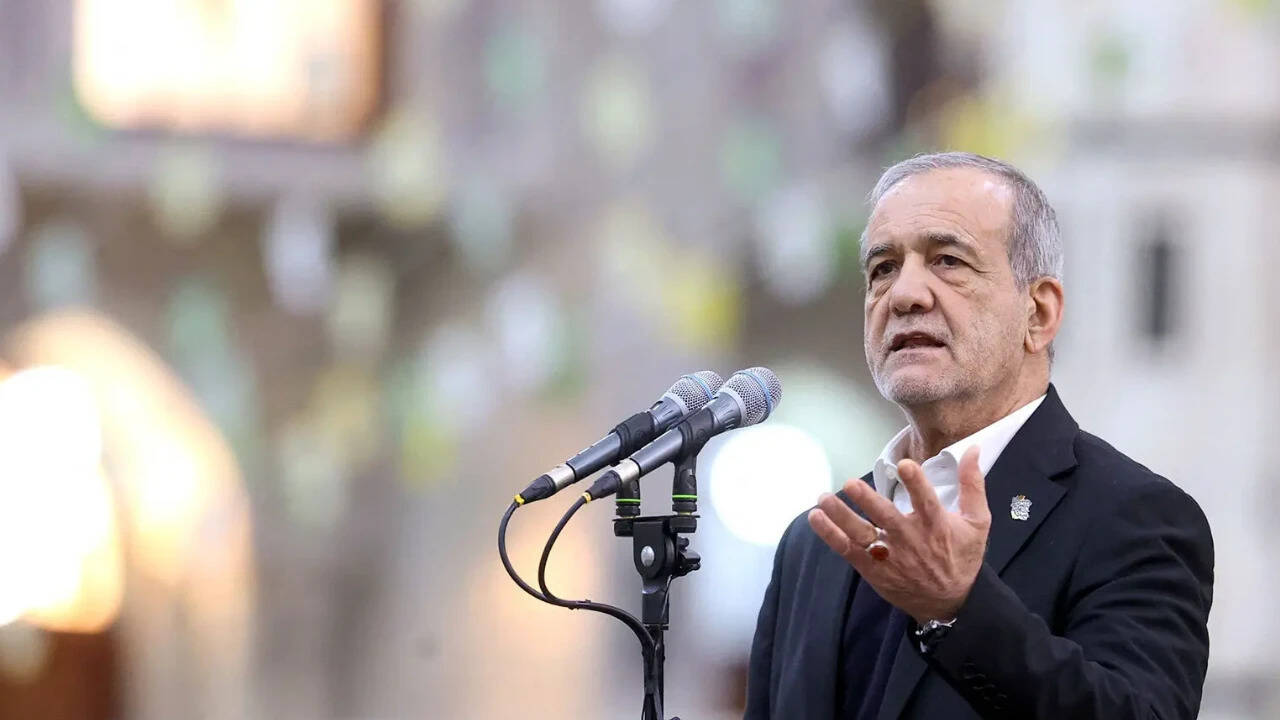
'Without missiles, we'd be like Gaza': Tehran rejects US calls to limit its defence arsenal
Key Points
Iranian President Masoud Pezeshkian on Tuesday said the country's missile programme is not part of the 14-point memorandum of understanding (MoU) reached with the United States and will not be included in any future arrangement. Firmly rejecting any linkage he said, "Iran's missiles were not in the MoU and will never be." According to a video shared by Iranian state broadcaster Islamic Republic of Iran Broadcasting (IRIB), Pezeshkian made the remarks during a news conference in Pakistan's...
Iranian President
Masoud Pezeshkian on Tuesday said the country's missile programme is not part of the 14-point memorandum of understanding (MoU) reached with the United States and will not be included in any future arrangement.
Firmly rejecting any linkage he said, "Iran's missiles were not in the MoU and will never be."
According to a video shared by Iranian state broadcaster Islamic Republic of Iran Broadcasting (IRIB), Pezeshkian made the remarks during a news conference in Pakistan's Islamabad.
Defending Iran's missile capabilities, he added, "If the missiles we have for our defence did not exist, Israel and the United States would have ploughed Iran just like Gaza, showing no mercy to either the old or the young."
His comments came after technical talks in Switzerland linked to the 14-point MoU aimed at ending hostilities in the region.
Last week, the United States released the text of the agreement. A senior US administration official read out the 14-point document, which includes provisions on reopening the Strait of Hormuz, easing some financial restrictions on Iran and setting out a framework for future technical talks on Tehran's nuclear programme.
The published text, reportedly contains no reference to restrictions on Iran's missile programme or wider defence capabilities. The only weapons-related provision mentioned is Iran's commitment not to "procure or develop nuclear weapons".
The issue remains contentious despite ongoing diplomacy. While US President Donald Trump had earlier argued for curbing Iran's missile programme, he appeared to soften his position during recent negotiations. Speaking at last week's G7 summit in France, Trump said: "missiles aren't the problem".
Trump also said, "I'm saying that if other countries have them, it's a little bit unfair for them not to have some."
Accoring to AFP, Iran began developing its missile programme during the 1980s Iran-Iraq war to offset weaknesses in its air defences, with the arsenal subsequently expanding in both range and accuracy. Israel, about 1,500 kilometres from Iran, has long viewed the programme as a major security threat. Before the conflict, the United States had sought to include Iran's ballistic missile capabilities and support for regional armed groups in negotiations over Tehran's nuclear programme.
"We will never negotiate with anyone, under any circumstances, ever, about our defensive capabilities," the Iranian president said.
AFP also reported that Pakistani Prime Minister Shehbaz Sharif said the preliminary agreement made no mention of ballistic missiles.
"There cannot be double standards... that some countries can have ballistic missiles and Iran shouldn't have. You cannot digest this duplicity," Sharif said.
Gaza (LOCATION)
Tehran (LOCATION)
US (LOCATION)
Iranian (ORG)
Masoud Pezeshkian (PERSON)
MoU (ORG)
the United States (LOCATION)
Iran (LOCATION)
Islamic Republic of Iran Broadcasting (LOCATION)
IRIB (ORG)
Pezeshkian (PERSON)
Pakistan (LOCATION)
Islamabad (LOCATION)
Israel (LOCATION)
Switzerland (LOCATION)