
World News
Iran says deal to end Middle East war 'declaration of US defeat'
Key Points
Iran says deal to end Middle East war 'declaration of US defeat' US Secretary of State Marco Rubio kicked off a tour of the Middle East on Wednesday in a bid to reassure Gulf allies of America's security commitments. Iran called the deal to end the Middle East war "a declaration of America's defeat" on Wednesday (Jun 24), as the top US diplomat renewed his country's commitment to UAE security during a tour of the Gulf. The war that began with US-Israeli strikes on Iran on Feb 28 ended with...
Iran says deal to end Middle East war 'declaration of US defeat'
US Secretary of State Marco Rubio kicked off a tour of the Middle East on Wednesday in a bid to reassure Gulf allies of America's security commitments.
TEHRAN: Iran called the deal to end the Middle East war "a declaration of America's defeat" on Wednesday (Jun 24), as the top US diplomat renewed his country's commitment to UAE security during a tour of the Gulf.
The war that began with US-Israeli strikes on Iran on Feb 28 ended with the Islamic Republic striking an agreement it has portrayed as a victory.
The conflict sowed chaos in the region, with Tehran retaliating by blockading a key waterway for energy shipments and launching thousands of drones and missiles at its Gulf neighbours and Israel.
The US and Iran signed the agreement last week and launched a process aimed at reaching a permanent settlement - with the Islamic Republic's leadership transformed but the system of rule firmly in place.
"The Islamabad understanding was not the result of pressure and coercion, but rather the result of the resistance and authority of the brave Iranian nation," Iran's top negotiator Mohammad Bagher Ghalibaf said Wednesday of the deal, which was finalised through Pakistan's mediation.
"That is why, the Islamabad Memorandum of Understanding became a declaration of America's defeat," he said, adding that security in the Middle East must be ensured by the countries of the region.
The US maintains troops in military bases across the Middle East, notably in the Gulf, where US Secretary of State Marco Rubio kicked off a tour on Wednesday in a bid to reassure allies.
"COEXISTENCE"
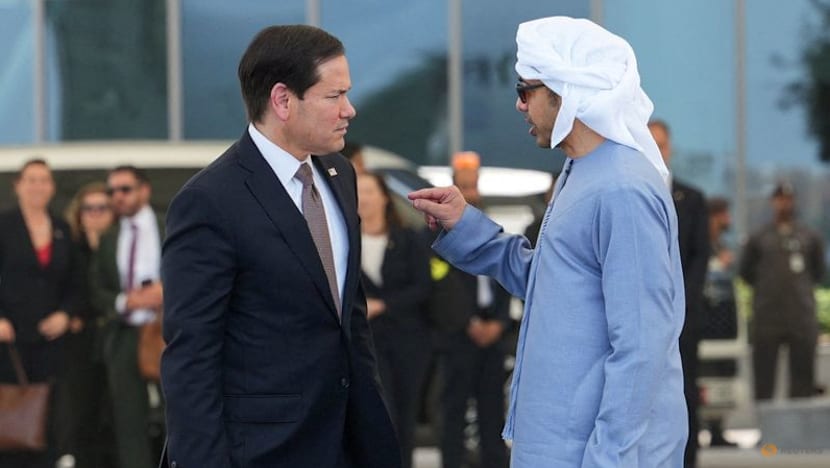
Rubio arrived in the United Arab Emirates on Tuesday and held talks with its leader, Sheikh Mohamed bin Zayed. From there, he is due to fly to Kuwait and then Bahrain, where he will attend a Gulf Cooperation Council meeting.
Rubio is seeking to reassure the close allies, who were hit hard by Iran during the war, about the memorandum of understanding, which fails to address some of the Gulf's long-standing concerns about Iran's missile programme and proxies.
"They discussed President Trump's memorandum of understanding with Iran, efforts to secure full and safe transit through the Strait of Hormuz, and the importance of peace and stability in the region," Rubio's spokesperson Tommy Pigott said.
Rubio "thanked the UAE for their leadership and unparalleled support, praised their courage and resilience in the face of Iran's attacks, and reaffirmed the US commitment to the security of the Emirates", Pigott added.
Iran has said it plans to charge what it calls maritime service fees for crossing the strait, as opposed to tolls, a plan fiercely opposed by the United States.
On Wednesday, US President Donald Trump wrote on his Truth Social platform that Iran had told Washington it would not charge for passage.
"Iran has informed the US that... there are 'NO TOLLS, NO INSURANCE COSTS, & NO OTHER CHARGES OF ANY KIND BEING SOUGHT OR RECEIVED BY IRAN ON SHIPS TRAVELING THE STRAIT OF HORMUZ'," Trump said, without specifying whether the commitment would outlast their 60-day negotiating period to reach a permanent settlement.
Speaking to AFP on condition of anonymity, a diplomat said talks on reconciliation between Gulf countries and Iran are expected in Saudi Arabia, though the source did not specify a date.
Iran was defiant, appearing to insist that the Gulf nations might do better by aligning themselves with the Islamic Republic instead of the West.
"We see the future of the region not in confrontation but in interaction and not in elimination but in coexistence," Ghalibaf said.
Iran's chief negotiator also reiterated that peace in Lebanon, which was drawn into the war when Tehran-backed Hezbollah launched attacks on Israel, was a fundamental pillar of reaching a definitive agreement with the US.
"For us, the ceasefire in Lebanon has been and is as important as the ceasefire in Iran, and the end of the war in Lebanon has been as important as the end of the war in Iran," Ghalibaf said.
"LIKE THE PHOENIX"
In Lebanon, where Iran insisted a fragile ceasefire was a precondition for a broader agreement, people in areas worst affected by Israeli bombing were struggling to clear rubble from their streets.
In the beachside city of Tyre, 40-year-old Hussein Hassan told AFP he had fled with his family to north Lebanon during the war but returned this week to reopen his barbershop.
Tyre residents "love life and work. We shake off the dust and rise up again like the phoenix", he said proudly, while welcoming customers to his shop, one of its walls cracked and its glass facade blown away.
Israeli troops remain deployed in parts of Lebanon following a ground invasion, and on Wednesday, the military carried out an airstrike in a border area targeting what it said were two Hezbollah operatives who posed a threat to its troops.
"The IDF will not allow the Hezbollah terrorist organisation to harm Israeli civilians or IDF soldiers, and will continue to operate to remove immediate threats," the military said.
Pakistan said Wednesday that technical talks will resume next week between the US and Iran, with no date yet confirmed.
One of the key sticking points has been Iran's nuclear programme, long a source of friction with Western powers who suspect Tehran is building a bomb, a claim it has systematically denied.
US President Donald Trump said Tuesday that Tehran had "fully and completely agreed" to allow UN inspectors to return to the country, but Iran said it has no intention of doing so.
On Wednesday, Rafael Grossi, the head of the UN's nuclear watchdog, said inspections of Iranian nuclear sites were "going to happen".
But the Iranian official overseeing technical discussions in negotiations with the US reiterated that no agreement has been reached on inspections.