
Science
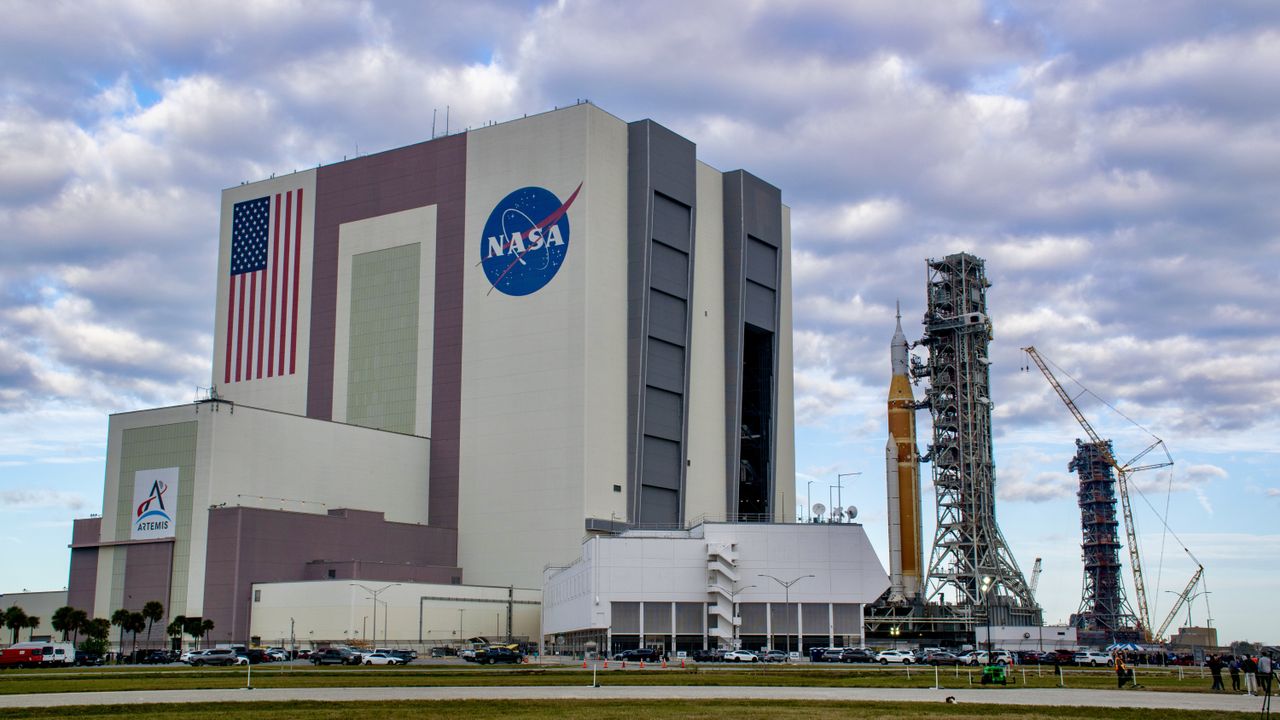
NASA's aging infrastructure can't handle Artemis launches without $1 billion in upgrades, watchdog warns
Key Points
NASA's aging infrastructure can't handle Artemis launches without $1 billion in upgrades, watchdog warns Decades-old facilities are struggling to keep pace with the new space race. NASA's plan to return astronauts to the moon and bolster a rapidly growing commercial space industry is facing an infrastructure obstacle. A new report from NASA's Office of Inspector General (OIG) warns that launch facilities at the Kennedy Space Center (KSC) in Florida and Wallops Flight Facility in Virginia are...
NASA's aging infrastructure can't handle Artemis launches without $1 billion in upgrades, watchdog warns
Decades-old facilities are struggling to keep pace with the new space race.
NASA's plan to return astronauts to the moon and bolster a rapidly growing commercial space industry is facing an infrastructure obstacle.
A new report from NASA's Office of Inspector General (OIG) warns that launch facilities at the Kennedy Space Center (KSC) in Florida and Wallops Flight Facility in Virginia are approaching capacity as demand accelerates across the agency and the private sector. Support infrastructure — such as roads, electricity, and gas and fuel pipelines that laid the foundation for KSC's network of launch pads built to support the Apollo program in the 1960s — are being increasingly stretched by the demands of NASA's Artemis missions, SpaceX, Blue Origin, United Launch Alliance (ULA) and other users.
"Based on current launch projections, Kennedy and Wallops are expected to operate near capacity in the 2028 to 2029 time frame," states the report, which was released on Monday (June 22). Though it credits NASA for already taking steps to address these issues, agency officials estimate it will take at least $1 billion to complete all the necessary upgrades, of which only $250 million was provided as part of NASA's funds allocated in last year's 2025 H.R.1 reconciliation bill.
On Florida's Space Coast, the assessment encompasses launch facilities at KSC as well as Cape Canaveral Space Force Station (CCSFS), which saw an increase of NASA-supported launches from 31 in 2020 to 109 in 2025, according to the report. Wallops, where there are fewer and smaller launch pads, doesn't traditionally see as many missions compared to KSC. But the Virginia site has experienced an even sharper jump, percentage-wise, over the same timeframe — from three launches in 2020 to 17 in 2025 (a 467% rise). By 2030, NASA expects traffic at both sites to increase by another 150% or so. And NASA officials told auditors that raw launch counts don't fully capture the strain on infrastructure, because launch campaigns require days or weeks of support activity before liftoff.
The report outlines launch infrastructure shortcomings at both facilities, but notes that Wallops' challenges have been partially mitigated by recent upgrades across its seven active launch sites. Wallops generally hosts small and medium-lift launch vehicles, like Northrop Grumman’s Antares rocket and Rocket Lab's Electron, but has taken steps to support Rocket Lab's upcoming Neutron, as well as Firefly Aerospace's Alpha rocket, which is expected to launch from the site sometime this year.
The major launch pads in question at KSC and CCSFS include Launch Complex-39A (LC-39A) and LC-39B, used by SpaceX and NASA, respectively; Space Launch Complex-40 (SLC-40), also used by SpaceX; SLC-41, used by ULA's Atlas and Vulcan rockets; and SLC-36, used by Blue Origin's New Glenn rocket.
SpaceX has transitioned to launching its Falcon 9 rocket primarily from SLC-40 and has reserved LC-39A for Falcon Heavy launches while construction of the first Florida launch tower for its Starship rocket is underway at the same pad. SpaceX hopes to start launching Starship from this pad before the end of 2026.
The company also has plans for a second Space Coast pad for Starship, at SLC-37. Once Starship, which is still under development at SpaceX's Starbase, Texas, facility, becomes fully operational, the company expects up to 44 launches a year from KSC, with an additional 76 launches per year projected from SLC-37 at CCSFS. That equals about one Starship launch every eight days for LC-39A, but a higher cadence will be needed to successfully support NASA's Artemis program.
Artemis missions utilize NASA's Orion spacecraft to transport astronauts from the Earth to the moon, and the agency has contracted Starship, as well as Blue Origin's Blue Moon lander, to be the program's crewed lunar landers. All of these vehicles require heavy-lift rockets.
Orion launches on NASA's Space Launch System (SLS) rocket from LC-39B. For Artemis 4, currently scheduled for 2028, NASA plans to dock Orion with Starship in Earth orbit, and use Starship to propel the two spacecraft to orbit around the moon. Starship will then undock from Orion, carry a set of astronauts down to the lunar surface, and then launch them back to orbit around the moon to rendezvous and dock again with Orion.
To accomplish this, Starship will require at least 15 refueling flights to top off its tanks before its initial burn for the moon, which would fly in addition to the company's projected eight-day launch cadence, according to the report.
Growing demand for heavy-lift rockets is also increasing pressure to find additional launch sites. Blue Moon is designed to launch on New Glenn, and will also require refueling launches to reach the moon. Setting aside the fact that New Glenn recently exploded during a fueling test that severely damaged SLC-36, the report indicates that Blue Origin officials have told NASA that the pad alone may not provide sufficient long-term capacity and resiliency for the company's future plans, and noted that the constraints have already forced the company to delay launches.
Much of the infrastructure between KSC and CCSFS facilities is considered "common-use," the report says, which puts added stress on available resources shared across different launch providers. That includes a massive electrical grid; 231 miles (372 kilometers) of roadway, much of which was paved in the 1960s without consideration for the weight and frequency of super heavy rocket stages being transported to and from launch pads; and more than 40 miles (64 km) of gaseous pipeline supporting nitrogen (GN2) and helium distribution, which is unable to supply high-flow operations from multiple users in its current state.
"This issue created a major scheduling challenge during preparation for the New Glenn-1 mission that launched in January 2025," the report says. It also anticipates further Artemis mission launch constraints if the issue is not addressed.
Artemis 3, targeted for 2027, will require launches of SLS, New Glenn and multiple Starships all within a small handful of days. The mission will see both private landers — if they're both ready — rendezvous with Orion to practice docking maneuvers in low Earth orbit over the course of about two weeks, but the OIG report calls the feasibility of those back-to-back launches into question.
"Kennedy will be unable to provide GN2 for future Space Launch System launches for Artemis from LC 39B while simultaneously supporting Blue Origin's New Glenn launch vehicle launching from Space Launch Complex 36 at CCSFS," the report says. It projects a possible one- to two-month blackout period of GN2 availability as a result of future SLS launches.
The report further found that NASA has struggled to maintain and modernize its launch infrastructure, partially due to declining maintenance budgets and poor funding structures that prevent an equitable recoupment of costs from commercial providers leasing the launch facilities. "Significant statutory funding barriers prevent the Agency from receiving money directly from commercial partners for use of the Agency’s launch infrastructure," the report says. And, as it currently stands, any commercial investment in NASA's infrastructure is deducted from the agency's budget appropriation, in addition to being a violation of the Antideficiency Act, which prohibits the agency from spending federal funds without Congressional approval.
Ultimately, the report recommends prioritizing improvements to NASA's transportation networks, utility systems and resource distribution infrastructure while exploring additional funding mechanisms to support future upgrades. It also suggests three key action items for the space agency:
- Perform an assessment and create a mitigation strategy to address roadway degradation caused by the increased traffic from heavy-lift launch vehicle transportation and commercial providers.
- Prioritize the allocation of available funds for the maintenance of common-use launch infrastructure, including roads, electricity distribution, and gaseous pipelines and resource reserves.
- Explore alternative funding mechanisms and evaluate commercial partnership policies to charge an "Other Approved Indirect Rate" to contribute to upgrades necessary to maintain the aforementioned infrastructure.
"While NASA’s goal is to renew — replace, repair, or upgrade — its infrastructure every 66 years, the current renewal rate, based on the available budget, is over 260 years," the report says.
You must confirm your public display name before commenting
Please logout and then login again, you will then be prompted to enter your display name.
Josh Dinner is Space.com's Spaceflight Staff Writer. He is a writer and photographer with a passion for science and space exploration, and has been working the space beat since 2016. Josh has covered the evolution of NASA's commercial spaceflight partnerships and crewed missions from the Space Coast, NASA science missions and more. He also enjoys building 1:144-scale model rockets and spacecraft. Find some of Josh's launch photography on Instagram, and follow him on X, where he mostly posts in haiku.
[Image text:] NASA
ARTEMIS